
In recent years, several technologies have quietly reshaped how large-scale digital systems can operate.
Modern identity frameworks such as W3C Verifiable Credentials and Decentralized Identifiers allow individuals to hold credentials that are cryptographically verifiable without exposing unnecessary personal data. Instead of relying on a single centralized database, identity attributes can be validated across institutions through shared trust frameworks.
Financial infrastructure has been evolving along a similar path. Global payment networks increasingly rely on standards such as ISO 20022, which standardizes how financial institutions exchange transaction data across borders. This framework enables banks, regulators, and clearing systems to coordinate large volumes of financial activity while maintaining strict compliance requirements.
At the same time, blockchain verification layers are introducing new ways to anchor data with cryptographic guarantees. Protocols such as Sign Protocol create infrastructure for attestations, which are verifiable statements about identities, agreements, or data events that can be confirmed across systems without depending on a single authority. Tools like EthSign extend this concept to legally verifiable digital agreements, while platforms such as TokenTable enable programmable distribution of financial assets.
Taken together, these technologies point toward a different model of digital infrastructure where identity, financial coordination, and verifiable records can operate across multiple institutions rather than inside isolated systems.
However, most blockchain platforms were originally designed around consumer applications. Wallets manage assets, decentralized applications deliver services, and protocols process transactions at the level of individual users. That architecture works well for open digital markets, but it does not necessarily address the structural needs of national institutions.
Governments operate under very different constraints.
A national digital system must coordinate millions of identities, synchronize data across ministries, manage public financial flows, and enforce regulatory policy. In many countries these responsibilities are distributed across separate systems maintained by different agencies. Identity registries, payment networks, compliance databases, and public records rarely share a unified verification layer.
The result is fragmentation.
Public funds often move through multiple intermediaries before reaching their destination. Data must be verified repeatedly across agencies. Regulatory oversight requires reconciliation between independent databases that were never designed to communicate with each other in real time.
These inefficiencies only become visible when digital infrastructure operates at the scale of an entire country.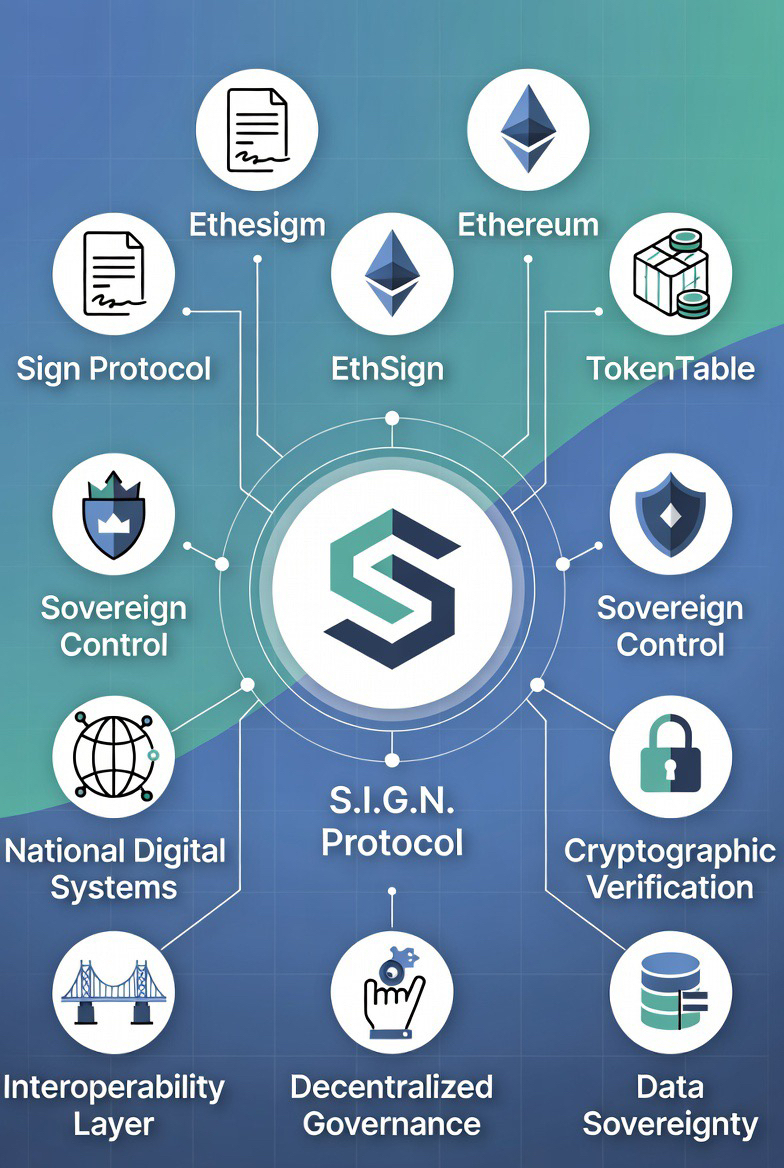
This is the environment in which S.I.G.N. begins to make sense.
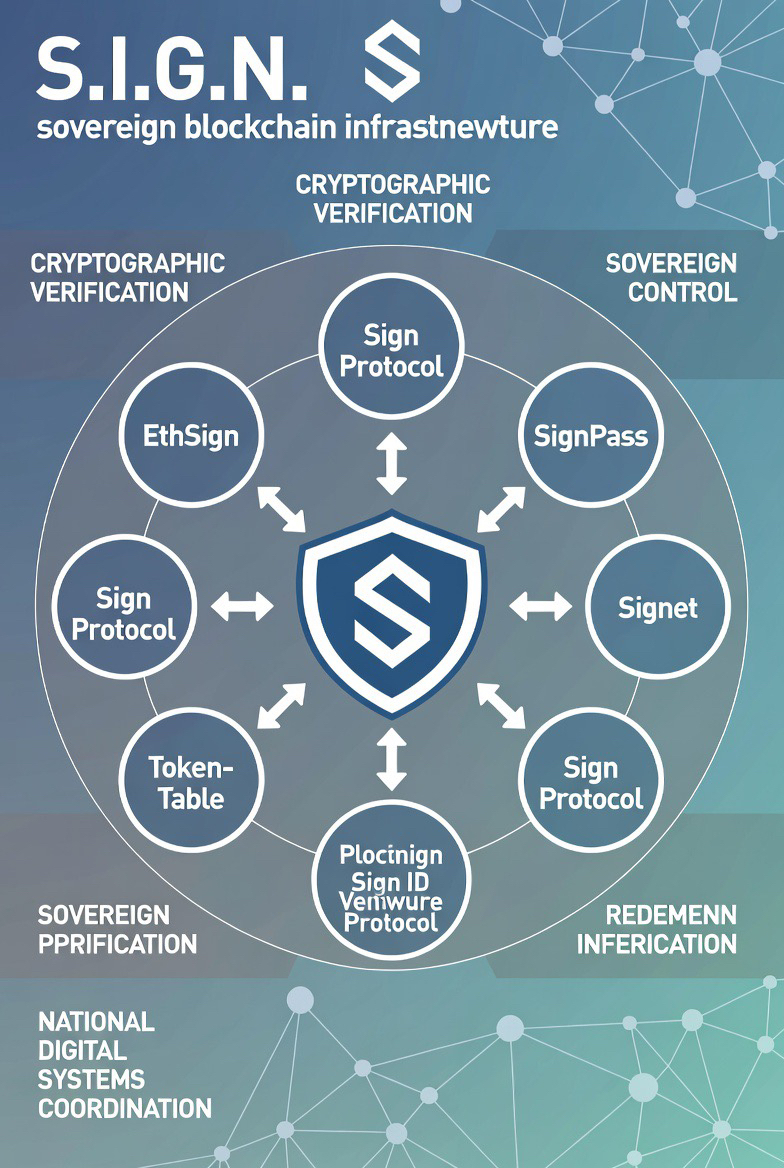
Rather than positioning itself as another consumer blockchain network, S.I.G.N. approaches the problem from the opposite direction. It is designed as a sovereign blockchain infrastructure framework intended for governments, central banks, and regulatory institutions.
Its goal is to provide a structural layer where national systems can coordinate digital identity, financial flows, and institutional data using cryptographic verification.
A key design principle is sovereign control.
Unlike public blockchain networks where governance is distributed among anonymous participants, sovereign infrastructure must allow governments to maintain authority over validators, governance parameters, and policy enforcement. In this model, cryptographic verification strengthens transparency while institutional governance remains firmly in place.
Another feature is what can be described as inspection ready infrastructure. National systems require lawful auditability and regulatory supervision. A verification layer capable of generating cryptographic evidence allows regulators to confirm system integrity while still protecting sensitive citizen data.
In practice, S.I.G.N. operates less like a single product and more like a system architecture.
Within its ecosystem, components such as Sign Protocol, EthSign, and TokenTable can function independently for institutional workloads or be combined as part of sovereign scale deployments.
Early collaborations with institutions such as the National Bank of the Kyrgyz Republic and the Ministry of Information and Communications of Sierra Leone suggest that governments are beginning to evaluate how blockchain based verification layers might support national digital infrastructure.
Seen from this perspective, S.I.G.N. is not simply another blockchain project competing for users. Its ambition is more structural. It attempts to define what sovereign blockchain infrastructure could look like in a world where digital identity, programmable finance, and verifiable public systems increasingly operate at national scale.