
For a long time, I assumed agreement between systems was mostly a technical problem.
Connect the APIs. Align the data formats. Standardize how information moves from one place to another.
If two systems could exchange data correctly, they could coordinate.
But the more you watch how systems actually behave, the more it becomes clear that agreement is not just about sharing data.
It’s about sharing interpretation.
Two systems can look at the same signal and reach completely different conclusions.
One might treat a user’s action as meaningful participation.
Another might see it as noise.
A third might require additional context before acting on it at all.
Nothing is technically broken.
But nothing is truly aligned either.
This is where most coordination friction lives.
Not in the transfer of information—but in the gap between how that information is understood.
SIGN appears to focus directly on that gap.
Instead of trying to improve how data moves between systems, it introduces a way for meaning itself to move with the data.
That shift changes what agreement looks like.
In most environments today, agreement happens after interpretation.
Each system processes the same signals independently, arrives at its own understanding, and then tries to reconcile outcomes. If those outcomes differ, coordination requires manual adjustment.
SIGN moves agreement earlier in the process.
When signals are structured into credentials, they carry a defined meaning that systems can recognize without reinterpretation. Agreement no longer depends on multiple systems arriving at the same conclusion independently.
It depends on them referencing the same definition.
That distinction matters more than it seems.
Independent interpretation is inherently variable. Even small differences in logic can produce different outcomes. Over time, those differences accumulate and create fragmentation.
Shared definitions reduce that variability.
When systems operate on the same underlying meaning, outcomes become more predictable. Coordination becomes less about negotiation and more about execution.
This creates a different kind of alignment.
Not alignment through constant communication, but alignment through shared structure.
Systems don’t need to ask each other what a signal means.
They already know.
This becomes increasingly important as ecosystems grow.
The more systems interact, the more opportunities there are for misalignment. Each additional layer introduces another point where interpretation can diverge.
Without a shared structure, maintaining agreement becomes harder over time.
SIGN introduces a direction where agreement scales naturally.
Instead of increasing coordination overhead as systems grow, shared definitions allow new participants to integrate without redefining existing logic.
The ecosystem becomes more cohesive because its components operate on the same conceptual foundation.
This also changes how users experience these systems.
In fragmented environments, users often encounter inconsistent outcomes. The same action might qualify them for something in one system but not in another. The logic exists, but it varies depending on where it is applied.
With shared meaning, those inconsistencies begin to decrease.
Users don’t need to navigate different interpretations of the same behavior. The system responds in a more predictable way because the underlying definitions remain consistent.
Of course, building shared meaning is not trivial.
Definitions must be precise enough to be useful, but flexible enough to apply across different contexts. Verification must ensure that credentials are trustworthy, otherwise the entire structure loses credibility.
And systems must adopt these shared definitions in a way that integrates with existing workflows rather than replacing them abruptly.
Infrastructure evolves gradually.
It becomes valuable not because it forces change, but because it reduces friction where it is already felt.
SIGN seems to be operating at that level.
It does not attempt to control how systems behave.
It focuses on how they understand.
And when understanding becomes consistent, agreement becomes a natural outcome rather than a constant effort.
That is a subtle shift.
But in complex ecosystems, subtle shifts in how systems align often determine whether coordination scales—or slowly breaks under its own complexity.
#US5DayHalt #CZCallsBitcoinAHardAsset 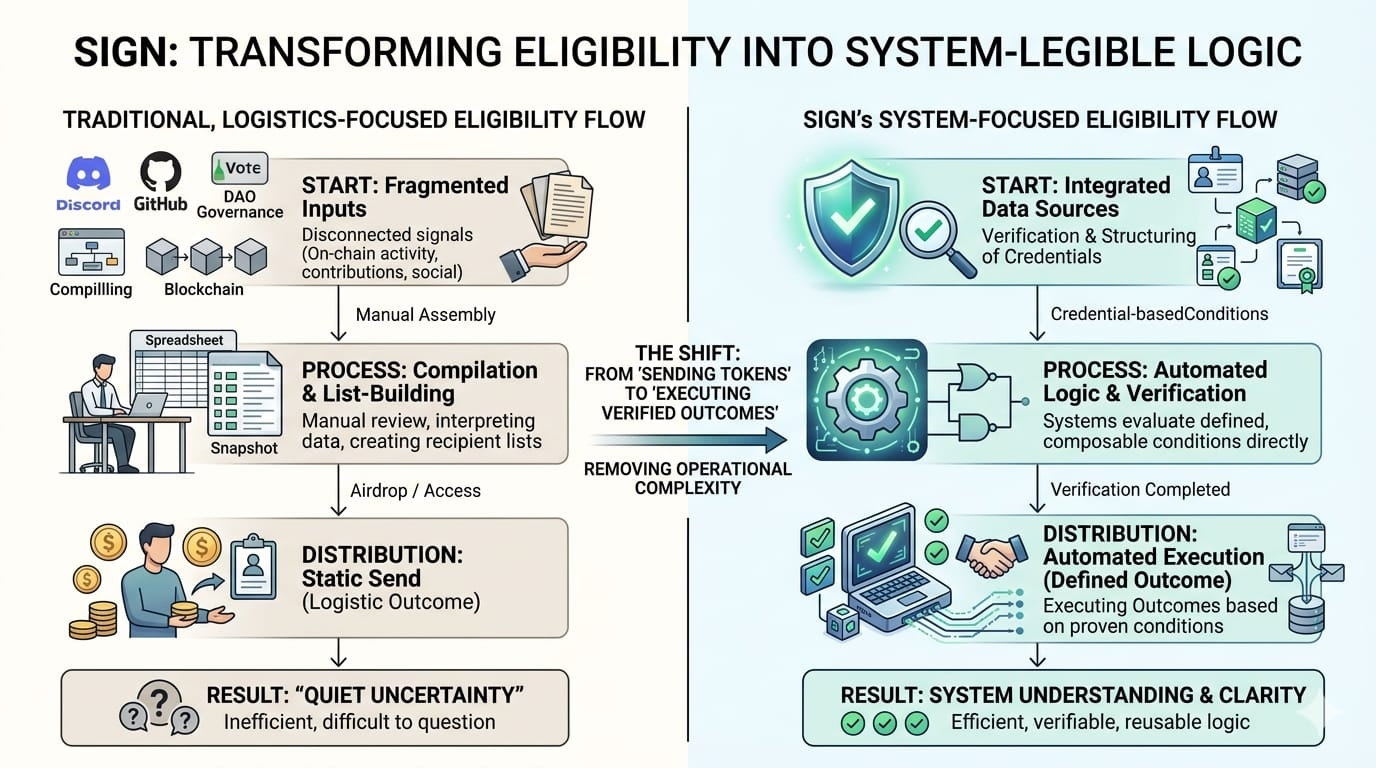
@SignOfficial #signdigitalsovereigninfra $SIGN
