At first, it seems like interpretation is what makes systems flexible.
Different platforms can take the same data and use it in different ways. One system emphasizes activity, another prioritizes ownership, another values consistency over time. That variability allows ecosystems to evolve without being locked into a single perspective.
But the longer systems interact with each other, the more that same flexibility begins to create friction.
Because interpretation doesn’t just create variety.
It creates divergence.
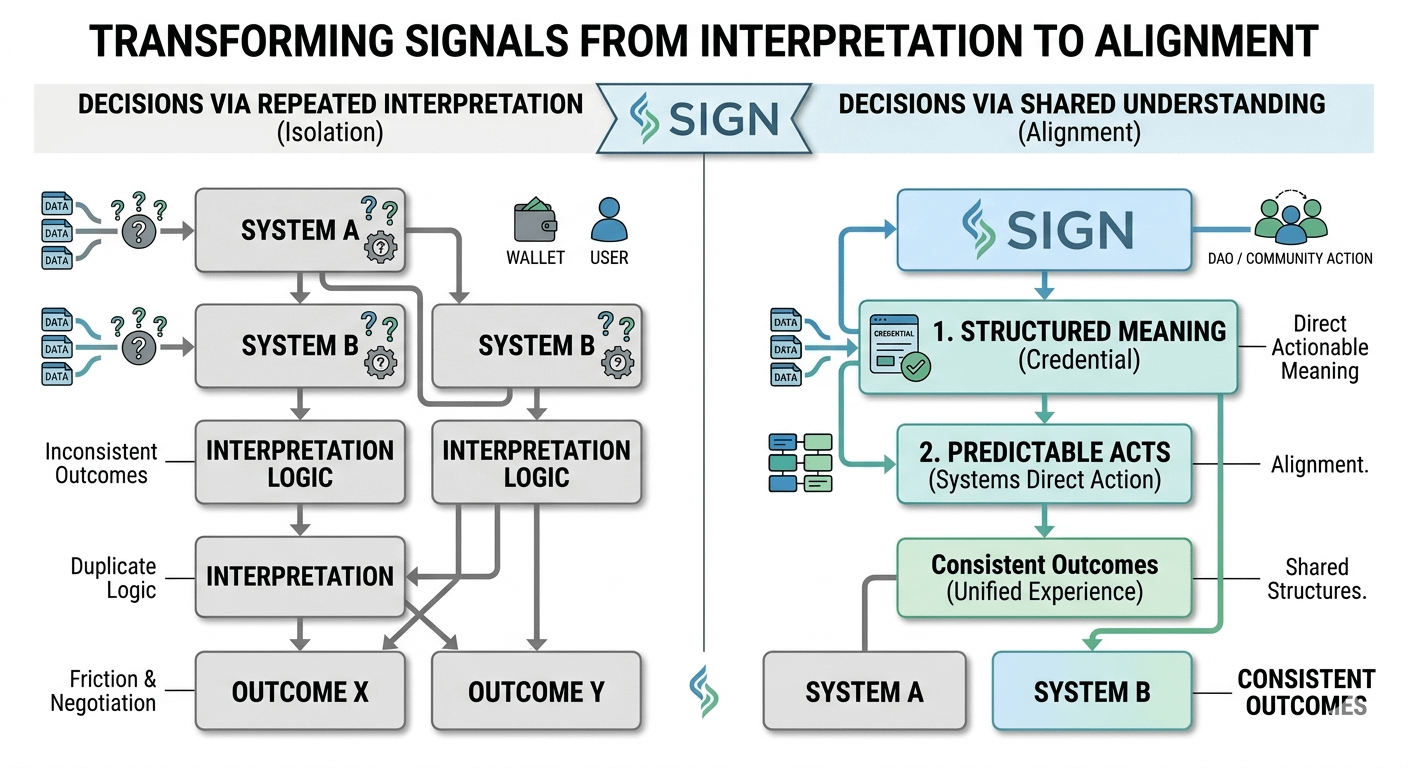
A user performs an action once. That action is recorded. From that point forward, every system that encounters it begins its own process of interpretation.
What did this action represent?
Does it qualify here?
Should it influence an outcome?
Each system answers those questions independently.
And even when the differences are small, they accumulate.
One system includes the user.
Another excludes them.
A third applies additional conditions.
Nothing is technically incorrect.
But the ecosystem no longer behaves consistently.
This is where coordination becomes complicated.
Not because systems lack data, but because they lack shared meaning.
SIGN appears to focus directly on this point of divergence.
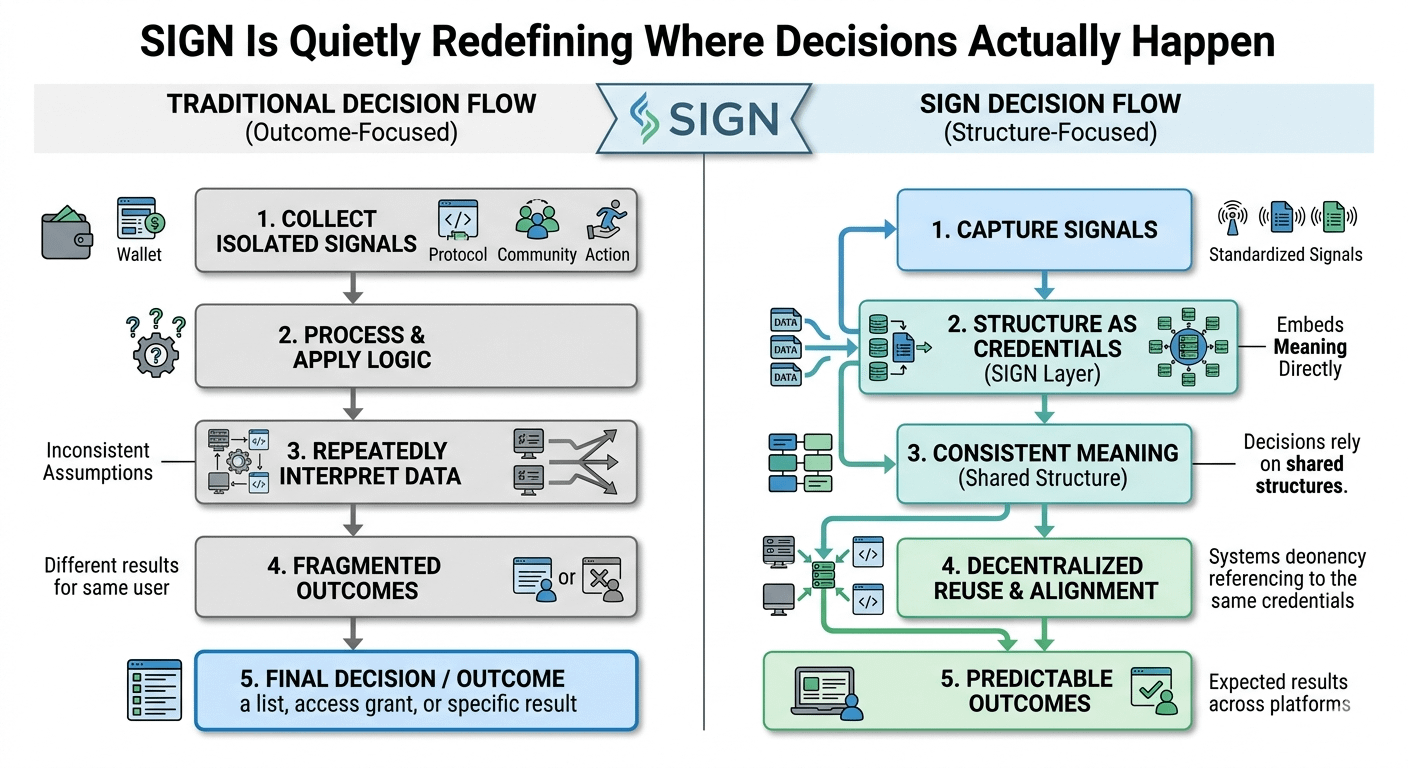
Instead of allowing interpretation to happen separately in every system, it introduces a structure where meaning can be defined once and recognized consistently across different environments.
That shift changes the role of interpretation itself.
In most systems today, interpretation is unavoidable. Raw signals do not carry enough context, so each system must decide what those signals mean before acting on them.
SIGN reduces that dependency.
When signals are structured into credentials, they no longer arrive as raw inputs. They arrive with defined meaning attached. The system doesn’t need to interpret them—it can recognize them.
This reduces variation.
Instead of multiple systems deriving their own conclusions, they can reference the same underlying definition. The outcome becomes more consistent because the starting point is aligned.
That alignment changes how ecosystems grow.
In fragmented environments, every new system introduces another layer of interpretation. Even if all systems use the same data, their conclusions may differ because their logic is not shared.
Over time, this leads to a kind of conceptual drift.
The same signal means slightly different things depending on where it is used.
With shared structure, that drift becomes harder to introduce.
New systems can integrate without redefining meaning. They can build on existing definitions rather than creating their own.
The ecosystem begins to behave more like a network with a common language.
This also affects how users experience these systems.
In environments driven by interpretation, users often encounter inconsistency. The same action may produce different results depending on where it is evaluated. That unpredictability makes it harder to understand how to participate effectively.
When meaning is shared, outcomes become more predictable.
Users do not need to navigate multiple interpretations of their behavior. The system responds in a way that reflects consistent definitions rather than isolated judgments.
Of course, removing reliance on interpretation is not absolute.
Some level of flexibility is always necessary. Systems must be able to adapt to new contexts and evolving requirements. The goal is not to eliminate interpretation entirely, but to reduce unnecessary repetition of it.
SIGN appears to operate at that boundary.
It preserves flexibility where it is needed, while reducing redundancy where it creates friction.
That balance is what allows systems to remain adaptable without becoming fragmented.
Building this kind of structure introduces its own challenges.
Meaning must be defined carefully to ensure it remains useful across contexts. Credentials must be verifiable so that systems can trust them. And developers must be able to integrate these structures without adding complexity to their workflows.
Infrastructure at this level is rarely visible.
Users do not think about how meaning is preserved or how interpretation is reduced. They simply experience smoother interactions, more consistent outcomes, and fewer points of confusion.
If SIGN succeeds, that is likely how it will be recognized.
Not as a system that removed interpretation entirely, but as one that made interpretation less necessary.
And that leads to a broader shift.
Systems stop depending on repeated understanding.
They start depending on shared meaning.
And when that happens, coordination becomes less about constantly deciding what things mean…
…and more about building on meaning that already exists.