
When I first realized what Midnight was actually trying to do, it wasn’t during some big announcement or hype cycle moment. It came quietly, somewhere between scrolling through recycled privacy offerings and feeling that familiar weariness. This industry tends to repeat itself until everything starts to blur. But Midnight didn't immediately blend into the noise, and that alone was enough to make me pause and take a closer look.
Midnight felt different. Not that it rejected privacy, but that it redefined it. It wasn't about disappearing, it was about controlling. And that shift resonated with me more than any dazzling promise.
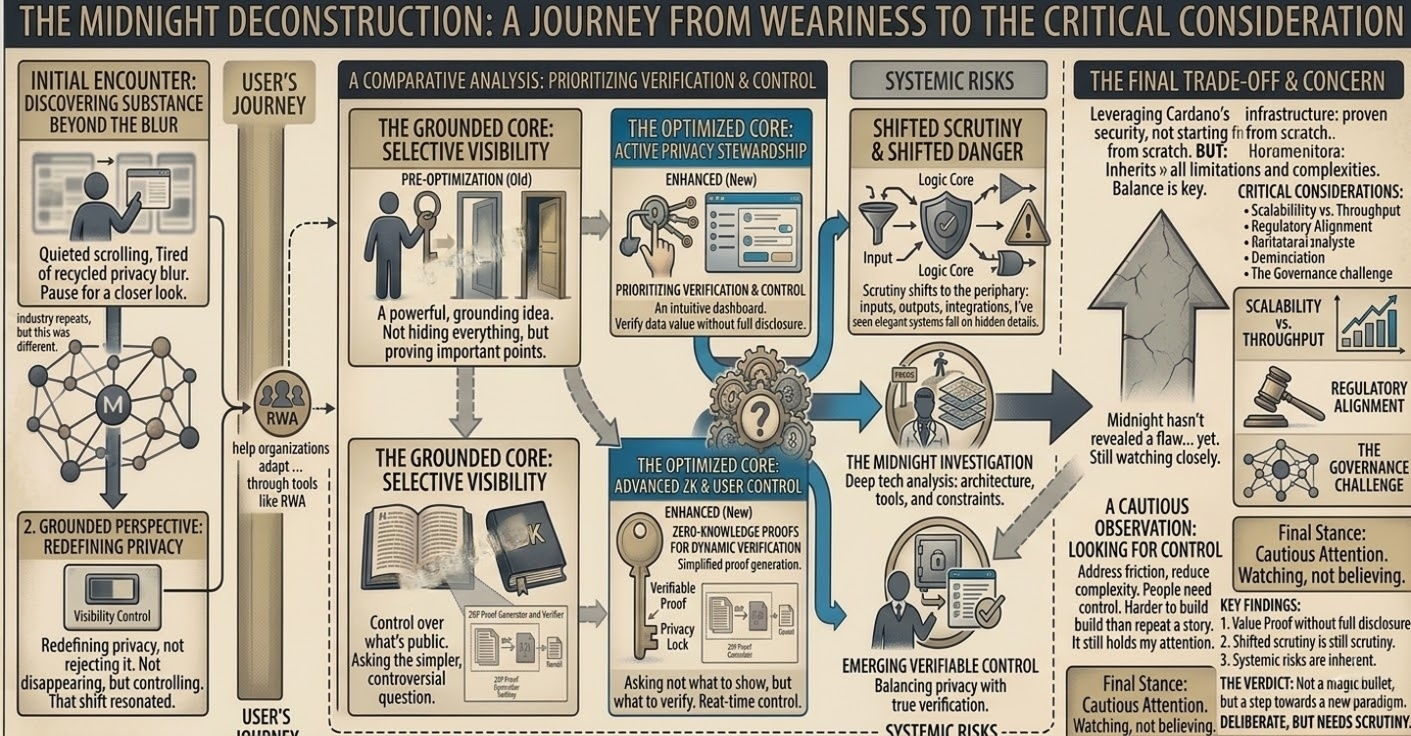
What always frustrates me about this industry is how easily transparency is treated as a universal virtue. In theory, total transparency seems ideal. In practice, it often creates friction. Users reveal more than they should. And developers try to work around systems that reveal too much by default. It starts off as a forced openness designed by people who have never had to protect anything of value, rather than a genuine commitment to trust.
This is where Midnight started to feel grounded. It doesn't assume everything should be public forever. Instead, it poses a simpler, more controversial question: What should actually be visible? This distinction is important. Sensitive data can remain private, while the network verifies what's truly important. This balance feels more realistic than the extremes the industry constantly teeters on.
The more I researched, the more convinced I became of this perspective. Midnight doesn't seek to hide everything, nor does it claim that transparency equates to trust. It occupies that difficult middle, where privacy and verification must coexist. This space is harder to build, harder to explain, and much harder to market. But it's also where the real value lies.
What really captivated me, however, was how the system's design reflects this thinking. Instead of building from scratch and seeking market trust with a new set of verifiers, Midnight leverages Cardano's proven infrastructure. The same operators, the same security foundation, only expanded into a system capable of experiencing privacy. It feels less like starting from scratch and more like carefully building on something that already works.
Another aspect is how it handles interoperability. I’ve worked with cross-chain systems before, and most of them feel fragile: bridges, encapsulated assets, and constant risks. Midnight changes this paradigm by offering Privacy as a Service. Other chains can interact with it directly, without duplicating assets or forcing users onto isolated systems. This idea alone seems like a much clearer direction.
From a developer’s perspective, the introduction of Compact was also significant. Making the complex encryption logic more like a language like TypeScript makes things considerably easier. But at the same time, it raises a concern I can’t ignore. Easier tools don’t necessarily mean more secure systems. In fact, they can make it easier to build something flawed without realizing it. This tension between accessibility and security is what Midnight will have to navigate carefully.
Another thing I keep coming back to is how privacy shifts the place of trust. When the underlying logic becomes private, scrutiny doesn’t disappear; it just shifts to the periphery. Inputs, outputs, triggers, and integrations. I've seen systems that were elegant in their essence, but the real danger lay in the deliverables that no one wanted to scrutinize. Midnight doesn't eliminate this problem; it redirects it.
Perhaps that's why I haven't been too quick to judge.
I've seen many projects that sound brilliant in theory, only to crumble in practice. Midnight hasn't yet revealed this flaw, but I'm still watching closely. Not because I expect it to fail, but because I've learned not to mistake calm for proof. Right now, it seems more structured, more deliberate, and less superficial than most of what's on the market. But this is still a stage, not the end result.
What keeps me coming back to it is simpler than the hype. The problem Midnight addresses is real. Public blockchains expose a lot of data. Developers are still building serious systems in environments that leak far too much data. This friction hasn't disappeared; it's become the norm.
Midnight seems to be one of the few projects that genuinely aims to reduce this complexity rather than embellish it.
I don't know if that makes it a successful project; I'm past the point of certainty. But I do know one thing: people don't need to hide everything, nor do they need to reveal everything. They need control. And building a project around this idea is much harder than simply repeating the same old story.
Perhaps that's why Midnight still holds my attention.
Or maybe I'm simply looking for a project that doesn't recycle the same idea over and over again.
@MidnightNetwork #night $NIGHT
