A lot of digital growth looks impressive from the outside. New users arrive, communities expand, campaigns become larger, and attention moves quickly from one network to another. But the deeper question is rarely about visibility alone. Real digital growth depends on whether a system can verify who should be recognized, who should qualify, and who should receive value. That is where @SignOfficial becomes important in a way that goes beyond simple attention.
The idea behind SIGN matters because blockchain ecosystems are no longer small experiments built only around enthusiasm. They are becoming more complex, more layered, and more demanding. When networks are young, loose coordination can still function for a while. A project can rely on trust, manual decisions, or informal community judgment. But once the scale increases, that approach starts to weaken. The moment a network must distribute tokens fairly, verify participation accurately, and prove eligibility clearly, the infrastructure underneath becomes far more important than the excitement around it.
This is why credential verification deserves much more respect than it usually gets. Many people still treat it like a background tool, something administrative rather than essential. I see it differently. Credential verification is part of the structure that allows a digital system to remain coherent while it grows. It helps define who belongs to a category, who has completed a contribution, who has access to a specific benefit, and who can be trusted in a certain process. Without this layer, even strong ecosystems can become messy. People start to question fairness, distribution becomes harder to defend, and participation begins to lose clarity.
That same logic applies to token distribution. In theory, distribution sounds simple. A network decides who should receive value, then sends it. In reality, it is one of the most sensitive parts of digital coordination. Every mistake affects trust. Every unclear allocation creates doubt. Every weak verification process opens the door to confusion, abuse, or resentment. If a project wants to build long term credibility, it cannot treat distribution like a minor operational detail. It has to treat it like infrastructure.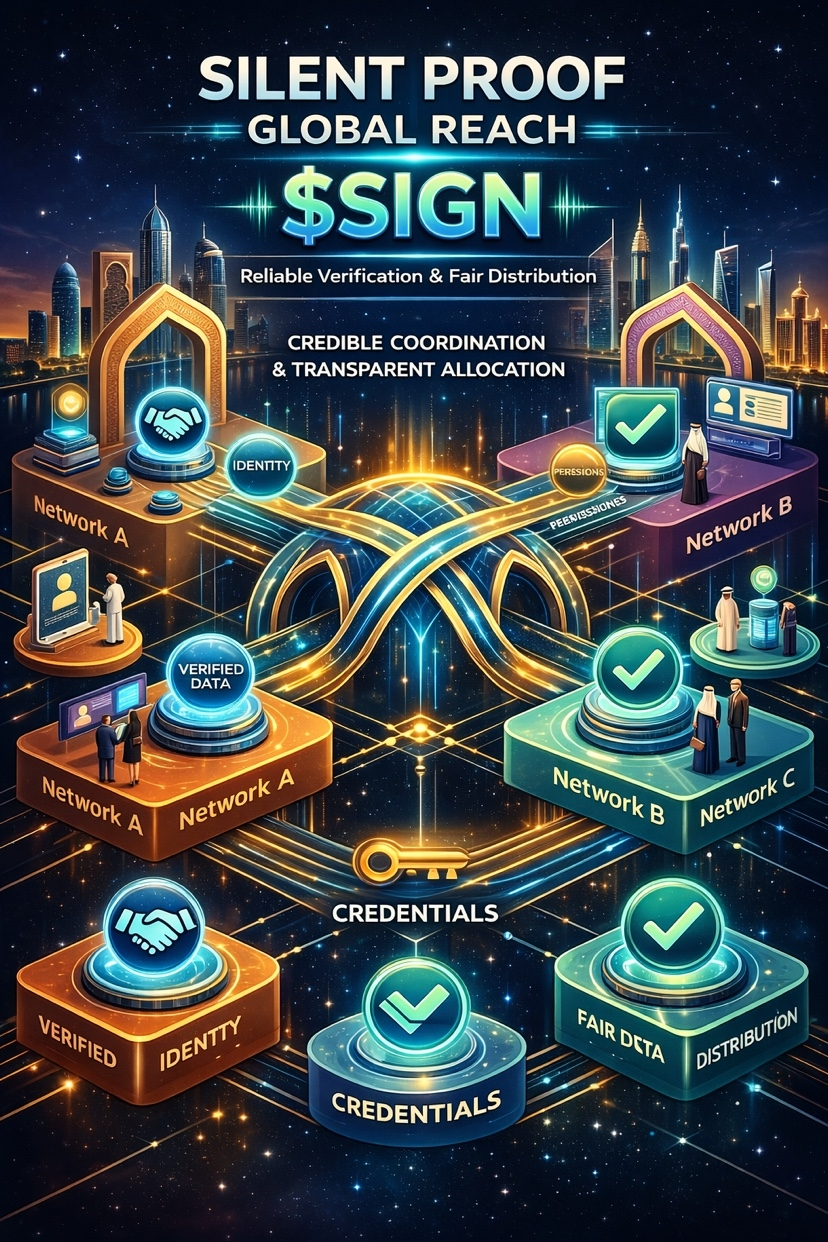
That is what makes this area so meaningful. It sits quietly underneath growth, yet it shapes whether growth can actually hold together. A lot of blockchain conversation still centers on speed, liquidity, narrative, and short term market energy. Those things can attract attention, but they do not solve the harder problem of organized participation. A network can be fast and still be disordered. It can be visible and still be structurally weak. It can gain momentum and still fail to distribute value in a way people trust. This is exactly why credential verification and token distribution deserve to be seen as core infrastructure rather than secondary features.
What stands out to me about @SignOfficial is the direction of focus. It points toward a reality that many digital systems are slowly being forced to confront. Coordination at scale needs more than open access and good intentions. It needs proof, structure, and a reliable method for assigning value and recognition. If digital ecosystems want to mature, they need to become better at deciding who qualifies for what, and they need systems that can support those decisions without creating endless friction.
This matters across more than one use case. Communities need ways to verify contributors. Ecosystems need ways to identify eligible participants. Campaigns need ways to reward real engagement rather than noise. Token launches need distribution systems that can be defended with credibility. Governance environments need stronger methods for determining who should take part in decisions. Even outside the immediate world of token rewards, the same principle remains true. Digital systems need infrastructure that transforms uncertain participation into verifiable coordination.
The phrase global infrastructure fits well here because the problem is global by nature. Every growing digital ecosystem faces some version of this challenge. As participation becomes broader and more diverse, simple trust becomes less reliable on its own. The network needs a way to recognize status, contribution, and eligibility with more precision. It needs a layer that does not depend on constant manual oversight. It needs a system that can support scale without letting fairness collapse under pressure.
That is why I think this kind of infrastructure is more important than it first appears. It is not loud infrastructure. It does not always generate the same immediate excitement as trading narratives or speculative themes. But it belongs to the category of systems that become more valuable as ecosystems become more serious. The stronger the network grows, the more it needs dependable verification and dependable distribution. In that sense, the quiet parts of blockchain may eventually prove more important than the flashy parts.
There is also a wider shift happening in how people judge digital value. Early attention often goes to novelty. Later attention goes to durability. A project begins to matter differently when people stop asking whether it is interesting and start asking whether it can support real scale. Can it reduce confusion. Can it protect fairness. Can it make participation easier to verify. Can it make value distribution easier to trust. These are harder questions, but they are the questions that decide whether infrastructure has lasting relevance.
To me, this is where SIGN feels well positioned. It is connected to a problem that will not disappear as blockchain evolves. If anything, that problem will become more urgent. Larger ecosystems will need better mechanisms for proving eligibility, organizing access, and distributing value with confidence. Networks that cannot do this cleanly will struggle to maintain trust over time. Networks that can do it well will have a stronger foundation for growth.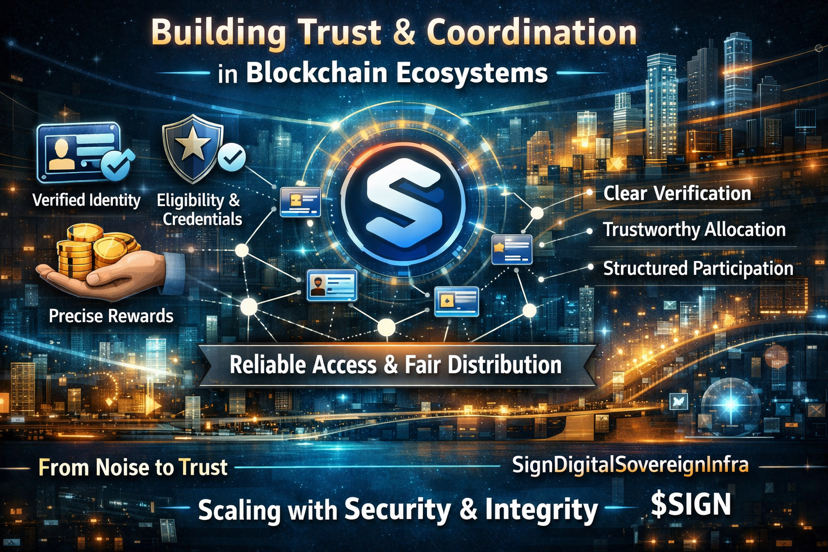
That is why the role of $SIGN GN stands out to me as more than a simple token mention. It represents a direction tied to digital order, verifiable coordination, and credible distribution. These are not small concerns. They are part of what decides whether blockchain systems remain fragmented or begin to operate with real structural maturity.
In the end, the strongest infrastructure is often the least theatrical. It does not need to be loud to be important. It needs to solve a real problem that becomes more critical with scale. Credential verification and token distribution are exactly that kind of problem. They shape trust, organize participation, and make digital ecosystems more coherent. That is why @SignOfficial feels relevant in a serious way. It is working in a layer that many people overlook at first, but the more the industry grows, the harder that layer becomes to ignore. #SignDigitalSovereignInfra

Artigo
Silent Proof, Global Reach
Aviso Legal: inclui opiniões de terceiros. Não se trata de aconselhamento financeiro. Poderá incluir conteúdos patrocinados. Consulta os Termos e Condições.
0
17
851
Fica a saber as últimas notícias sobre criptomoedas
⚡️ Participa nas mais recentes discussões sobre criptomoedas
💬 Interage com os teus criadores preferidos
👍 Desfruta de conteúdos que sejam do teu interesse
E-mail/Número de telefone