Midnight Out of everything this space has produced, it is one of the few ideas that actually feels meaningful. Not just another token. Not just another trend dressed up as innovation. It tries to solve something real.
Because honestly, a lot of crypto still feels broken in ways people have just learned to tolerate.
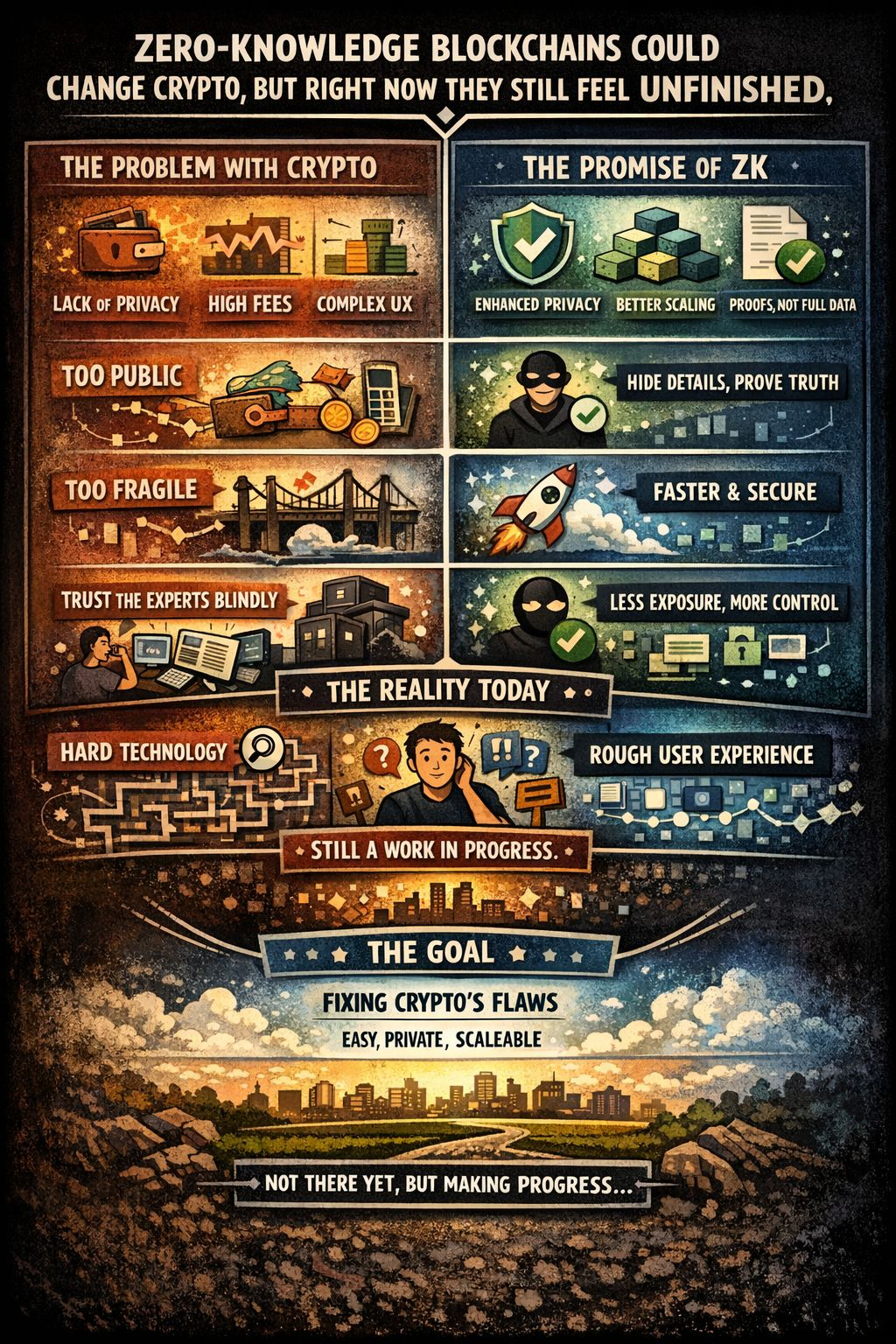
Using blockchain apps is still weirdly stressful. Fees can jump for no reason. Wallets still make normal people feel like they are one bad click away from disaster. Bridges feel like trust exercises. And the whole experience is supposed to be about freedom and control, yet half the time it feels like you need a survival guide just to move from one step to the next.
Then there is privacy, which has always been sold in a way that feels a little dishonest.
People love saying crypto is private. It usually is not. It is public by default. Everything sits out in the open. Once someone links your wallet to your identity, that history can follow you forever. What you sent, what you received, where you moved, what you touched — it is all there.
That is not freedom. That is exposure with better branding.
That is why zero-knowledge technology matters.
The idea behind it is actually pretty beautiful. You can prove something is true without revealing every detail behind it. You can show that a transaction is valid without exposing the full balance. You can verify that someone qualifies for something without making them hand over their whole identity. You can confirm the result without putting all the raw information on display.
That is a real shift. It changes the logic from showing everything so everyone can inspect it to showing only what is necessary and proving the rest.
And honestly, that makes sense. More than a lot of things in crypto do.
But this is also where the nice clean story starts running into real life.
Because zero-knowledge sounds much smoother than it actually feels.
The technology is hard. Not casually hard. Not watch-two-videos-and-you-get-it hard. Properly hard. The kind of hard that pushes even smart developers into highly specialized corners. The kind of hard where regular users are expected to trust systems they cannot explain, built by teams they cannot really evaluate, using assumptions they have never even heard of.
That is where the whole thing gets a little ironic.
Crypto was supposed to reduce blind trust. But when systems become this complex, a lot of people stop understanding anything and just trust the experts again. The bank disappears, but the black box stays. It just has different branding now.
That does not mean the technology is fake. It just means the reality is messier than the pitch.
And performance still matters too.
Zero-knowledge systems have gotten better, no question. Proofs are getting faster. Infrastructure is improving. Teams are doing work that would have sounded unrealistic a few years ago. But better is not the same thing as simple. It is not the same thing as smooth. And it definitely is not the same thing as mainstream-ready.
A lot of what gets built in this space still feels more impressive than usable.
You can admire the engineering and still not want to use the product twice.
That is a big problem.
Because normal people do not care about the brilliance of the proving system. They care whether the app works. Whether it is fast. Whether it feels safe. Whether they can recover if something goes wrong. Whether they need a tutorial every time they open it.
And right now, most zero-knowledge apps still do not feel like they were built for normal people. They feel like strong ideas still trying to become actual products.
Where ZK feels the most real today is probably scaling.
This is one of the few places where it already feels less like theory and more like infrastructure. Rollups using zero-knowledge proofs are giving blockchains a practical way to handle more activity without pushing every little action directly onto the main chain. That part is useful. It solves pressure. It lowers some costs. It makes the system more workable.
So yes, there is something genuine here.
But even then, the experience around it is still rougher than people like to admit.
Moving assets across layers can still feel fragile. Bridges still make people nervous. Users are still expected to manage too many steps, too many interfaces, too many chances to mess up. The core cryptography might be elegant, but the surrounding experience often is not.
And that is really the pattern across the whole ZK space.
The deeper you go, the more you see that every gain comes with a trade-off. Better privacy can create harder questions around compliance and disputes. More advanced proof systems can bring more complexity. Some setups avoid one kind of trust but introduce other costs. Some systems are faster but more demanding. Some are cleaner in theory but harder to scale in practice.
There is no perfect version sitting here waiting to be discovered.
There are just different ways of balancing what matters most.
That is why I think the most honest way to look at zero-knowledge blockchains is not as some polished future that already arrived. It is as a serious rebuilding effort. One of the few real ones in this industry.
It is crypto trying to correct its own flaws.
Too much exposure. Too much inefficiency. Too much noise. Too much pretending that public-by-default systems automatically make sense for everyone. ZK is one of the strongest attempts to fix that. And I respect that.
But respect does not mean pretending it is finished.
Because it is not.
The space is still early in all the ways that matter most. Security is still a concern. User experience is still shaky. Many products still feel experimental. A lot of the conversation is still led by people who are more comfortable talking about what the technology could become than what it actually feels like right now.
That is why I think the current moment needs more honesty.
Zero-knowledge is real innovation. It deserves serious attention. It is probably one of the most important technical directions in blockchain right now.
But it is also still awkward, still hard, still confusing, and still trying to prove that it can become something ordinary people trust without needing to understand the entire machine underneath.
Maybe that future comes.
Maybe in a few years, zero-knowledge will sit quietly in the background doing exactly what it is supposed to do — protecting privacy, improving scale, reducing what needs to be exposed, and making systems feel lighter and safer without turning every action into a technical event.
That would be the ideal outcome.
Not a world where everyone talks about ZK all the time, but a world where nobody has to.
Because that is when infrastructure is actually working.
Until then, I think the fairest thing to say is this:
Zero-knowledge blockchains are one of the smartest things crypto has built.
They are also still messy, unfinished, and a long way from feeling normal.
And maybe that is fine.
Some technologies arrive polished.
The important ones usually do not.
#night $NIGHT #NİGHT @MidnightNetwork