
Before anything else, I just want to be clear about one thing.
This isn’t a hype post.
I’m writing this after sitting with it for a bit.
I’ve been following Midnight closely for months.
Reading every State of the Network update, watching the Consensus Hong Kong announcements, tracking the Glacier Drop thaw events.
But even with all that
watching the Kukolu mainnet actually go live this week felt different.
Not because of the price.
Because of what it might unlock next.
What It Actually Took to Launch This
We throw around the word “mainnet” like it’s just another update.
It’s not.
Building a zero-knowledge blockchain from scratch
one that can run private smart contracts in production,
stay compatible with the Cardano ecosystem,
and onboard institutional node operators at the same time
that’s a genuinely hard problem.
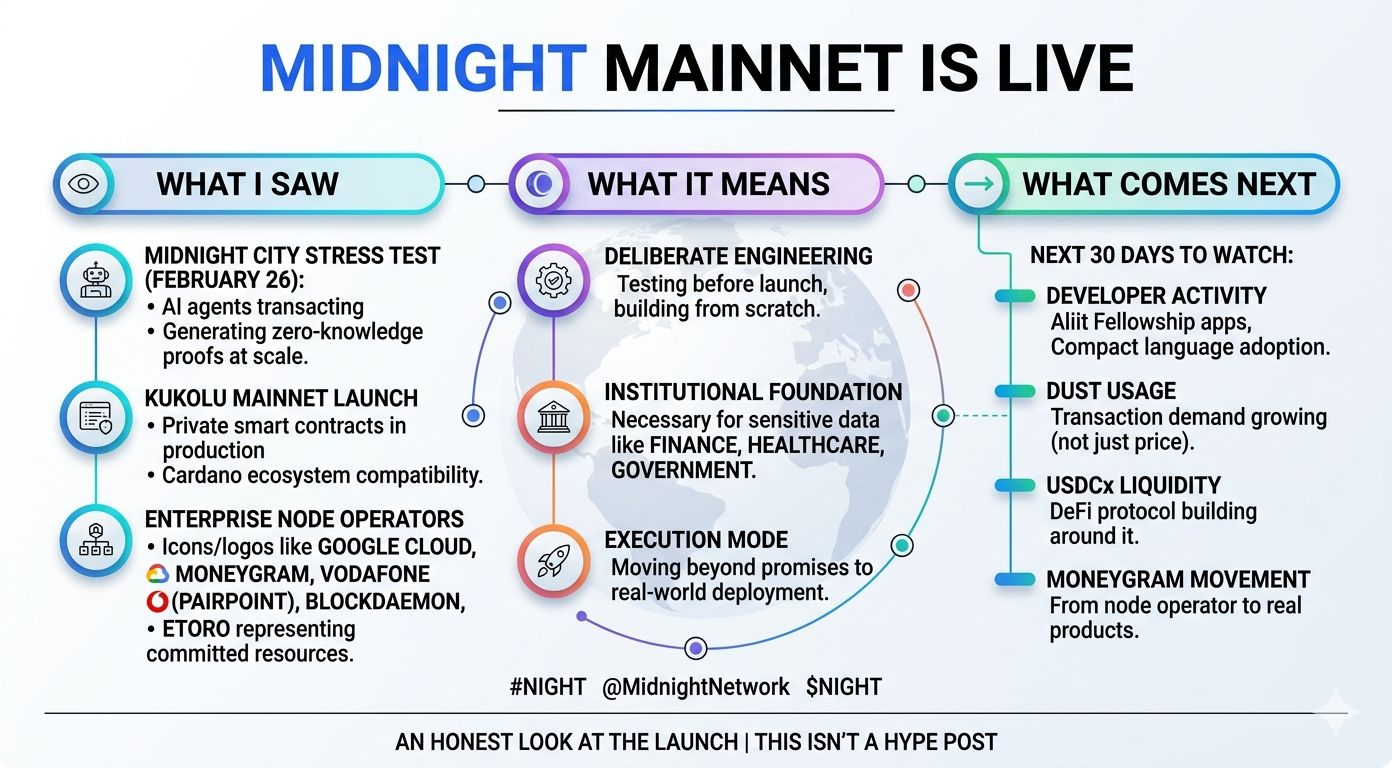
The Midnight City simulation back on February 26 wasn’t just a demo to me.
It felt more like a live stress test.
AI agents transacting in real time, generating zero-knowledge proofs at scale
basically testing the system under pressure before anything went live.
Most projects don’t do that.
They launch first, then figure things out later.
Midnight tried to break things before launch.
That says a lot about how this was built.
The Node Operators Change the Story
This is the part I keep thinking about.
Google Cloud, MoneyGram, Vodafone (Pairpoint), Blockdaemon, eToro
these aren’t just logos.
They actually committed resources.
Engineering teams, infrastructure, integration
before the network even had users.
That matters.
It means day one isn’t being held together by hope.
It’s running on enterprise grade infrastructure.
And when your goal is to handle sensitive data finance, healthcare, government
that kind of foundation isn’t just impressive.
It’s necessary.
What I’m Watching Over the Next 30 Days
For me, mainnet isn’t the finish line.
It’s the starting point.
Here’s what I’m paying attention to:
1. Developer Activity
There are 17 builders from 11 countries in the Aliit Fellowship.
How fast do real apps go live?
If Compact (their TypeScript-based language) actually lowers the barrier,
we should see activity soon not months later.
2. DUST Usage
Not price. Usage.
Every transaction consumes DUST.
If that number grows week over week,
that’s real demand not speculation.
3. USDCx Liquidity
The LayerZero-powered USDCx integration is already there.
The question is
do DeFi protocols actually start building around it?
That’s how the financial layer begins to form.
4. MoneyGram Movement
This one matters more than people think.
Being a node operator is one thing.
Deploying real products is another.
If that shift happens,
it changes the entire narrative.
The Honest Part
There’s excitement here, no doubt.
But there are also things worth being honest about.
The federated model means the network is still somewhat centralized right now.
A small group of trusted operators isn’t the same as open decentralization.
Yes, the roadmap points toward that by 2026.
But today’s reality is different.
And then there’s the token unlock schedule.
Every 90 days, new supply enters the market.
Mainnet doesn’t pause that.
The real question is:
can actual utility absorb that pressure?
Ignoring these doesn’t make them go away.
Where This Leaves Me
I’ve been around crypto long enough to know
mainnet launches don’t prove everything.
They just start the story.
The projects that matter years from now
are the ones that execute after this moment.
What I saw this week from Midnight feels… deliberate.
The engineering looks solid.
The partners are serious.
The problem they’re going after is real.
But now it’s not about promises anymore.
It’s about execution.
The next 30 days will say a lot.
Am I interested? Yes.
Am I fully convinced yet? Not completely.
Now the network has to prove it.