
 Here's something nobody in crypto wants to admit out loud.
We spent years building this industry on the idea that everyone should see everything. Every transaction. Every wallet. Every move. We told ourselves it was trust. We told ourselves it was progress. We told ourselves it was the only way.
But that version of the future never made sense for most people.
Hospitals don't put patient records online for fun. Banks don't publish customer transactions. Supply chains don't advertise supplier lists. The rest of the world figured out a long time ago that transparency is useful sometimes and a liability other times. Crypto is still catching up.
That's where Midnight comes in.
The Default That Became a Problem
Back in the early days, the setup was simple. A handful of developers. A shared love for open systems. Technology that did exactly what it said on the box. Public ledgers felt like freedom. No middlemen. No hidden agendas. Just code and math and the clean feeling of everyone watching everyone.
Then the real world knocked on the door.
Companies wanted to build. Regulators wanted to understand. Institutions wanted to participate. And all of a sudden, the design flaw everyone ignored became impossible to miss.
Try running a healthcare network when patient data is visible to strangers. Try settling cross-border payments when transaction details are public. Try building supply chain software when your vendor list is exposed. What worked for a small group of enthusiasts became a wall for everyone else.
The Wrong Answer
Some projects saw this and went the other way. Everything locked down. Total secrecy. Nothing visible to anyone.
That didn't work either.
When a system is completely dark, it's useless for anyone who needs to prove anything. Regulators can't check. Institutions can't trust. Users can't tell if anything is even working underneath.
The black box solved privacy but broke accountability. So the industry got stuck. Two extremes. Neither one practical. And the market kept pretending one of them would eventually win.
The Uncomfortable Middle
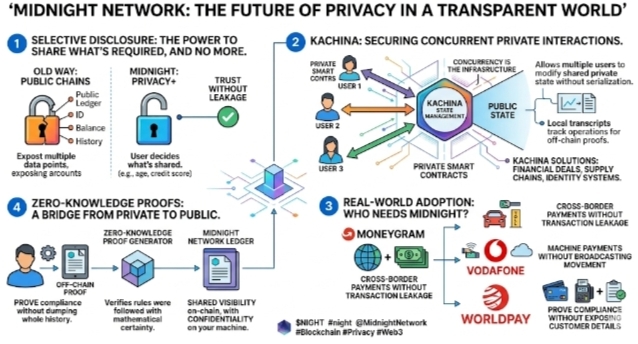
Midnight asks a different kind of question. Not "how do we hide everything" and not "how do we show everything." Just "what actually needs to be visible?"
Some data lives on-chain where anyone can see it. The rest stays private, on your own machine. Zero-knowledge proofs bridge the gap. You show you followed the rules without spilling everything you did. You prove compliance without dumping your whole history on a public ledger.
That's not some radical new idea. It's how the rest of the world already handles information.
You flash your ID to prove your age, not your bank balance. You share your credit score to get a loan, not your entire spending history. Selective disclosure is normal. Crypto just forgot.
Why This Matters Now
The space isn't what it used to be. It's not just early adopters anymore.
MoneyGram works in 200 countries. They need to move money across borders without leaking transaction data. Vodafone is building payments between machines. Connected cars paying tolls without broadcasting where they've been. Worldpay handles trillions in merchant payments. They need to prove compliance without exposing customer details.
These companies aren't looking to disappear. They're looking to operate. But they can't run on systems that broadcast everything by default.
Midnight was built for that reality. Not as an afterthought. As the starting point.
What Kachina Actually Does
Under the hood, Midnight runs on Kachina. The technical specs matter less than what it makes possible.
Kachina splits public state from private state. It lets multiple people interact with contracts at the same time without stepping on each other. It uses local transcripts to keep track of operations, letting the network verify without exposing the raw data underneath.
That concurrency piece is usually where privacy chains fall apart. Most solutions force everything to happen in sequence to avoid leaks. Kachina doesn't.
This matters because real-world applications—supply chains, financial deals, identity systems—involve lots of people acting at once. Without concurrency, private smart contracts stay in the lab. With it, they start to look like actual infrastructure.
The Control Question
What I like about Midnight is what it's not trying to say.
It's not arguing that privacy is good and transparency is bad. It's not arguing that transparency is good and privacy is bad. It's saying people should have control over what they share. That's a different conversation.
Most projects either lean too hard into exposure and call it trust, or lean too hard into secrecy and expect people to treat opacity like a feature. Midnight sits in the middle. That middle is harder to explain, harder to build, and definitely harder to sell. But it's also where real utility tends to live.
What I'm Watching
I don't know if Midnight becomes the standard. I've seen too many smart ideas go nowhere to bet on certainty. But I'm paying attention because Midnight seems to understand something a lot of teams miss.
The future isn't total transparency. It's not total privacy. It's selective disclosure. It's systems that let you prove what's required and nothing more. It's infrastructure that actually works for people who have something worth protecting.
That's a harder problem. It's also the one that actually matters.
Bottom Line
I'm not here to pump a token or call a bottom. I'm here because I'm tired of pretending the old way was ever good enough.
Public chains show too much. Privacy coins hide too much. We've spent years swinging between two extremes, neither of which fits the world that actually exists.
Midnight is trying to build something in between. Not because it's easier. Because it's the only way this industry grows up.
That's worth watching.