
What keeps pulling me back to @MidnightNetwork is that it still feels early, but not in that empty crypto way where “early” just means people are trying to sell you hope before anything real exists. This feels different. It feels early in the sense that the idea is already public, the structure is becoming easier to understand, and the next real test is close enough that the market will soon decide whether the whole thing actually works. To me, that is always a more interesting stage than pure hype, because this is where a project stops living on promises and starts living on execution.
That shift is exactly why Midnight feels more worth watching now. For a while, it was easy to look at the project and simply admire the concept from a distance. Privacy, zero-knowledge tech, programmable protection for sensitive data, all of that sounds strong on paper. But crypto is full of projects that sound brilliant on paper. The space has never had a shortage of big ideas. What it usually lacks is the moment when those ideas have to survive contact with real usage, real builders, and real expectations. Midnight now feels close to that moment. With March 2026 framed as the mainnet window, the tone around the project has started to change. 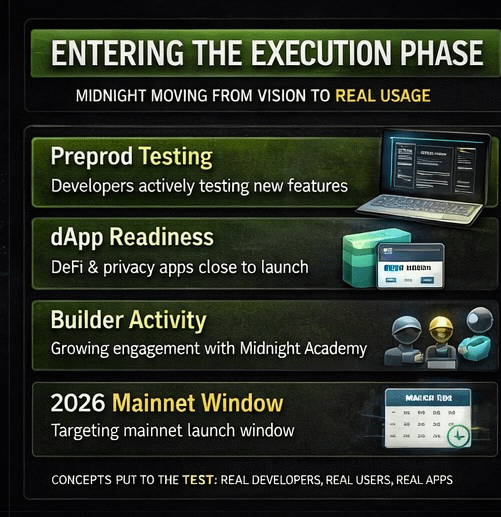 The updates are no longer just about the long-term vision. They are about Preprod, about developers learning the stack through Midnight Academy, about dApps moving closer to launch readiness, and about how the mechanics of the network will actually function. That makes it feel less like a concept and more like something preparing to be used.
That matters because the problem Midnight is trying to solve is not small. Crypto already proved it can create transparent systems. Public blockchains are excellent when open verification is the goal. But transparency becomes more complicated the moment you imagine serious applications running on-chain. A business does not want every payment pattern exposed forever. A fintech app cannot put every sensitive user-related action on a completely public stage. Even ordinary users who believe in crypto may not want every move they make to become part of a permanent public record. That is where Midnight starts to feel relevant in a much deeper way. It is not trying to reject transparency altogether. It is trying to create a version of blockchain infrastructure where what needs to be proven can still be proven, while everything else does not have to be unnecessarily exposed.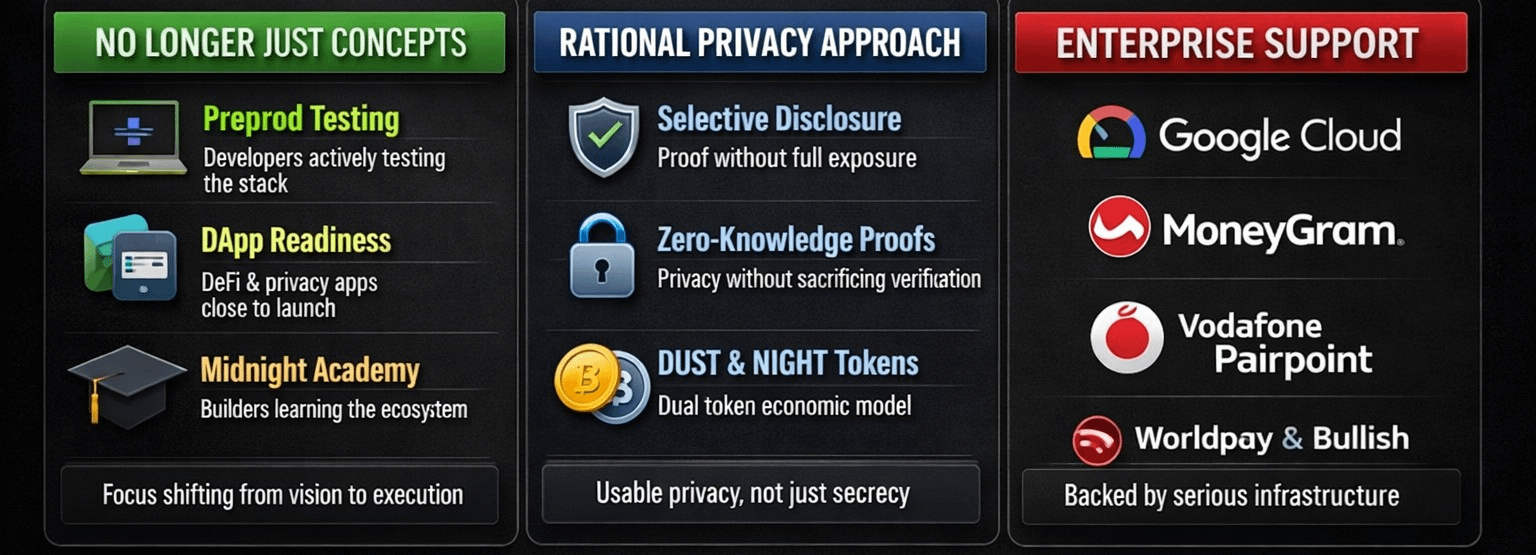
That is why Midnight’s rational privacy angle feels stronger to me than the older privacy narratives crypto used to lean on. It does not come across as secrecy for the sake of secrecy. It feels more like selective disclosure built into the design. That is a more practical and mature framing, especially in a market where privacy has often been misunderstood or oversimplified. Midnight describes itself around programmable privacy and zero-knowledge smart contracts, and I think that wording matters because it shifts the conversation. Instead of treating privacy like a separate niche, it treats privacy like infrastructure. That opens the door to a much bigger story if the network can actually deliver.
The token model is another reason I keep watching $NIGHT . One thing that often weakens crypto projects is that their token design feels forced. One token is expected to do everything, and in the end it becomes messy. Midnight’s setup feels more deliberate than that. The official structure describes NIGHT as the public, unshielded native and governance token, while DUST is the shielded, non-transferable resource used for transaction fees and smart contract execution. That separation is one of the smartest parts of the design to me. Instead of making the main token handle every role directly, Midnight splits holding from network usage. You hold NIGHT, DUST gets generated over time, and that DUST is what powers activity. Midnight even presents it like a battery recharge model. That is a very different experience from the usual crypto pattern where users constantly buy, spend, and worry about gas for every step.
That design could matter more than people realize. One of the reasons many blockchain apps still feel clunky is that too much of the infrastructure burden gets pushed onto the user. Every action becomes a fee calculation. Every interaction asks the user to think like someone who understands chain mechanics. Midnight seems to be trying to soften that friction. If developers can work with a system where usage is powered by generated DUST instead of exposing every cost in the most visible way possible, the network may end up feeling cleaner and more practical for real-world apps. Of course, a smart design on paper does not automatically become adoption in practice. But it does show that the project is at least trying to solve usability problems instead of just building a token narrative around speculation.
The operator story also makes Midnight feel more grounded now than it did before. Normally, I do not think crypto projects deserve instant praise just because they attach themselves to recognizable names. The industry has overused that game for years. Still, it is hard to ignore the signal when a project moves toward mainnet with infrastructure and enterprise-linked operators like Google Cloud, Blockdaemon, Shielded Technologies, MoneyGram, Pairpoint by Vodafone, eToro, Worldpay, and Bullish in the picture. That does not guarantee anything, but it gives Midnight a more serious feel. It makes the project look less like an isolated experiment and more like something trying to enter the market with real support around the edges.
The real challenge, though, is still ahead. Midnight can have a fresh privacy model, a more thoughtful token system, and recognizable operators, but none of that matters if developers do not build useful apps and users do not stay. That is the hard truth. Crypto is full of good ideas that never became sticky ecosystems. Midnight may have one of the better stories in the privacy category, but story alone will not carry it. The network has to prove that programmable privacy can feel practical, scalable, and worth choosing over other serious alternatives in the zero-knowledge and enterprise blockchain space.
That is why Midnight still feels early to me, even with mainnet this close. The big questions are still unanswered, but they no longer feel vague. They feel close. And that is exactly what makes this phase so interesting. Midnight is no longer just asking people to imagine what it could become. It is moving toward the stage where it has to show what it actually is. If Midnight Network gets that balance right, if it can make privacy feel usable instead of theoretical, then #night could end up being tied to something much bigger than a temporary crypto narrative.