
What makes SIGN stand out is not the fact that it puts data on-chain. The real difference is how it redefines the role of data in Web3. Most blockchain systems are good at recording and storing information. But as the ecosystem grows, storage alone is no longer enough. The market now needs an infrastructure layer that can answer harder questions. Is this data valid. Who verified it. Under what standard. How can other applications reuse that proof. Binance Research describes SIGN as global infrastructure for credential verification and token distribution. That means the project is not focused on storage alone. It is built around verification and value distribution.
The strength of SIGN is that it turns data from a record into evidence. According to the official documentation, Sign Protocol is an omnichain attestation protocol that allows systems to define schemas and write verified data as attestations on-chain or through decentralized storage. That data can then be queried and validated later. This matters because it changes the logic of how systems operate. Instead of every application building its own verification process, data is standardized into a structured format with a verifier, a retrieval path, and the ability to be reused across different contexts.
That is why SIGN becomes more important when data must be trusted at scale rather than simply stored. The builder documentation makes this clear. Without a shared trust layer, data gets fragmented across contracts, chains, and storage systems. Indexing becomes custom for every app. Auditing becomes manual and error prone. Sign Protocol is designed to standardize how data is defined, written, linked, and queried while supporting fully on-chain, fully Arweave, and hybrid models. In simple terms, SIGN does not just help systems have data. It helps data become verifiable, machine readable, and actionable.
What makes this narrative more credible is that SIGN already has visible traction. According to Binance Research, schema adoption on Sign Protocol grew from 4,000 to 400,000 in 2024. The number of attestations rose from 685,000 to more than 6 million. At the same time TokenTable distributed more than 4 billion dollars in tokens to over 40 million wallets across more than 200 projects. Binance Research also reported that Sign generated 15 million dollars in revenue in 2024 which was higher than the project’s total prior funding at the time of the report.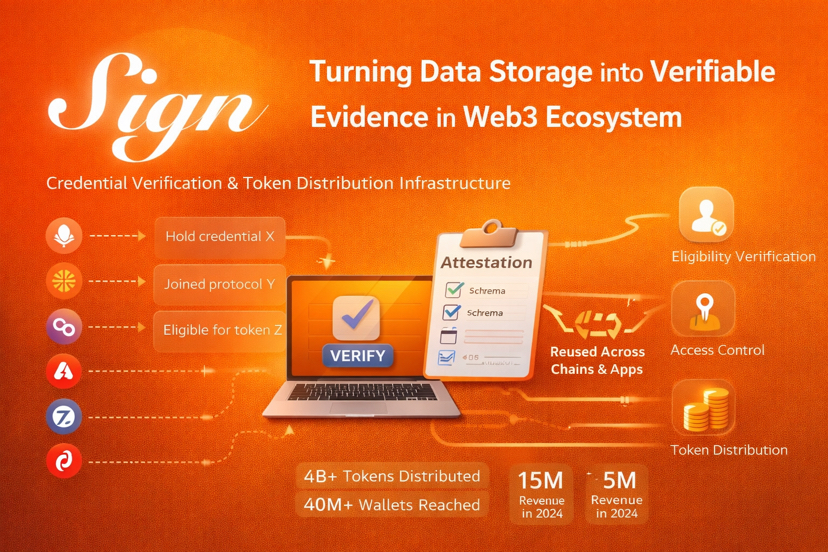
From my perspective, this is the real reason SIGN deserves attention. Many projects talk about on-chain data. SIGN is trying to solve the harder problem. It is turning data into proof that can be verified and reused across the multi-chain environment. If execution stays strong, SIGN may become more than another infrastructure project. It could become one of the most important trust and evidence layers in Web3.