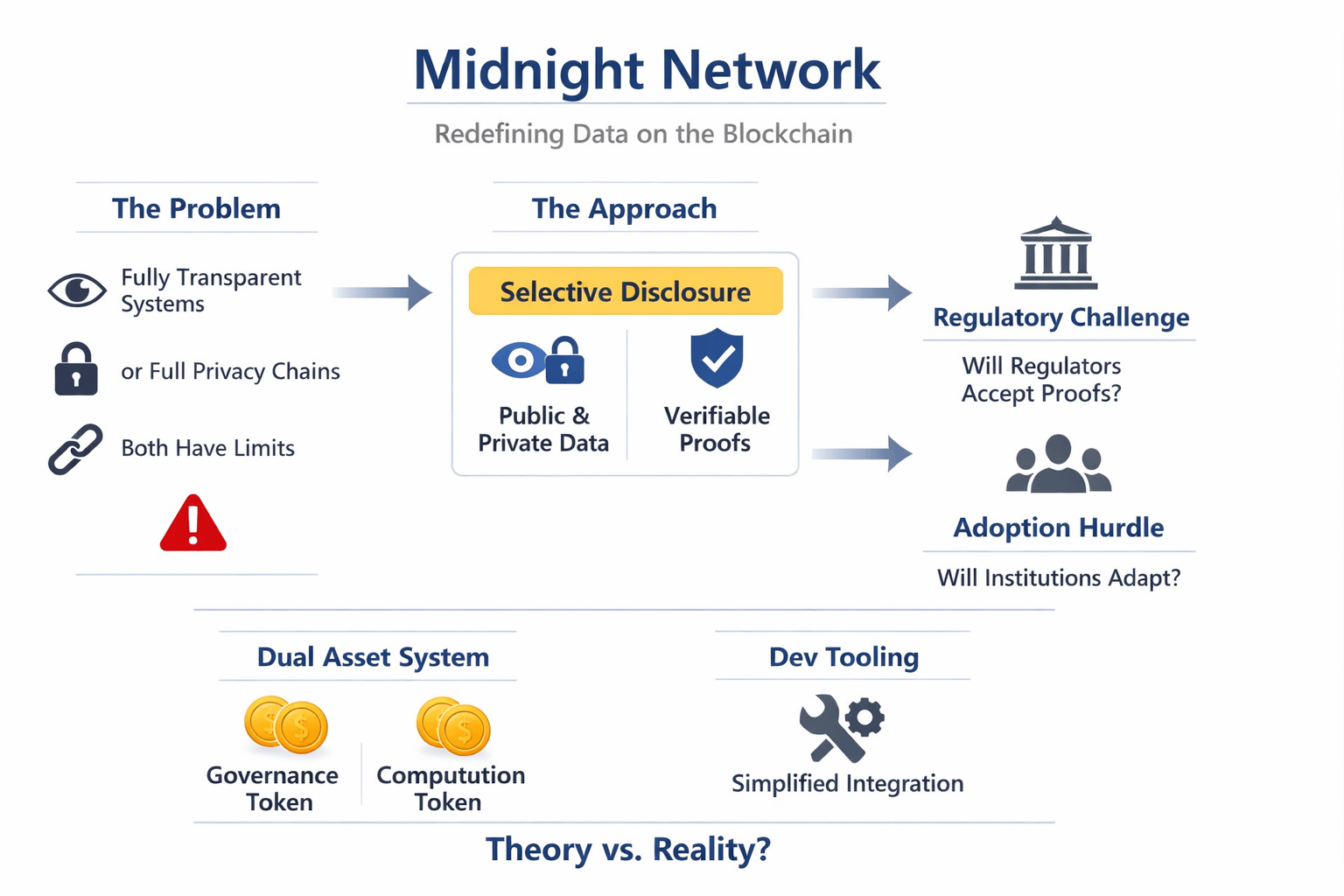
Lately, I’ve been returning to the same thought after spending time studying newer blockchain designs. Not speed. Not fees. But whether these systems actually understand how the real world treats information. Most still don’t. They assume openness is always good. That if everything is visible, everything can be trusted. But outside of crypto, that’s rarely how things work.
And that’s where Midnight Network starts to feel different.
At first glance, it’s easy to label it as just another privacy-focused chain. But I think that’s missing the point. Mujhe lagta hai ke hum isay sirf privacy-oriented keh kar galti kar rahe hain. Mere nazdeek, ye data ki puri architecture ko badalne ki koshish hai. It’s not just hiding data. It’s trying to redefine how data is handled in a system that still needs to be verifiable.
Because the core problem here is pretty obvious, even if people don’t say it directly. Public blockchains made a strong early bet: make everything visible, and trust will follow. That worked for simple transfers. But it falls apart the moment real-world data enters the picture. Financial records. Identity. Contracts. None of these can live comfortably on a fully transparent system.
Some projects tried to fix this by going in the opposite direction. Full privacy. Hide everything.
That didn’t really solve it either.
If you look at Monero, it achieved strong privacy, but at the cost of regulatory friction. It became difficult for institutions to even consider using it. On the other hand, Zcash introduced advanced cryptography, but adoption struggled, partly because the experience never fully clicked for most users.
Midnight seems to be studying both outcomes carefully. It’s trying to sit somewhere in between. Not fully transparent. Not fully hidden.
Selective.
The idea is simple to describe, but harder to execute. Data stays private, but proofs about that data can still be verified. You don’t show everything. You show just enough. That’s the promise.
And honestly, this is where things start to feel more grounded in reality. In traditional systems, nobody hands over raw data unless they absolutely have to. Instead, they provide attestations. Proofs. Certifications. Midnight is trying to bring that exact behavior on-chain.
Its structure reflects that. There’s a separation between public and private state. Some data is visible. Some isn’t. And importantly, the system is built so that both can interact without collapsing into one or the other.
Ye sirf coding ka kamaal nahi hai. Ye ek faisla hai ke har cheez sab ko dikhana zaroori nahi.
Another design choice that caught my attention is how it handles usage. Instead of tying everything to one token, it splits responsibilities. One asset holds value and governance weight. Another is used for computation and gets consumed over time.
That might sound like a small detail, but it changes behavior. Users aren’t constantly exposed to fluctuating costs in the same way. It introduces a kind of predictability that most networks still struggle with. And if you’re thinking about real businesses using this infrastructure, predictability matters more than anything else.
From a builder’s perspective, there’s also an effort to reduce complexity. Privacy systems usually demand deep cryptographic knowledge. Here, that burden is pushed into the tooling. Developers define intent, what should be public, what should stay private, and the system handles the rest.
That’s a practical move. Maybe even necessary.
But this is where I think it’s worth slowing down a bit.
Because on paper, a lot of this sounds clean. Almost too clean.
Lekin, does it actually hold up in the real world.
That’s the real test.
Paper par to ye sab bohat acha lagta hai, lekin asal imtehan tab hoga jab regulators is selective disclosure ko dekhenge. Will they accept a cryptographic proof as sufficient, or will they still demand raw data, full access, full transparency. Agencies like the U.S. Securities and Exchange Commission haven’t historically been comfortable with black box assurances, even if the math is sound.
And it’s not just regulators. There’s also the question of integration. Can existing institutions adapt to a model where they don’t directly see the data they’re used to verifying. That’s not just a technical shift. It’s a cultural one.
Midnight isn’t just solving an engineering problem. It’s challenging expectations.
Recent progress around the network suggests that it’s moving steadily rather than aggressively. The focus has been on building out its execution environment, refining how private and public logic interact, and preparing the groundwork for broader distribution and governance. No dramatic moves. Just infrastructure taking shape.
That’s usually a good sign. But it also means the hardest parts are still ahead.
Because ultimately, systems like this don’t fail at the level of design. They fail at the point of adoption. When theory meets regulation. When cryptography meets compliance departments. When elegant ideas meet messy reality.
Still, I can’t ignore what Midnight is attempting.
It’s not chasing the usual metrics. Not trying to be the fastest or the cheapest. It’s asking a different question entirely. Can a blockchain system behave more like the real world without losing its core guarantees.
And maybe that’s the right question to be asking now.
Because if blockchains are ever going to move beyond isolated use cases, they’ll need to handle information the way institutions actually do, not the way early crypto imagined they should.
Midnight feels like a step in that direction.
Not a finished answer. But a serious attempt.
Personal verdict
I think Midnight’s tech is strong in theory, but the real game will come down to developer adoption. If the tooling turns out to be difficult or unintuitive, this could easily remain just another research heavy project that never fully translates into real usage.
What do you think. Will institutions actually trust cryptographic proofs, or will they still fall back to demanding raw data like they always have.