
There was a time when I used to chase ideas just because they sounded important.
Digital identity was one of those ideas.
It felt obvious. If people controlled their own data, everything else would eventually adjust around that. Simple. Logical. Almost inevitable.
But the deeper I looked, the more uncomfortable it got.
Most of these systems didn’t actually work the way they were supposed to. Either there was some hidden central control sitting quietly in the background, or the whole thing demanded too much effort from users. And that’s where things usually break. Because if a system needs people to constantly think about it, it’s already losing.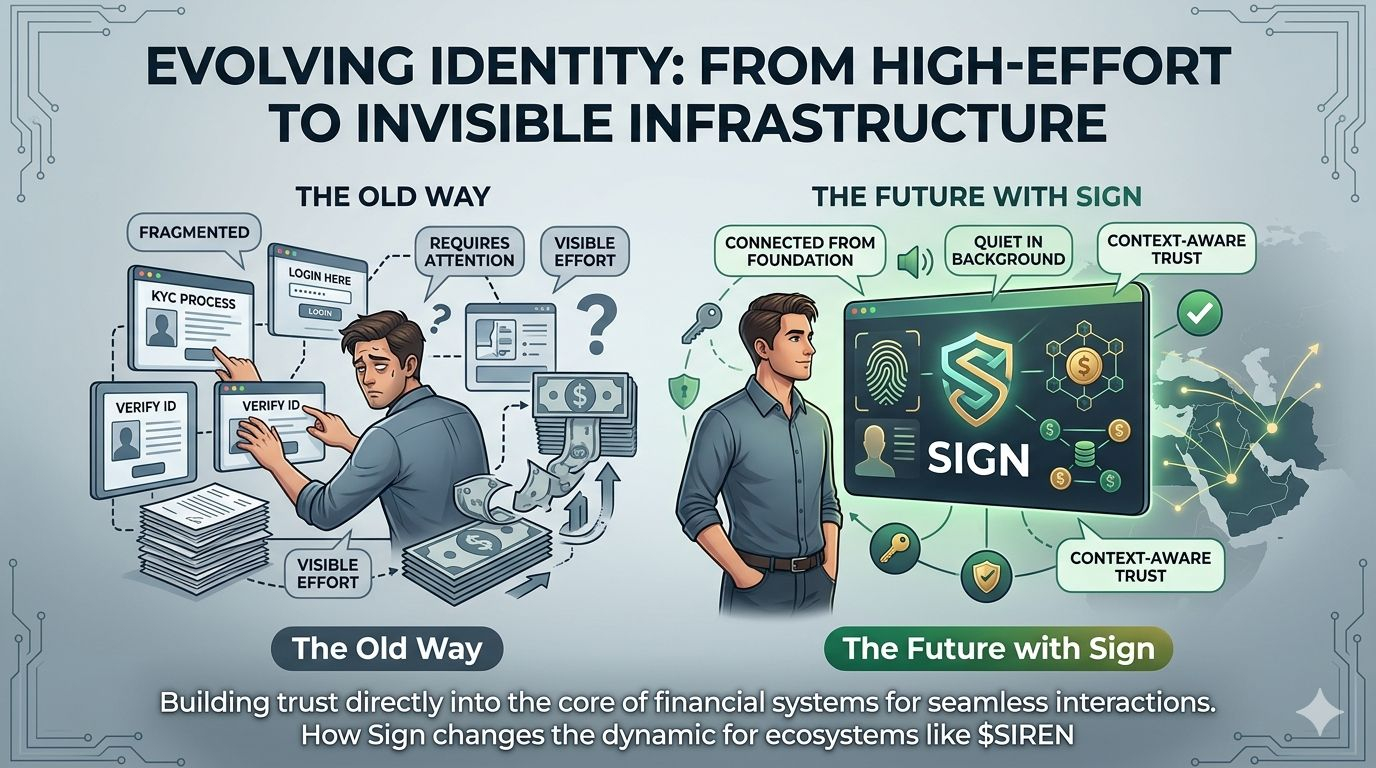
That realization changed how I look at projects.
Now I don’t ask how powerful an idea sounds.
I ask something much simpler:
Does this work quietly in the background, or does it need attention to survive?
That’s why Sign caught my attention.
Not because digital identity is new. It isn’t.
But because of how it’s being positioned.
Instead of treating identity like an extra feature, Sign pushes it into the core of the system. Into the part where transactions actually happen.
And that changes the dynamic.
Now it’s not just about sending value from one place to another.
There’s context attached to it.
There’s verification built into it.
Not in a way that exposes everything — but enough to create trust without killing privacy.
It’s almost like the system knows “who” is interacting, without needing to reveal everything about them.
That balance is hard to get right. Most projects lean too far in one direction.
Either too private → and nothing can be verified properly
Or too open → and privacy disappears completely
Sign is trying to sit somewhere in between.
What makes this more interesting is how it connects to financial infrastructure.
Because the real problem isn’t just moving money anymore. We’ve solved that part many times.
The real problem is trust across different environments.
If identity is weak, systems become restrictive.
If identity is fragmented, systems become unreliable.
So instead of fixing identity later, Sign builds it into the foundation.
Validators handle the integrity.
Applications build on top of it.
And the token isn’t just sitting there — it’s tied into how the system actually functions.
At least, that’s the idea.
Now bring the Middle East into the picture, and things start to make more sense.
This is a region that isn’t just adopting technology — it’s actively building new systems. From finance to governance, a lot of things are being redesigned from the ground up.
And when you’re building from scratch, the decisions you make early matter a lot.
If identity and finance are separated, problems show up later.
If they’re connected from the beginning, systems scale more smoothly.
That’s where Sign tries to position itself.
Not as another crypto project chasing attention,
but as something that could fit into a much bigger shift.
You can already imagine how ecosystems like $SIREN benefit from this — where user identity isn’t something external, but part of how the system operates.
But then there’s the market side.
And this is where things get real.
Right now, it still feels like we’re in the attention phase.
People are watching.
Narratives are forming.
Activity comes in waves.
But attention is not the same as usage.
And that gap matters more than most people realize.
Because markets often price in what could happen, not what is happening.
So the question becomes:
Is this actually being used, or are we just early in the story?
That leads to the real test.
Not technology.
Not vision.
Not even partnerships.
Just one thing:
Do people use it repeatedly?
Because that’s where everything either works… or falls apart.
If identity becomes part of everyday financial interactions — even in small ways — the system starts to reinforce itself.
Usage creates demand.
Demand attracts builders.
Builders expand the ecosystem.
And suddenly, it’s not a concept anymore. It’s infrastructure.
But if usage stays occasional, or optional, or forgettable…
then none of that cycle starts.
So if I’m watching this closely, I’m not looking at price first.
I’m looking at behavior.
Are apps forcing identity as part of the flow?
Are users interacting with it more than once?
Are developers still building after the initial hype fades?
#SignDigitalSovereignInfra @SignOfficial $SIGN
Are validators actually incentivized to stay?
Those signals matter more than anything else.
At the end of the day, the difference is simple.
Some ideas sound necessary.
But real infrastructure becomes necessary only when people use it again and again — often without even noticing.
If Sign reaches that point, it becomes something much bigger.
If it doesn’t…
then it’s just another strong idea that never fully landed.