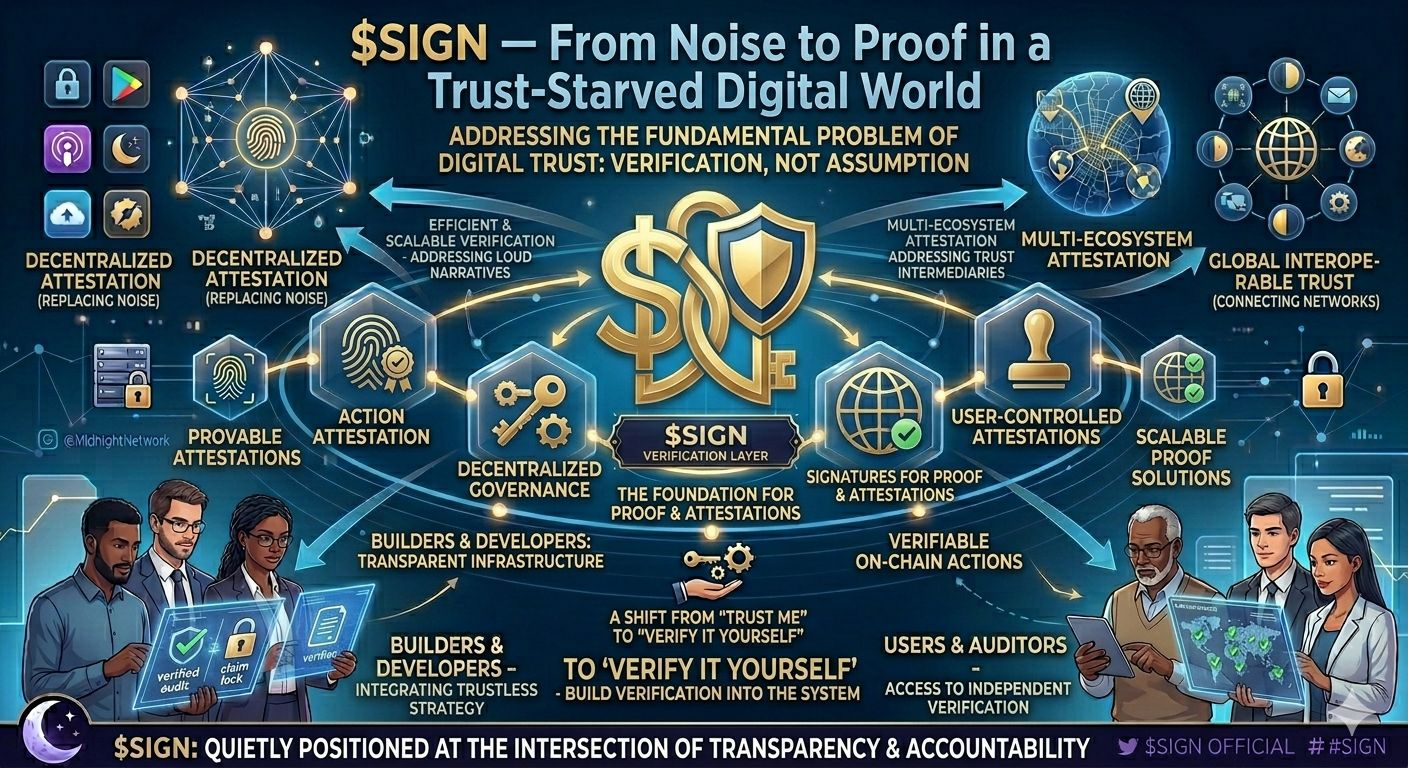
Every cycle in crypto brings louder narratives, bigger promises, and faster-moving trends. But beneath all that noise, one problem keeps resurfacing: trust. Not the kind people talk about—but the kind you can actually verify.
That’s where $SIGN starts to stand out.
Instead of competing for attention, SIGN feels like it’s addressing something more fundamental. In a digital world where actions happen instantly and often anonymously, the ability to prove what actually happened becomes incredibly valuable. Not assumed. Not trusted. But verified.
Right now, most systems still rely on a mix of reputation, intermediaries, or blind belief. You click, sign, transact—and just hope everything works as expected. But what if every action carried its own proof? What if verification was built into the system itself?
SIGN moves in that direction.
It represents a shift from “trust me” to “verify it yourself.” And while that idea sounds simple, its implications are massive. It could reshape how agreements are made, how data is shared, and how digital interactions are validated across networks.
What makes SIGN interesting isn’t hype—it’s positioning. It sits at the intersection of transparency and accountability, two things the crypto space desperately needs as it matures.
And like many foundational ideas, it might not explode overnight. Because real infrastructure rarely does. It builds quietly, gains relevance over time, and eventually becomes something everything else depends on.
In the end, the future won’t belong to the loudest projects.
It will belong to the ones that make the system more truthful.
$SIGN isn’t just another token in the market—
it’s a step toward a world where proof matters more than promises.
#signdigitalsovereigninfra 🚀 @SignOfficial $SIGN