
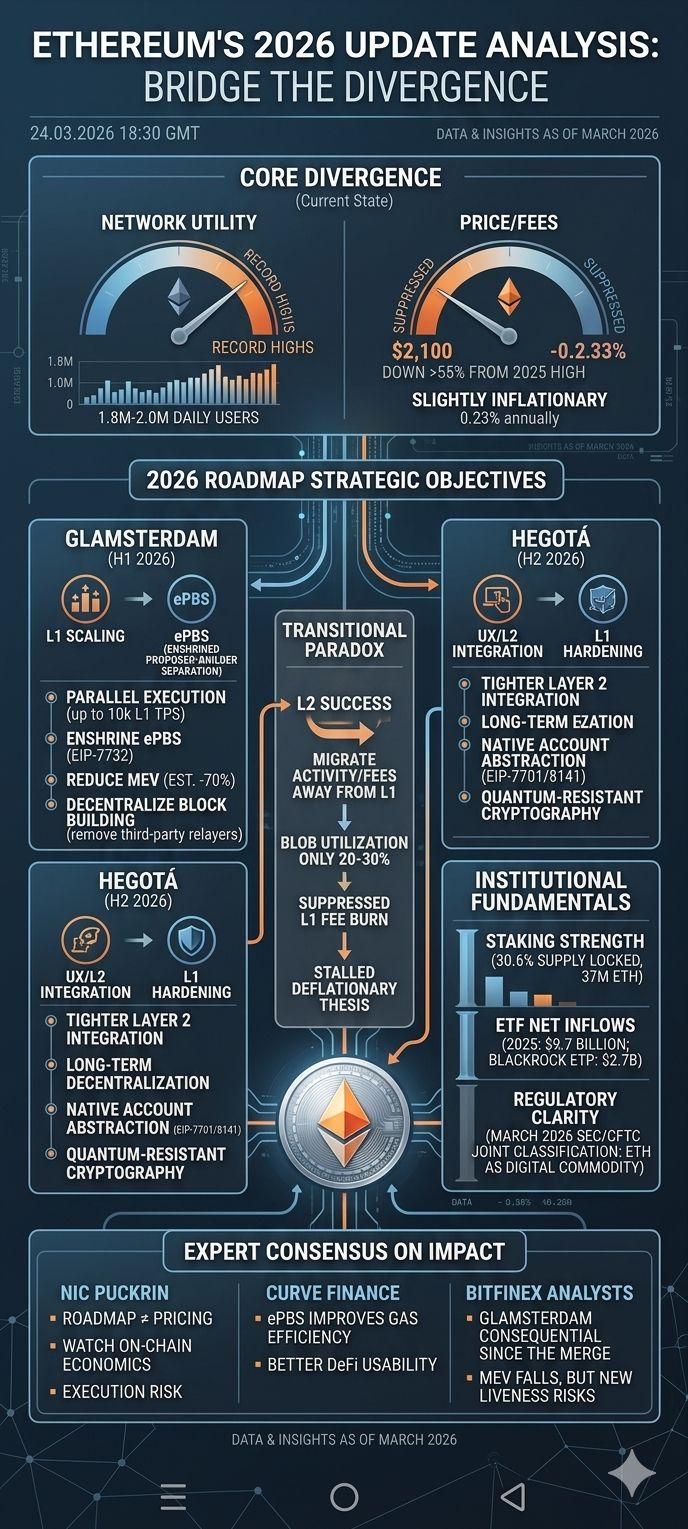
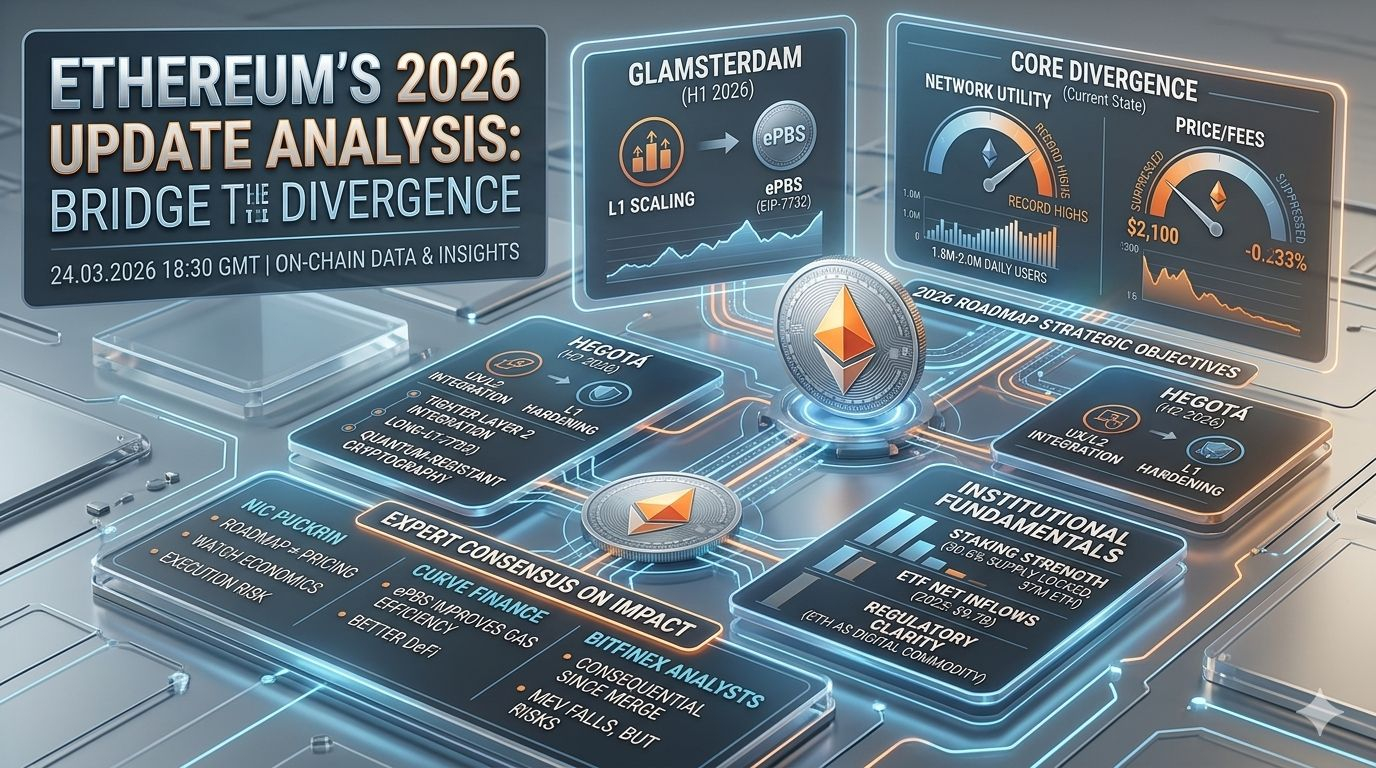

A rede Ethereum está atualmente navegando uma profunda divergência entre a dominância on-chain e a valorização de mercado. Enquanto o protocolo se prepara para sua revisão técnica mais ambiciosa desde "The Merge," o preço permanece surpreendentemente contido. Para entender para onde o ETH está indo em 2026, devemos olhar além dos tickers e para a "sala de máquinas" estrutural da blockchain.
1. O Roteiro de 2026: Glamsterdam & Hegotá
A evolução do Ethereum este ano centra-se em duas atualizações principais projetadas para resolver os "problemas de sucesso" da rede:
* Glamsterdam (H1 2026): Este é um jogo de escalabilidade de Camada 1 (L1). Seu objetivo é introduzir paralelização—permitindo que a rede processe múltiplas transações simultaneamente em vez de em uma única linha. Ao implementar ePBS (Separação de Propositor-Construtor Consagrada), a rede visa remover a dependência de "relayers" de terceiros, descentralizando o processo de construção de blocos e tornando a rede mais resiliente.
* Hegotá (H2 2026): Embora os detalhes ainda estejam sendo finalizados, esta atualização está programada para construir sobre a UX e o endurecimento do L1 estabelecido na primeira metade do ano, focando na sustentabilidade a longo prazo e na disponibilidade de dados.
2. O Efeito de "Canibalização" da Escala
Os dados revelam um paradoxo fascinante: o uso da rede está em um nível recorde (2 milhões de usuários diários), mas a receita de taxas do L1 está em queda.
O sucesso das soluções de Camada 2 (rollups) tem migrado atividade da cadeia principal. Embora isso seja ótimo para os usuários (taxas mais baixas), isso temporariamente estagnou a narrativa "ETH é deflacionário". Atualmente, o Ethereum é levemente inflacionário em 0,23% anualmente porque o L1 não está "queimando" taxas suficientes para compensar a nova emissão. Para o ETH retornar a um estado deflacionário, precisamos ver "saturação da taxa de blob"—essencialmente, os L2s precisam se tornar tão ocupados que comecem a pagar significativamente mais para liquidar no L1.
3. A "Acumulação" Institucional "Stealth"
Apesar do preço estar em queda de aproximadamente 55% em relação ao seu pico de 2025 de $4.956, o interesse institucional não vacilou.
* Força de Staking: Aproximadamente 30,6% do suprimento total de ETH (37 milhões de ETH) está bloqueado em staking.
* Entradas de ETF: Somente em 2025, os ETFs Spot ETH viram $9,7 bilhões em entradas líquidas.
* Clareza Regulatória: Em março de 2026, a SEC e a CFTC classificaram conjuntamente o ETH como uma commodity digital, fornecendo o "sinal verde" legal que muitas instituições conservadoras estavam esperando.
4. Riscos Técnicos vs. Recompensas
O consenso dos especialistas destaca uma abordagem "Navio de Teseu": substituindo os componentes principais da rede enquanto ainda está em operação.
* A Recompensa: Uma potencial capacidade de 10.000 transações por segundo (TPS) no L1 e até 10 milhões de TPS nos L2s nos próximos anos.
* O Risco: Atraso na execução. O Ethereum tem um histórico de atrasos. Se Glamsterdam ou Hegotá enfrentarem reveses significativos, o mercado pode continuar a favorecer concorrentes mais rápidos e "monolíticos".
Veredicto Final
O Ethereum está atualmente em uma fase de construção de infraestrutura, não em uma fase de "hype". A transição para criptografia resistente a quantum e abstração de conta nativa (tornando as carteiras tão fáceis de usar quanto e-mail) sugere que a Fundação está jogando o "jogo longo". Para o investidor paciente, os níveis de preço atuais refletem pressões macroeconômicas—inflação e altas taxas de juros—em vez de uma falha do próprio protocolo Ethereum.
#Ethereum #CryptoAnalysis #Web3 #BlockchainTechnology #ETH2026