
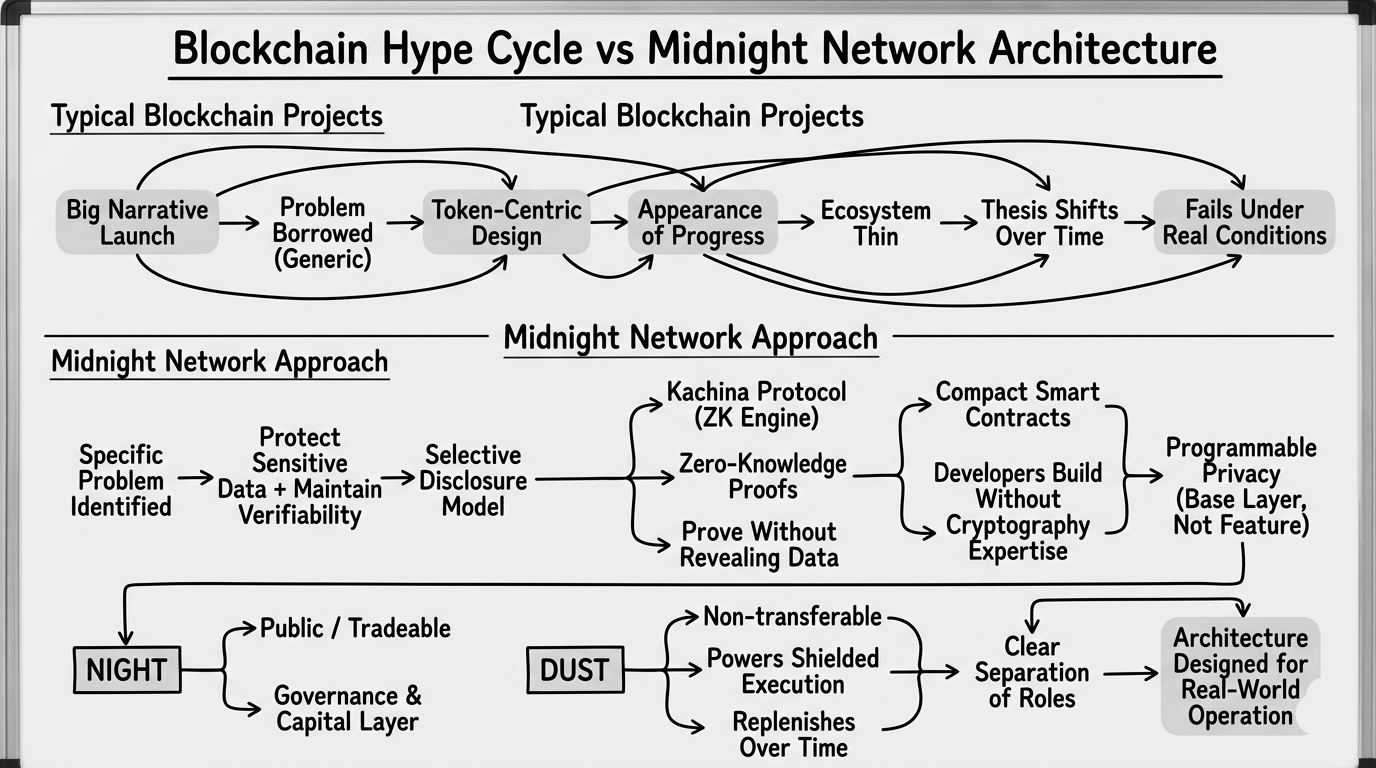
@MidnightNetwork I have been following blockchain infrastructure projects long enough to develop a reliable instinct for the ones that will not survive contact with reality. They announce themselves loudly. They borrow the most compelling problem they can find, build just enough around it to attract attention, and then spend the rest of their existence maintaining the appearance of progress rather than delivering it. The architecture sounds serious in the pitch. It sounds less serious eighteen months later when the ecosystem is thin and the original thesis has quietly shifted to fit whatever the market is rewarding that cycle.
Midnight does not read like that to me. Not yet.
What caught me first was not the privacy angle. Every project in this space has a privacy angle now. What caught me was the specificity of the problem Midnight is actually trying to solve. Not hiding everything. Not making all activity invisible. Something more precise than either of those — the idea that sensitive data should stay protected without that protection destroying the network's ability to verify anything. Keep what is private, private. Prove what needs to be proven. Let the network enforce that boundary without seeing what is behind it. Most projects in this lane cannot even articulate that distinction clearly. Midnight built infrastructure around it.
That is harder than it sounds.
The design underneath reflects genuine thinking about how a privacy network would function under real operating conditions. NIGHT sits on the surface — public, tradeable, the governance and capital layer that the market can see and price. DUST runs underneath. It powers the shielded execution layer, cannot be transferred between wallets, cannot be traded, and replenishes passively through NIGHT holdings over time. I find that separation more considered than almost any token model I have looked at this cycle. It feels like someone started with the question of how private computation should actually be funded — and worked backwards to a structure that answers it cleanly. The shielded layer runs on DUST. The capital layer runs on NIGHT. Neither one is carrying the other's weight.
That kind of role clarity is genuinely rare.
What Midnight Network is attempting — and I use attempting deliberately, because the real test is always in the running, not the design — is to make programmable privacy a base layer rather than a bolt-on feature. The zero-knowledge proof system underneath feels like it was built by people who understood the cryptographic problem specifically, not by people who borrowed a solution from somewhere else and adapted it. Kachina exists because someone asked what a ZK proof engine would look like if it was designed from the beginning for selective disclosure rather than retrofitted for it. Compact exists because someone understood that shielded application development would never scale if every developer needed a cryptography background to participate. As a partner chain to Cardano, Midnight inherits a security foundation built through years of peer-reviewed research — which is a starting point most privacy projects have never had access to.
That is a serious foundation. Whether serious foundations become serious ecosystems is always a separate question.
$NIGHT is trading around $0.0481 today — holding above its short-term moving averages after bouncing from the $0.04188 floor earlier this week. Volume has sustained at elevated levels, running near 18 billion NIGHT in the past 24 hours. The price structure has changed meaningfully from two weeks ago. MA(7) sits at $0.04776 and EMA(7) at $0.04760 — both below current price for the first time since the post-listing correction began. The market is no longer positioned purely around the listing event. Something shifted. Whether that shift reflects genuine conviction in the programmable privacy model or just technical positioning ahead of mainnet is the question worth sitting with.
Those are two very different reads. And the ecosystem will separate them.
Because the honest version of this is that thoughtful architecture does not create demand on its own. Midnight Network has the cryptographic infrastructure, the Cardano foundation, a dual-token model that actually makes structural sense, and a position in a space that has needed serious privacy infrastructure for longer than most people have been paying attention. What it does not have yet is a live ecosystem producing evidence that DUST gets consumed, shielded applications get used, and developers return to the selective disclosure model out of genuine necessity rather than early curiosity.
That evidence is arriving now.
And it will say more about Midnight Network's future than anything written about it before mainnet ever could.
