
I think what’s been bothering me lately is not that there are too many projects… it’s that they all start to feel the same after a while.
You hear the pitch, and your brain finishes it before they do.
New infrastructure. Better trust. Cleaner system. Fixing what’s broken.
And maybe it sounds different on the surface… but underneath, it’s usually the same loop. Same ideas, just dressed better. Same problems, just explained with more confidence.
That’s where I was mentally when I came across Sign Protocol.
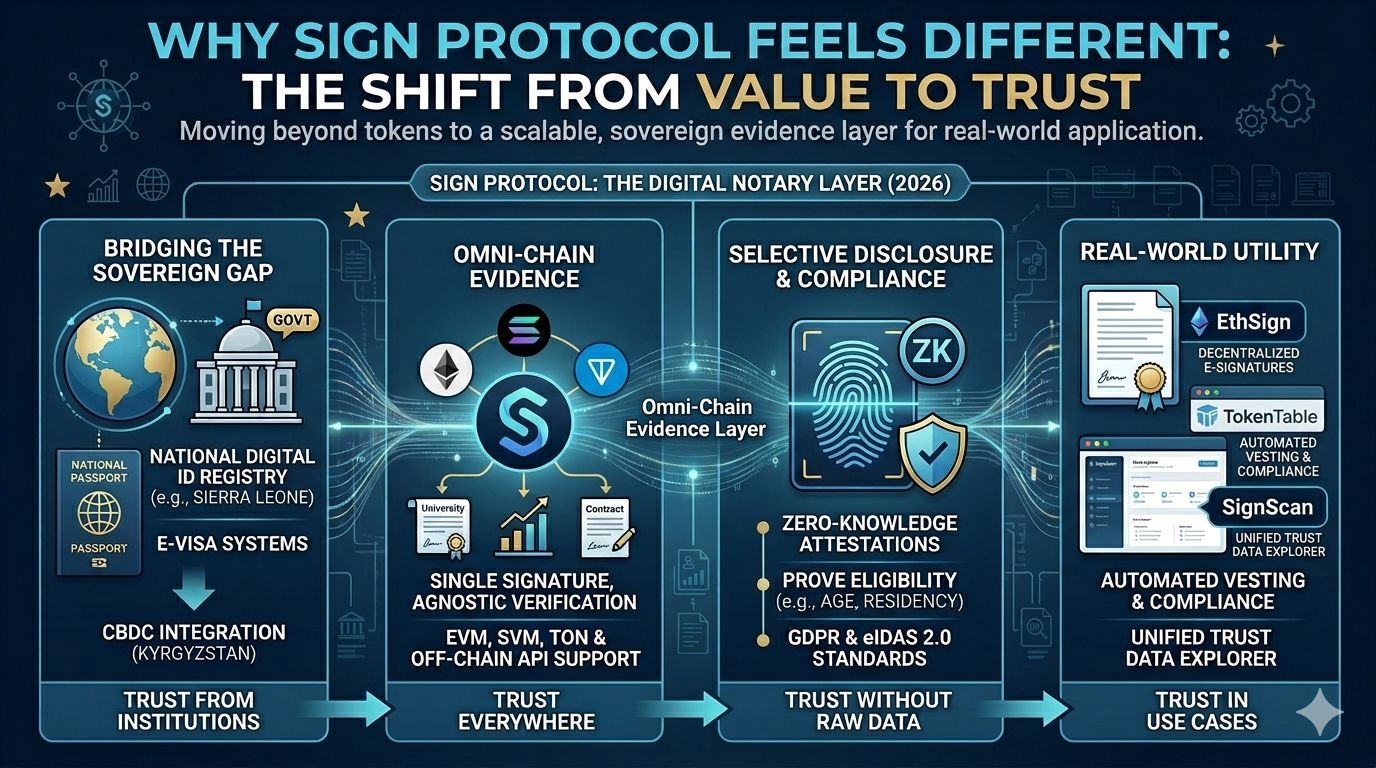
At first, I didn’t take it seriously.
Attestations. Credentials. Trust layer.
I’ve seen all of that before.
It felt like something I could just mentally file away with everything else and move on. But for some reason, I didn’t. It stayed. And the more I looked at it, the more I realized it wasn’t really about the words it was using.
It was about the problem it kept pointing back to.
And that problem is uncomfortable, because it’s everywhere.
Most systems today are very good at recording things.
They can log actions. Store data. Show history. Prove that something happened inside their own environment
But the moment that information needs to leave… everything gets messy.
That’s where things start to break.
Because recording something is easy.
Making it hold meaning outside its origin is not.
And I think that’s the part most people ignore.
We’ve built systems that move money fast. Systems that execute instantly. Systems that automate decisions.
But when it comes to trust… we’re still doing a lot of manual work.
Screenshots. Internal dashboards. Cross-checking. Re-verifying. Rebuilding context again and again.
It’s like everything works… but only if you stay inside the same system.
The moment you step outside, you’re back to friction.
And that’s the thought that kept pulling me back to Sign Protocol.
Not because it feels revolutionary.
Not because it’s loud.
But because it feels like it’s sitting right on top of that exact issue.
It’s not just trying to store claims.
It’s trying to make them survive.
Survive movement. Survive verification. Survive being questioned later. Survive different systems, different rules, different conditions.
That’s a very different kind of problem.
And honestly, it’s a heavier one.
Because most of crypto has been focused on execution.
Something happened on-chain. Great.
But… does it actually mean something outside that environment?
Can someone else trust it without rebuilding everything from scratch?
Can it be reused without turning into more work?
That’s where things usually fall apart.
And I think that’s why Sign Protocol doesn’t feel like just another “crypto product” to me.
It feels like it’s trying to deal with something older than crypto itself.
The idea of making a record that doesn’t lose its meaning when it moves.
The idea of making trust portable… without making it fragile.
That’s not a new problem.
It’s just one that most systems still handle badly.
Even now.
And I’m not blindly optimistic about it either.
I’ve seen too many projects start with a real problem and slowly drift into abstraction.
Everything becomes cleaner on paper… but less useful in reality.
That risk is still here.
It always is with infrastructure.
The real test is simple, but hard:
Does this become something people depend on?
Not something they understand.
Not something they admire.
Something they can’t easily remove without feeling pain.
Because that’s where real value starts.
Right now, I’m not saying Sign Protocol is already there.
I’m just saying it feels closer to a real problem than most of what I see.
And maybe that’s enough… for now.
Because in a market that’s exhausted from repeating itself…
even recognizing the right problem feels like progress.#SignDigitalSovereignInfra @SignOfficial $SIGN
