
I’ve been looking closely at how @MidnightNetwork is designed, and somewhere along the way, I realized it’s not just about adding privacy to blockchain. It’s quietly questioning something deeper why did we ever accept constant exposure as normal in the first place?
Because if I’m honest, that’s what most crypto systems feel like today.
Everything is visible. Every transaction leaves a trace. Every wallet becomes a story that anyone can follow if they look closely enough. We’ve learned to call that transparency, and in many ways it helped build trust early on. But while reading through Midnight’s documentation, I kept thinking… this isn’t really how people live or interact in the real world.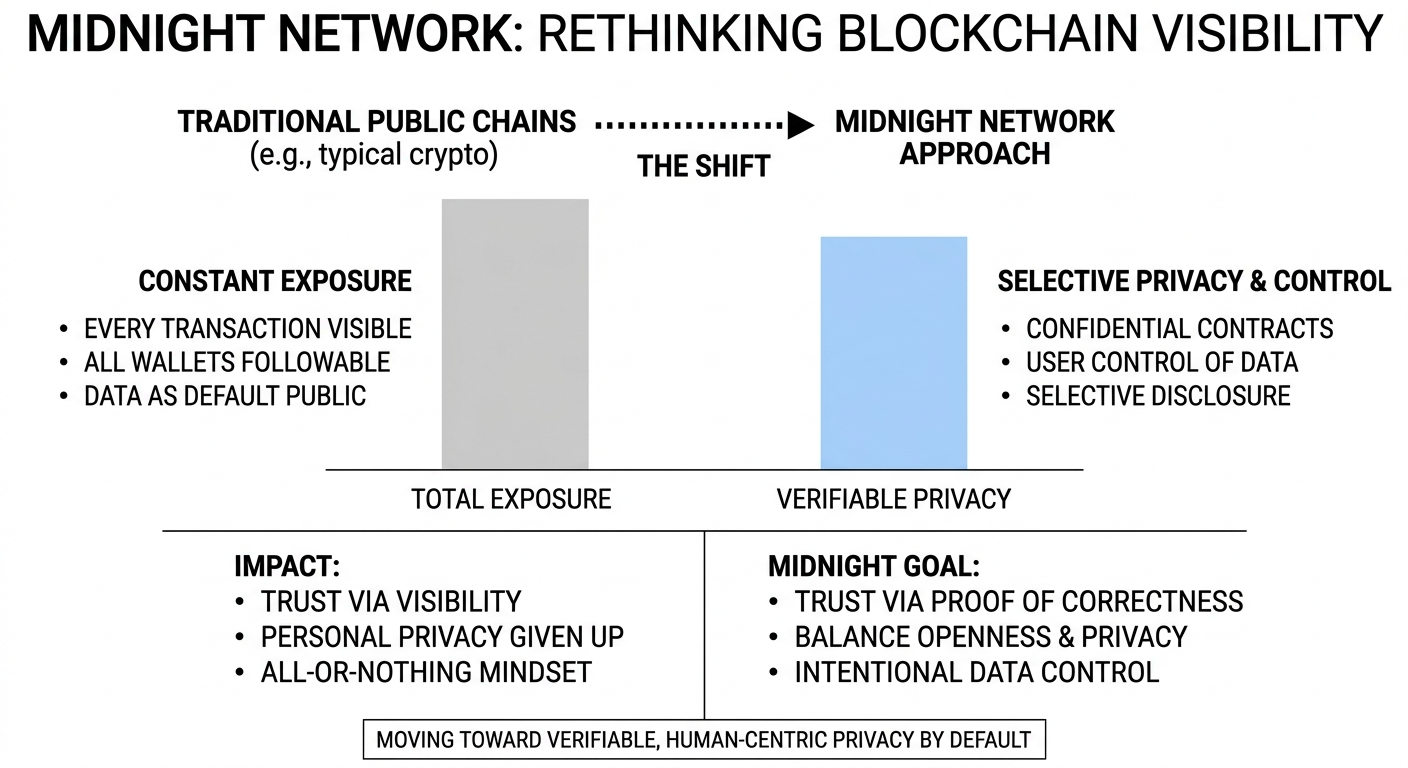
We don’t operate with total exposure.
We share information selectively. We reveal what’s necessary. We protect what matters.
What caught my attention while reading the documentation was how Midnight tries to bring that same logic into blockchain through confidential smart contracts and selective disclosure. Instead of forcing data to be public, it allows contracts to work with private information and still produce proofs that everything was done correctly.
That idea took me a moment to fully process.
Because it means trust doesn’t have to come from seeing everything. It can come from knowing that the system can prove correctness without revealing the details behind it.
In my view, that’s a quiet but important shift.
It moves blockchain away from this “all or nothing” mindset where you either expose everything or hide everything and toward something that feels more natural. Something closer to how trust actually works outside of digital systems.
Another thing that stood out to me is how Midnight fits into the broader Cardano ecosystem. It doesn’t try to replace public chains. It works alongside them. Transparent layers still exist for things that benefit from openness, while Midnight creates space for interactions that require privacy.
That balance feels… human.
Some things should be visible. Some things shouldn’t. But both still need to be reliable.
While thinking about this, I kept coming back to how this changes incentives. Right now, participating in blockchain often means giving up a level of personal privacy without really thinking about it. Midnight suggests a different direction one where users and institutions can stay in control of their data while still being part of a verifiable system.
But there’s also a reality that I couldn’t ignore.
Privacy in Midnight isn’t automatic. It depends on how systems are designed. Developers decide what gets revealed and what stays hidden. That means two applications built on the same network could feel very different in terms of privacy.
And that introduces something we don’t always talk about: responsibility.
Not everything is visible anymore. So not everything is easy to double check from the outside.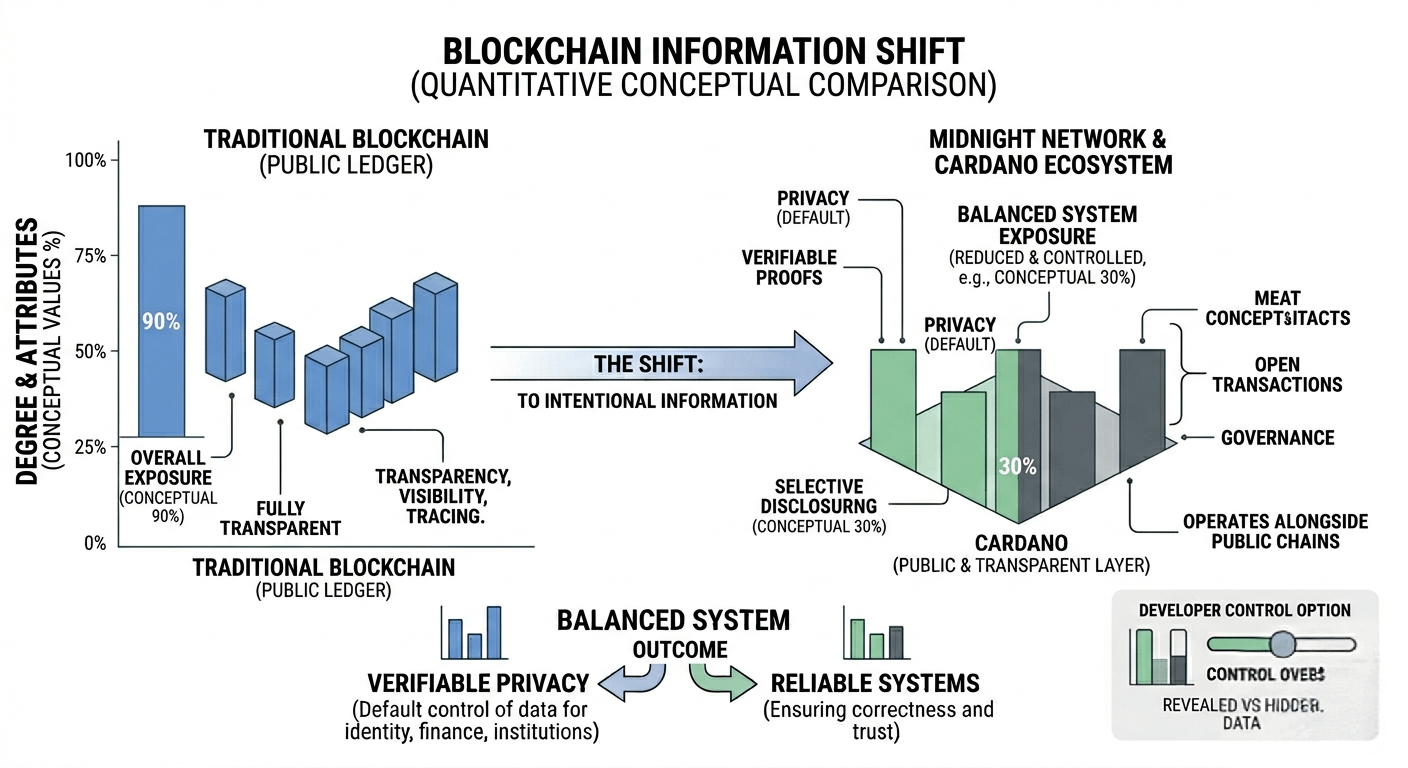
My takeaway so far is that Midnight isn’t just building privacy tools. It’s trying to rebuild the way we think about information in decentralized systems moving away from constant exposure and toward something more intentional.
Something where privacy isn’t an exception. But a default that can still be verified when needed.
As blockchain moves closer to real world use identity, finance, institutional systems this balance is going to matter more than ever. Maybe the future isn’t about making everything transparent, but about knowing when transparency actually makes sense.
How others are interpreting this shift within the Midnight ecosystem.