
The Crypto Project That Governments Chose Before the Crowd Did
In crypto, timing is everything.
But most people think about timing the wrong way. They watch charts. They track sentiment. They wait for the right candle pattern before they decide something is worth paying attention to.
The most important timing signals in this space never come from charts. They come from decisions made in rooms that crypto Twitter does not have access to government procurement offices, institutional investment committees, sovereign technology advisory boards.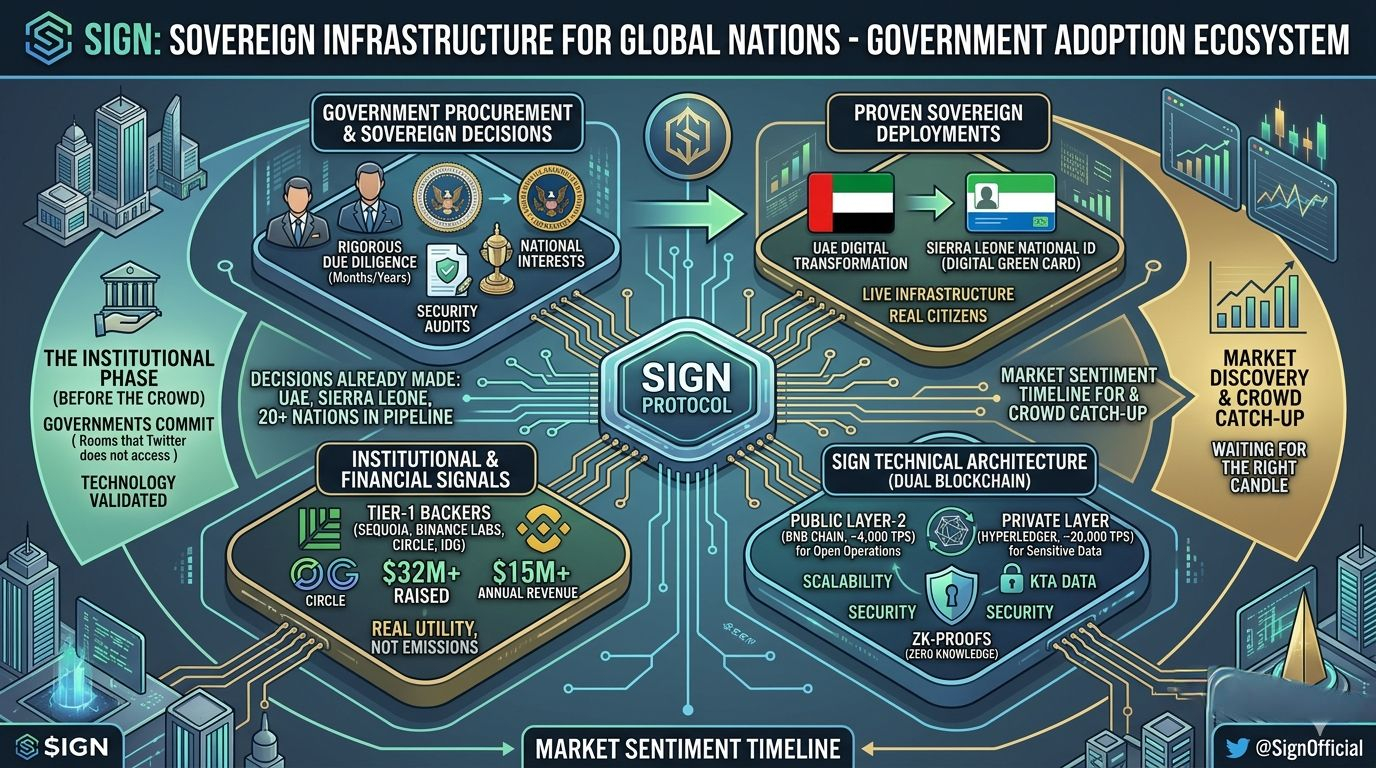
Those rooms already made their decision about $SIGN. The crowd just has not caught up yet.
The Missing Piece: Why This Matters More Than Hype
Most crypto projects try to win attention first and utility later. SIGN followed the opposite path. It built for governments first the most demanding clients in the world and let the market discover it afterward.
That changes the risk profile completely. Governments do not experiment casually with national infrastructure. They stress test legal compliance, cybersecurity resilience, scalability limits, vendor credibility, and geopolitical exposure before committing.
When a sovereign deploys infrastructure, it is not a beta launch. It is a long-term commitment. That alone separates SIGNAL projects from speculative narratives.
How Governments Actually Choose Infrastructure
When a sovereign nation decides to build its digital infrastructure on a particular technology, the process looks nothing like retail investment.
There are no influencers involved. No trending hashtags. No community vote. There are procurement specialists, security auditors, technical evaluators and political decision makers who spend months sometimes years stress testing the technology before a single line of national infrastructure gets built on top of it.
They look at the team. The technology stack. The existing deployments. The revenue. The institutional backers. The security model. The scalability. The long term roadmap.
And then they make a decision that is designed to last decades. Because sovereign infrastructure does not get rebuilt every two years. When a government chooses a foundation, that foundation is there for a generation.
The Decisions That Have Already Been Made
UAE went through that entire process. One of the most aggressive digital transformation programs in the world, backed by sovereign wealth and driven by a genuine national commitment to becoming a digital economy leader. They evaluated their options. They ran the due diligence. They chose to build on $SIGN and @SignOfficial infrastructure.
Sierra Leone did the same. They needed a national digital identity system the most foundational infrastructure a modern government can build. Something that would verify citizens, protect credentials, and create a tamper proof permanent record of national identity at scale. They launched it on SIGN and called it the digital Green Card. Live national infrastructure. Real citizens. Not a pilot.
These are not marketing partnerships. These are sovereign technology decisions made by governments with everything on the line. The kind of decisions that do not get reversed.
Twenty plus additional countries are actively moving through the deployment pipeline right now.
What Makes SIGN the Answer to the Government Question
S.I.G.N. stands for Sovereign Infrastructure for Global Nations. The name is not branding. It is a product description.
Sign Protocol handles digital identity and attestations using zero knowledge proofs. Governments can verify documents, credentials and identities on chain without ever exposing the underlying sensitive data. The blockchain sees the proof. Never the private information. This is not a feature for sovereign deployment, it is a requirement.
TokenTable has distributed over four billion dollars across forty million plus wallets for two hundred plus projects. When nations need to move digital assets at scale whether that is CBDCs, government tokens or institutional distributions this is the infrastructure that handles the load without breaking.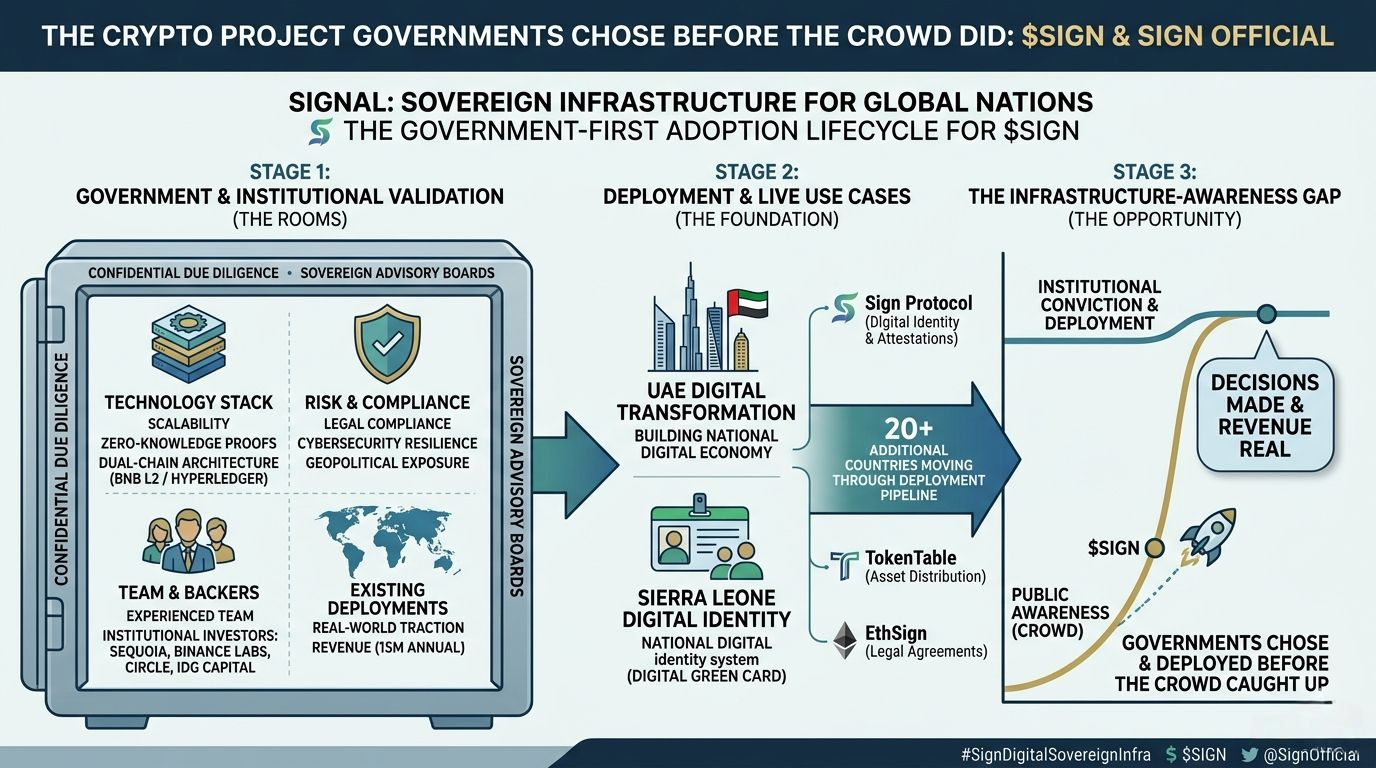
EthSign handles legal and sovereign agreements. Contracts that cannot be disputed. Documents that cannot be forged. Agreements that are permanently verifiable by any party at any time. For governments still running on paper, this is transformational.
The technical architecture runs on a dual blockchain system a public Layer-2 on BNB Chain handling four thousand transactions per second for open operations, and a private Hyperledger layer handling sensitive government operations at up to twenty thousand TPS. The system was built for exactly the scale and security requirements that sovereign deployment demands.
The Institutional Signal Most People Are Missing
Thirty two million dollars raised from Sequoia Capital, Binance Labs, Circle and IDG Capital.
These are not retail investors chasing a narrative. These institutions specialize in identifying foundational infrastructure early. When multiple tier-one backers converge on the same project, it signals long-term conviction, not short-term speculation.
Fifteen million dollars in real annual revenue backs that thesis with actual numbers. Not emissions. Not incentivized volume. Revenue from institutions paying for infrastructure that they depend on.
The Middle East Is the Accelerant
The timing of what is happening in the Middle East right now is not incidental to the SIGN story. It is central to it.
Billions are being committed to digital transformation across the region. Governments that have the capital, the political will and the urgency to move fast. They are not waiting for the technology to mature they are deploying it now. And the deployments happening today are setting the foundation for the next several decades of how these economies will function digitally.
SIGN is already in the ground in UAE. Already trusted by sovereigns in the region. Already positioned as the infrastructure layer that the broader regional transformation will build on top of.
Before the Crowd What That Actually Means
Every major infrastructure play in technology history had this same moment.
The moment where the institutions and the governments have already made their decisions. The deployments are real. The revenue is real. The backing is serious. But the broader market has not connected the dots yet because infrastructure is not exciting to talk about and the technology is not designed for retail narratives.
That gap between institutional conviction and public awareness is where the most asymmetric opportunities exist.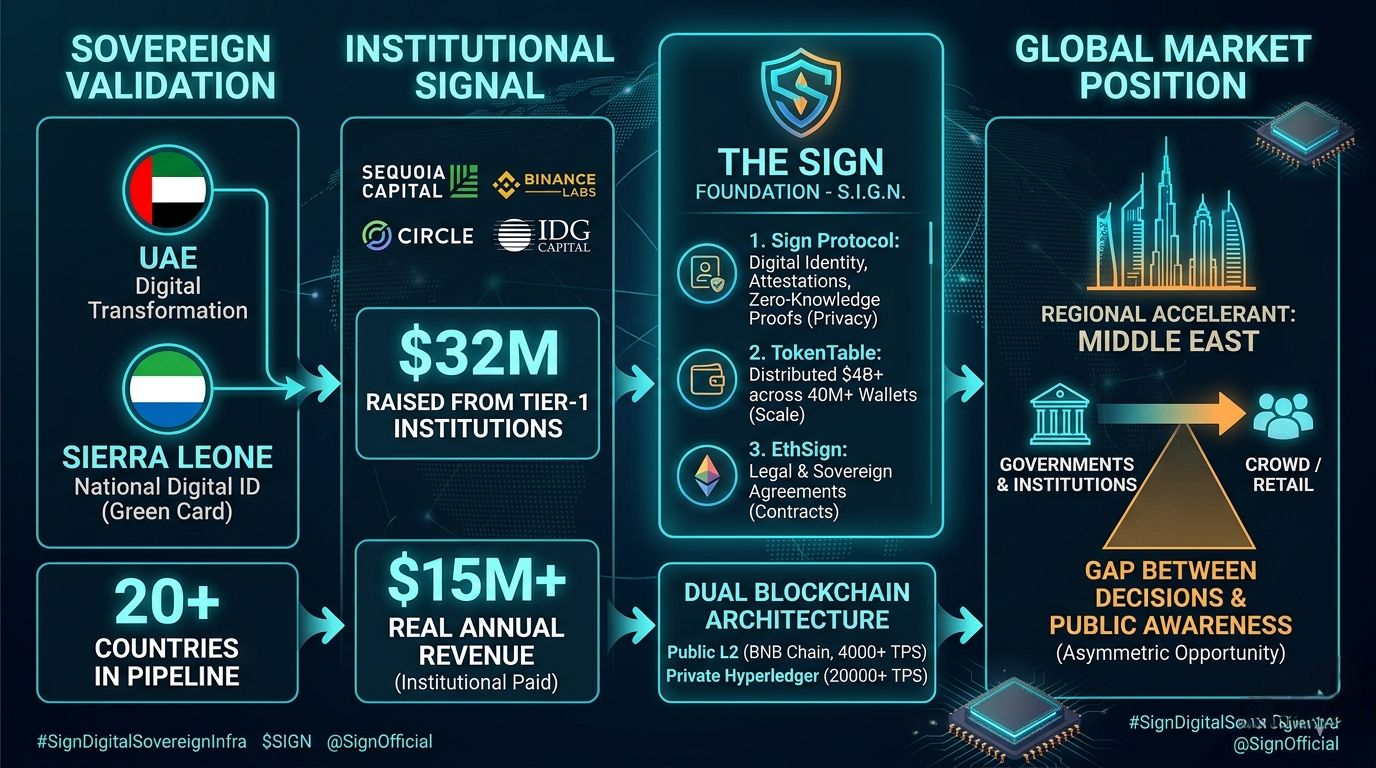
Governments chose $SIGN before the crowd did. Institutions backed it before the crowd did. Sovereigns deployed it before the crowd noticed.
The crowd always catches up eventually. The question is whether you are positioned before or after that happens.
@SignOfficial #SignDigitalSovereignInfra $SIGN
