
Hybrid attestations are an advanced feature of the Sign Protocol that combine the security of on-chain verification with the scalability of off-chain storage. They are designed to handle large or complex datasets efficiently while maintaining trust and verifiability across decentralized systems.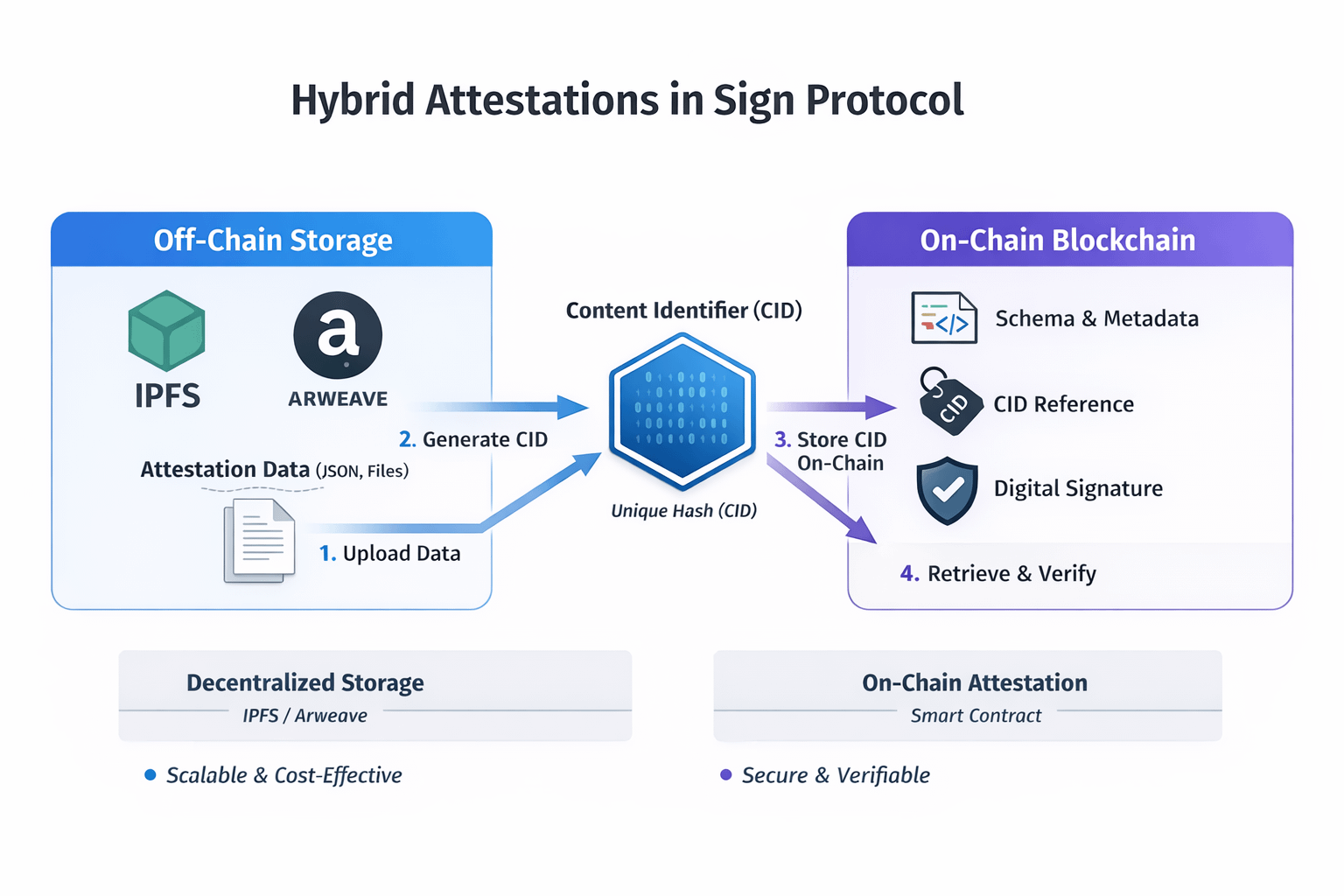
What Are Hybrid Attestations?
Hybrid attestations are standard on-chain attestations where the actual data is stored off-chain, typically on decentralized storage networks like IPFS or Arweave, while key metadata remains on-chain.
In this model:
The blockchain stores schema, metadata, and references
The full attestation data is stored externally
A Content Identifier (CID) links the two layers together
This approach allows developers to preserve blockchain integrity without incurring high storage costs.
Why Hybrid Attestations Matter
Traditional on-chain storage can become expensive and inefficient, especially for large datasets. Hybrid attestations solve this by:
1. Reducing Gas Costs
Storing large data directly on-chain leads to high transaction fees. Offloading data reduces these costs significantly.
2. Enabling Scalable Data Storage
Decentralized storage networks like IPFS and Arweave are optimized for handling large files, making them ideal for attestation data.
3. Maintaining Verifiability
Even though the data is off-chain, the CID stored on-chain ensures that the data remains:
Tamper-proof
Cryptographically verifiable
How Hybrid Attestations Work
The lifecycle of a hybrid attestation follows a simple process:
Step 1: Upload Data
Attestation data is uploaded to decentralized storage (IPFS or Arweave), usually in JSON format.
Step 2: Generate CID
A Content Identifier (CID) is created, which acts as a unique cryptographic fingerprint of the data.
Step 3: Store CID On-Chain
The CID is encoded and stored in the data field of the attestation within the smart contract.
Step 4: Retrieve & Verify
When needed:
The CID is fetched from the blockchain
The data is retrieved from IPFS/Arweave
The integrity is verified via the CID
Key Components of Hybrid Attestations
1. On-Chain Layer
Schema definition
Metadata
Encoded CID
Digital signatures
This ensures trust, immutability, and verification.
2. Off-Chain Storage Layer
Raw attestation data
Stored on IPFS or Arweave
Optimized for scalability and accessibility
3. Content Identifier (CID)
The CID is central to hybrid attestations:
It is a cryptographic hash of the data
Any change in data results in a new CID
Guarantees data integrity and immutability
Advantages of Hybrid Attestations
Cost Efficiency: Lower gas fees by avoiding large on-chain storage
Flexibility: Supports large and complex datasets
Decentralization: Uses distributed storage networks
Integrity: Cryptographic linking via CID ensures trust
Performance: Faster front-end access through cached CIDs
Use Cases
Hybrid attestations are ideal for:
Credential verification systems (e.g., KYC records)
Large datasets (e.g., documents, proofs, certificates)
Decentralized identity (DID) systems
NFT metadata and content storage
Cross-chain data referencing
Conclusion
Hybrid attestations represent a powerful evolution in decentralized data verification. By combining on-chain trust with off-chain scalability, Sign Protocol enables developers to build efficient, cost-effective, and verifiable applications.
This hybrid architecture ensures that data remains secure, accessible, and tamper-proof, making it a cornerstone for scalable Web3 infrastructure.
#SignDigitalSovereignInfra #blockchain #Web3 #BinanceSquareFamily #Binance