
@SignOfficial the thing about the UAE's D33 agenda that most people in crypto skip past is the deadline.
not the vision — the vision is well documented, ambitious, and genuinely specific. Dubai wants to double its economy by 2033. the digital economy is targeted to contribute 20% of Dubai's GDP within that same window. those are not aspirational numbers sitting in a government presentation somewhere. they are procurement timelines. they are budget line items. they are the kind of sovereign commitments that turn infrastructure from a concept into a contract.
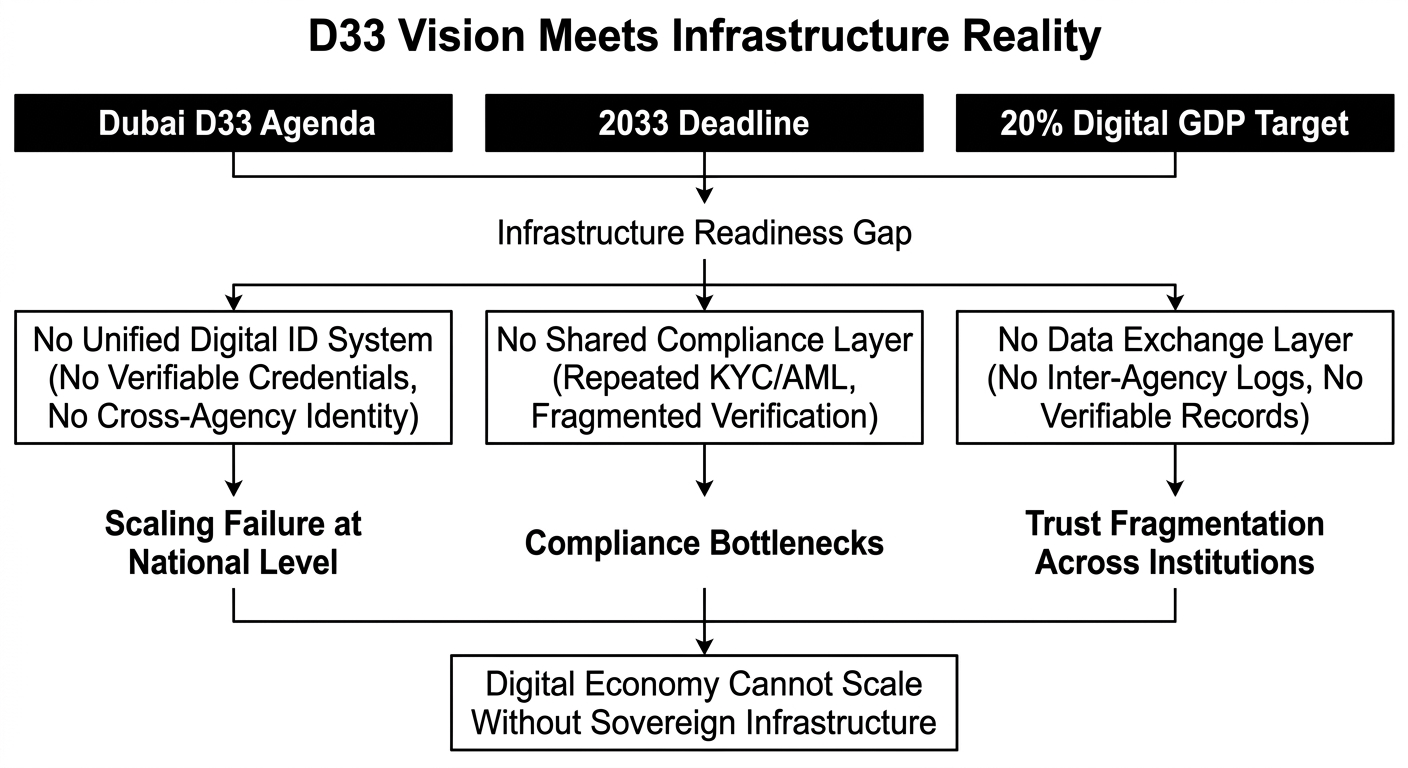
and that gap — between a government that has decided to digitize and the infrastructure layer that actually makes digitization work at national scale — is exactly where Sign is building.
the UAE is not an emerging market feeling its way toward digital governance. it is an economy that has already decided digital sovereignty is a policy outcome, funded it at the ministry level, and started asking the harder second-order question that most governments reach two years too late. not whether to build a Digital Money System and a Digital ID System. but whether the infrastructure underneath those systems is actually capable of carrying them when they go live at national scale, serving millions of users, processing real transactions, and sitting inside the compliance frameworks that banks and regulators and government agencies all depend on simultaneously.
on the market side, SIGN/USDT is currently priced at $0.05123, down 7.68% over the last 24 hours, with a session high of $0.05680 and a low of $0.05017. volume came in at 138.37 million SIGN tokens, translating to approximately $7.26 million USDT. the chart context matters here — Sign ran from a support level at $0.03906 in mid-March all the way to $0.055 range by March 21 to 23, a recovery of over 40% in roughly five days. today's pullback is happening with price still holding above the MA(99) at 0.04769 and the EMA(99) at 0.04586. the MA(7) at 0.05259 is beginning to flatten rather than roll over. this looks less like a trend reversal and more like a healthy consolidation after a strong recovery run. the structure that built from $0.03906 has not broken.
but the daily candle is still not the most interesting thing about Sign today.
what is more interesting is the specific infrastructure problem the UAE's D33 agenda has made visible that most digital economy strategies never name clearly enough. a government committing to 20% digital GDP contribution needs more than fast blockchains and stablecoin rails. it needs a sovereign identity layer where cryptographically signed claims can travel across every agency, every regulated operator, and every financial institution without losing their authority in transit. it needs a compliance architecture where KYC and AML verification is not rebuilt from scratch every time a new government service goes live. it needs a Data Exchange Layer where inter-agency interactions are recorded as verifiable, append-only logs without centralizing raw citizen data into a single point of failure.
"the gap between a digital economy strategy and a functioning digital economy is always the same gap. it is the infrastructure layer nobody budgeted for until the first system broke."
this is what makes Sign's B2G model structurally different from infrastructure projects still waiting for their first sovereign deployment. the proprietary technology that compounds inside a live government system — the edge cases encountered during a real CBDC rollout, the compliance gaps discovered when a Digital ID System meets legacy banking AML requirements, the trust registry anchoring problems that only appear when a government agency tries to verify a credential issued by a different ministry — none of that knowledge is acquirable from the outside. it only builds through deep integration, long iteration cycles, and the kind of institutional access that government contracts create and protect.
"the iteration loop is not a feature. it is the moat. and it only opens from the inside."
the Middle East understands this better than most regions right now. Saudi Vision 2030, the UAE's D33 agenda, Bahrain's open banking framework — these are not parallel experiments. they are converging sovereign commitments that need a shared infrastructure logic underneath them. a Digital Money System running CBDC and regulated stablecoin rails across Gulf economies. a Digital ID System issuing verifiable credentials that work across borders, across agencies, and across the regulated operators that citizens interact with every day. and above all of that, once the foundational systems are stable, sovereign AI — governance that stops being a bureaucratic process and starts being a software problem, where real-time data flows through programmable interfaces and the relationship between governments and citizens is direct, automated, and verifiable.
countries become companies. fiat becomes its stock. citizens becomes shareholders.
Sign is not describing that future as a vision statement. it is building the infrastructure stack that makes the vision a procurement decision — in the exact geographies where the decision to digitize has already been made at the highest level of government, with deadlines attached.
the D33 agenda has a 2033 deadline. the infrastructure underneath it needs to be ready before the economy it is supposed to carry gets there.
that is not a long window. and it is not the kind of deadline that waits for the sovereign infrastructure layer to figure itself out. 🤔
#SignDigitalSovereignInfra $SIGN
