
I’ve spent the last three days going through EthSign’s documentation, and there’s one tension I keep coming back to — something the product pages don’t really address, but feels central to how this actually plays out in the real world.
At a glance, the value proposition is clear and honestly pretty compelling. Legal agreements backed by cryptographic proof of execution. Multi-party signing workflows. An immutable on-chain record that shows exactly who signed what, and when.
For use cases like government procurement, enterprise contracts, or compliance acknowledgements — this makes a lot of sense. These are areas where traditional paper-based processes are slow, costly, and often messy when disputes arise. Moving that layer on-chain strengthens trust, reduces friction, and creates a much clearer audit trail.
But here’s where things get interesting.
Legal systems themselves are not immutable.
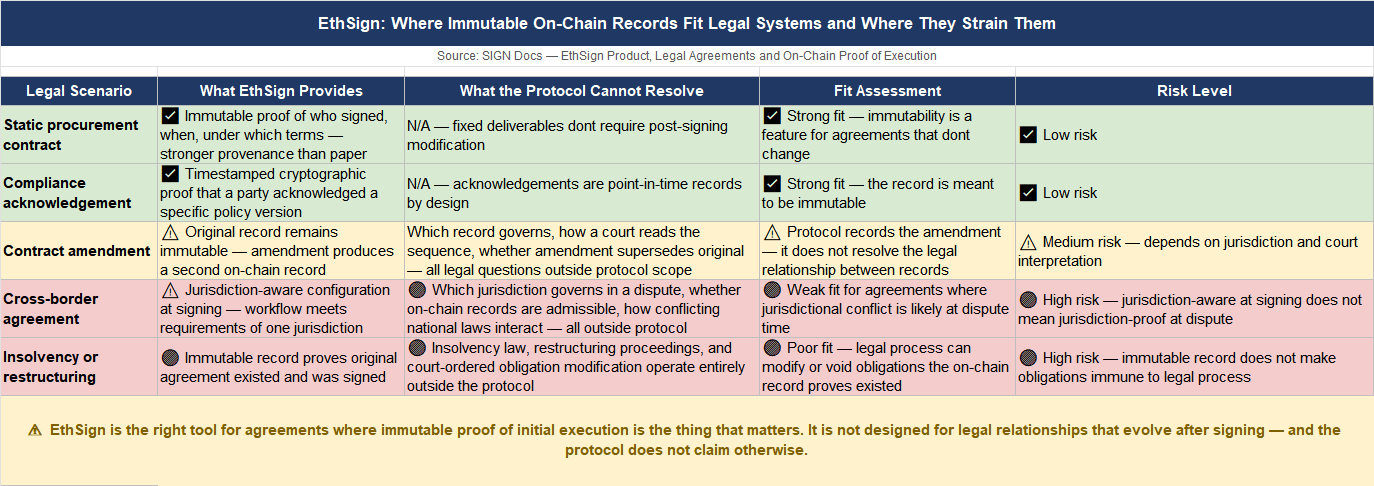
Contracts don’t exist in a vacuum where “signed” means “final forever.” In reality, contracts are often just the starting point of a relationship. They get disputed. Interpreted differently by courts. Modified later by mutual agreement. Sometimes one party becomes insolvent, and obligations are restructured. Sometimes external events trigger clauses like force majeure.
And when agreements span across borders, jurisdictions can even disagree on how those contracts should be interpreted or enforced.
So while EthSign creates an immutable record of execution, that record doesn’t — and realistically can’t — determine how a court will treat that agreement later if something goes wrong.
The documentation mentions being “jurisdiction-aware,” which is actually an important detail. In practice, this means the signing workflow can be configured to meet the requirements of a specific legal environment — who signs, in what order, with what type of verification. That’s valuable because it ensures the agreement is valid at the time of execution within a given legal framework.
But that still leaves a gap.
There’s a difference between something being evidentially strong and being legally decisive over time. A contract that meets all jurisdictional requirements when it’s signed might later face a legal system that has changed its stance on digital records or on-chain evidence.
And then there’s the question of change.
If two parties decide to amend an agreement after it’s already been signed through EthSign, the original record doesn’t go away. It stays there, permanently. Any modification would likely create a second record. But how those records relate to each other — which one supersedes the other, how a court interprets the sequence — that’s not something the protocol can resolve. That’s still a legal question.
And to be fair, EthSign doesn’t claim to solve that.
What it does solve — and solves well — is the proof layer.
The ability to clearly establish who agreed to what, and when, is significantly stronger than traditional paper systems. There’s real value in that, especially for agreements that are meant to be static. Things like one-time authorizations, compliance acknowledgements, or fixed procurement contracts benefit directly from immutability. In those cases, the “unchangeable” nature of the record is a strength, not a limitation.
But for more dynamic legal relationships — the kind that evolve, adapt, and sometimes break — it’s less clear.
That’s the question I keep coming back to:
Is EthSign best understood as a universal infrastructure for all agreements, or as a highly effective tool for a specific category of contracts where immutable proof of execution matters most?
Because immutability is powerful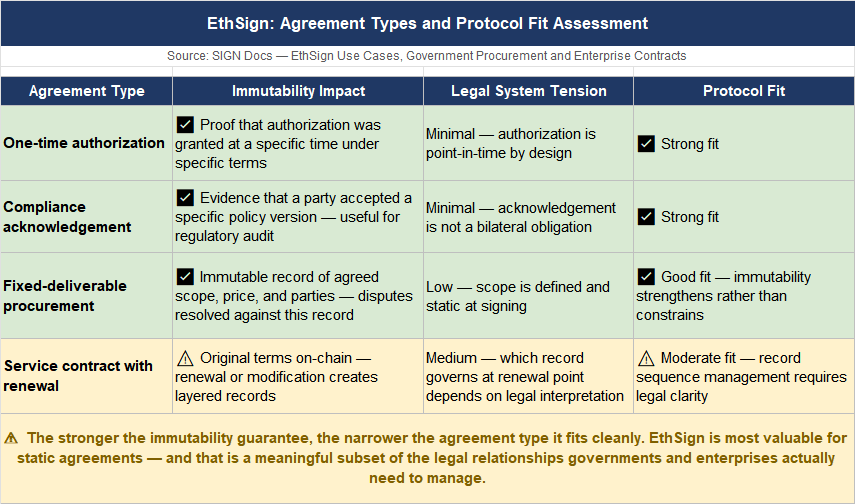
 but law, by design, needs room to move.
And somewhere between those two ideas is where the real story is. 🤔