

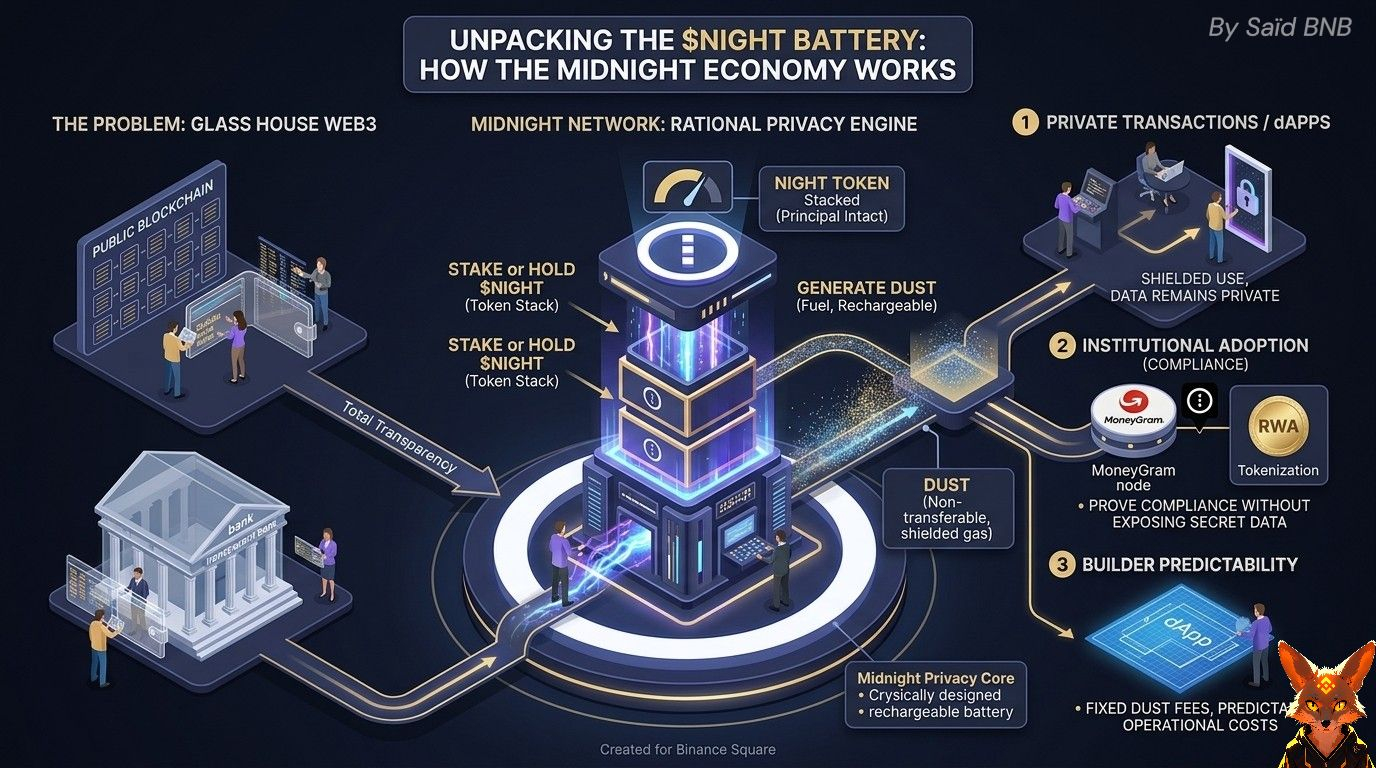
Let's be honest for a second, we all love the ethos of Web3—the sovereignty, the decentralization, the freedom. But there is a massive, uncomfortable elephant in the room that we rarely talk about: the glass house problem.
Right now, using a public blockchain is the financial equivalent of taping your bank statement to your forehead and walking down a busy street. Sure, the network is secure, but everyone can see exactly what you hold, who you transact with, and when. For years, we accepted this total transparency as the unavoidable "cost of doing business" in crypto.
If you wanted privacy, you had to use shadowy networks that regulators absolutely despised.
But what if you didn't have to choose?
As we close out March 2026, the conversation is aggressively shifting. The highly anticipated Midnight Network mainnet (Kūkolu phase) has officially arrived, and it’s bringing a concept called "Rational Privacy" to the forefront.
I’ve been diving deep into how this Cardano-partnered chain operates, and its native token, $NIGHT, is utilizing an economic model that is genuinely different from anything else trading on Binance right now.
Think of traditional gas tokens. You buy them, you use the network, and your tokens are burned or paid to validators. Your stack constantly bleeds.
Midnight flips this completely on its head through a dual-component system. Here’s the story of how it works:
Imagine $NIGHT not just as a standard crypto asset, but as a rechargeable battery. When you hold $NIGHT, you don't actually spend it to execute smart contracts. Instead, simply holding the token automatically generates a secondary, shielded resource called DUST.
DUST is the actual fuel. It is non-transferable, cannot be traded, and—here’s the kicker—it slowly decays over time if you don't use it. You spend the DUST to pay for your private transactions, while your principal $NIGHT stack remains completely intact, sitting safely in your wallet and maintaining your voting rights.
This is a massive breakthrough for both retail users and institutional players.
If you are a developer building a dApp, you can just hold enough NIGHT to generate the DUST needed to cover your users' fees.
It allows for predictable operational costs without the wild volatility spikes we see on other chains.
From a broader market perspective, this is exactly what the industry needs to unlock the next wave of adoption.
Think about the explosive growth we are seeing in Real-World Asset (RWA) tokenization and PayFi. Institutional giants and compliance-heavy businesses cannot operate on fully transparent ledgers.
They need to prove compliance without exposing trade secrets. Midnight's use of zero-knowledge cryptography allows you to prove you are solvent, or over 18, or holding a specific asset, without actually revealing the underlying data.
It’s no wonder that massive traditional finance players, like the global remittance giant MoneyGram, are already stepping up as early node operators to secure the network.
They see the writing on the wall.
With NIGHT gaining serious momentum and the mainnet gates finally opening, we are moving past the era where privacy was seen as a regulatory red flag. Instead, it is becoming the fundamental bedrock for the future of digital finance.
The glass house is finally getting curtains, and the market is paying attention.
Have you looked into $NIGHT yet, and do you think this "renewable battery" token model will become the new standard for Web3?
Let's discuss in the comments below 👇