
@SignOfficial keeps turning up at the exact point where every national digitization project runs out of answers.
not at the strategy phase. not at the budget phase. not even at the technology selection phase, because by the time a government has committed to building digital money systems and sovereign identity infrastructure at national scale, those decisions are already behind it.
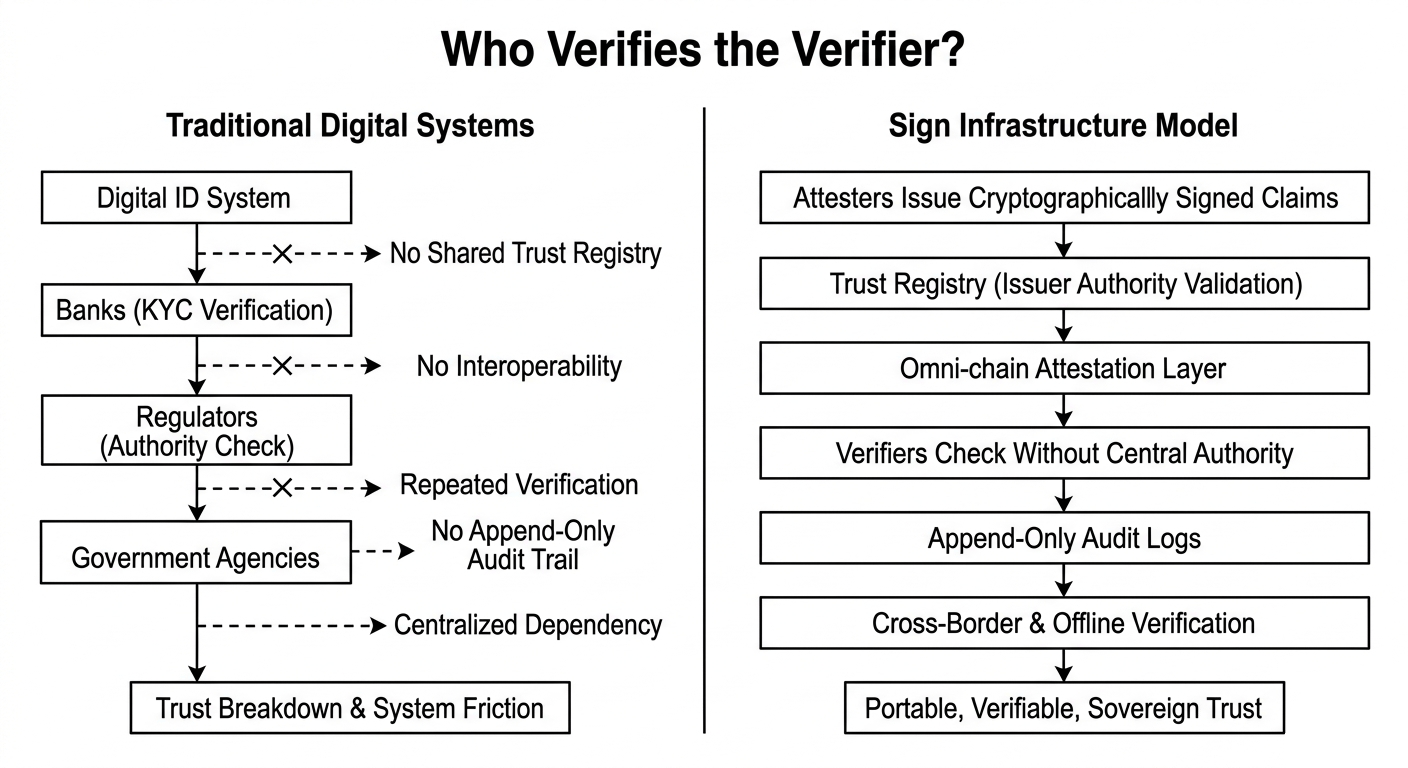
the point where things stall is quieter than all of that. and it is always the same point.
who verifies the verifier?
a Digital ID System issuing verifiable credentials to citizens needs banks to trust those credentials. banks need regulators to confirm the issuance authority. regulators need an audit trail that is inspection ready, append only, and consistent across every agency that touched the record. citizens need the whole thing to work at the point of use — offline if necessary, across borders when required, without a government call centre sitting in the middle of the transaction.
that is not one technical problem. it is five institutional problems wearing one technical coat.
on the market side, SIGN/USDT is currently trading at $0.04176, down 18.41% over the last 24 hours, with a session high of $0.05248 and a low of $0.04169. volume reached 215.82 million SIGN tokens — the highest in recent sessions — translating to approximately $9.85 million USDT. elevated volume on a sharp red day is worth paying attention to. it suggests an active repricing event rather than a low-liquidity drift. the MA(7) sits at 0.05253 and the MA(25) at 0.04782, with price now approaching that second level as the next meaningful support zone. the MA(99) at 0.04712 sits just below it, and the $0.03906 level that held through mid-March consolidation remains the structural floor. the chart architecture has not broken. what is being tested today is how deep this correction wants to go before buyers return.
but the token price is not where Sign's real story is being written right now.
the story is in what Sign already proved at scale before any government contract was signed. TokenTable — Sign's token distribution engine sitting inside the broader sovereign infrastructure stack — has distributed over $4 billion across more than 40 million on-chain wallet addresses, serving over 200 projects. that number is not a projection. it happened. and the operational knowledge embedded inside that execution is the thing that cannot be purchased off a shelf.
how do you prevent duplicate claims at scale. how do you verify recipient eligibility without centralizing sensitive data. how do you run high-volume distributions with a full inspection-ready audit trail intact from start to finish. how do you make a trust registry work when the issuers are government agencies operating in different ministries with different data systems and different compliance requirements.
these are not architecture questions. they are iteration questions. and they only get answered by a team that has been inside live sovereign systems long enough to find the edges.
"Sign did not pitch governments on blockchain. it showed up with $4 billion of evidence that the infrastructure already works."
that is the B2G moat that most analysis underweights. winning the first government contract is hard. but the proprietary technology that compounds inside each deployment — the compliance edge cases, the identity anchoring problems, the inter-agency data conflicts that only surface when a system goes live at national scale — that is the part that makes Sign structurally harder to displace with every passing quarter.
Sign is already active in the UAE, Thailand, and Sierra Leone. it has signed a technical agreement with the National Bank of Kyrgyzstan for the Digital SOM — a CBDC pilot targeting full issuance consideration by end of 2026. the expansion plan covers more than 20 countries. and $15 million in annual revenue means this is not a project surviving on fundraising cycles. it is a B2G infrastructure company with a real commercial model, real deployments, and the kind of long-term contracts and high switching costs that sovereign infrastructure creates naturally once it is embedded deep enough.
the Middle East is where this embedding is happening fastest. economies across the Gulf are not asking whether to build digital money systems and sovereign identity layers. they are asking who has already built them, who has the iteration depth to carry them at national scale, and who can produce inspection-ready evidence when the regulator asks for it.
"government budgets do not move with crypto cycles. once the infrastructure is inside, it stays inside."
the question of who verifies the verifier does not get answered by a whitepaper. it gets answered by a system that has already processed millions of cryptographically signed claims, maintained a trust registry across multiple sovereign deployments, and produced audit trails that regulators in multiple jurisdictions have actually opened and checked.
Sign is not describing that system anymore.
it is running it. and today's price does not change the depth of the moat underneath it. the governments that figure that out early will not be switching later — because replacing sovereign infrastructure is not a procurement decision.
it is a national risk event. 🤔
#SignDigitalSovereignInfra $SIGN
