Todos estão debatendo qual blockchain vai vencer.
Empresas reais já fizeram sua escolha — e não foi baseada em ideologia.
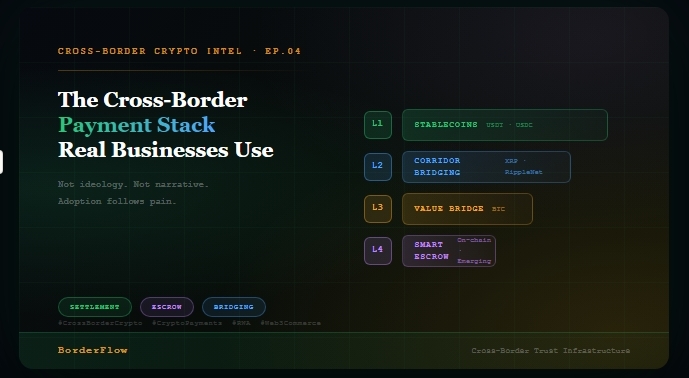
Depois de um ano trabalhando dentro de corredores de comércio transfronteiriço — abastecimento da China, assentamentos habitacionais europeus, armazenagem global — aqui está a pilha de pagamentos real que vemos as empresas usando agora.
Camada 1: Stablecoins para liquidação (USDT, USDC)
O padrão. Sem debate, sem drama. Fornecedores confirmam recebimento, compradores travam a base de custo, agentes são pagos. Funciona. USDT domina os corredores da Ásia, USDC está ganhando na Europa onde a conformidade é importante.
Camada 2: XRP / RippleNet para ponte de corredores
Quando a contraparte não tem uma carteira de criptomoeda, mas precisa de uma liquidação mais rápida que a do SWIFT, o RippleNet preenche a lacuna. Vemos isso especialmente na faixa de €50K–€500K em transações B2B entre importadores europeus e fornecedores asiáticos.
Camada 3: BTC como ponte de valor de última instância
Quando nenhuma das partes confia na infraestrutura de stablecoin da outra, o BTC é usado como uma camada de liquidação neutra. O remetente envia, o receptor converte imediatamente. Não é investimento — pura utilidade.
Camada 4: Escrow de contrato inteligente (emergente)
A camada mais empolgante. Ainda é cedo, ainda é desajeitada — mas as empresas que tentaram o escrow on-chain para acordos comerciais não voltam atrás. A liberação de pagamento baseada em marcos remove a maior lacuna de confiança no comércio transfronteiriço: "Eu pago antes de enviar, ou você envia antes de eu pagar?"
O que NÃO está sendo usado:
A maioria dos protocolos DeFi. Instrumentos de comércio baseados em NFT. A maioria das soluções L2 — não porque sejam ruins, mas porque os fornecedores em Guangzhou não estão solicitando-os.
O padrão: a adoção segue a dor, não a narrativa.
A dor está na liquidação, confiança e fricção cambial.
A pilha que resolve essas três coisas é a pilha que vence.
💬 Qual camada mais te surpreende? O que você está vendo em seu corredor?
#CrossBorderCrypto #CryptoPayments #RWA #Web3Commerce #DeFi