
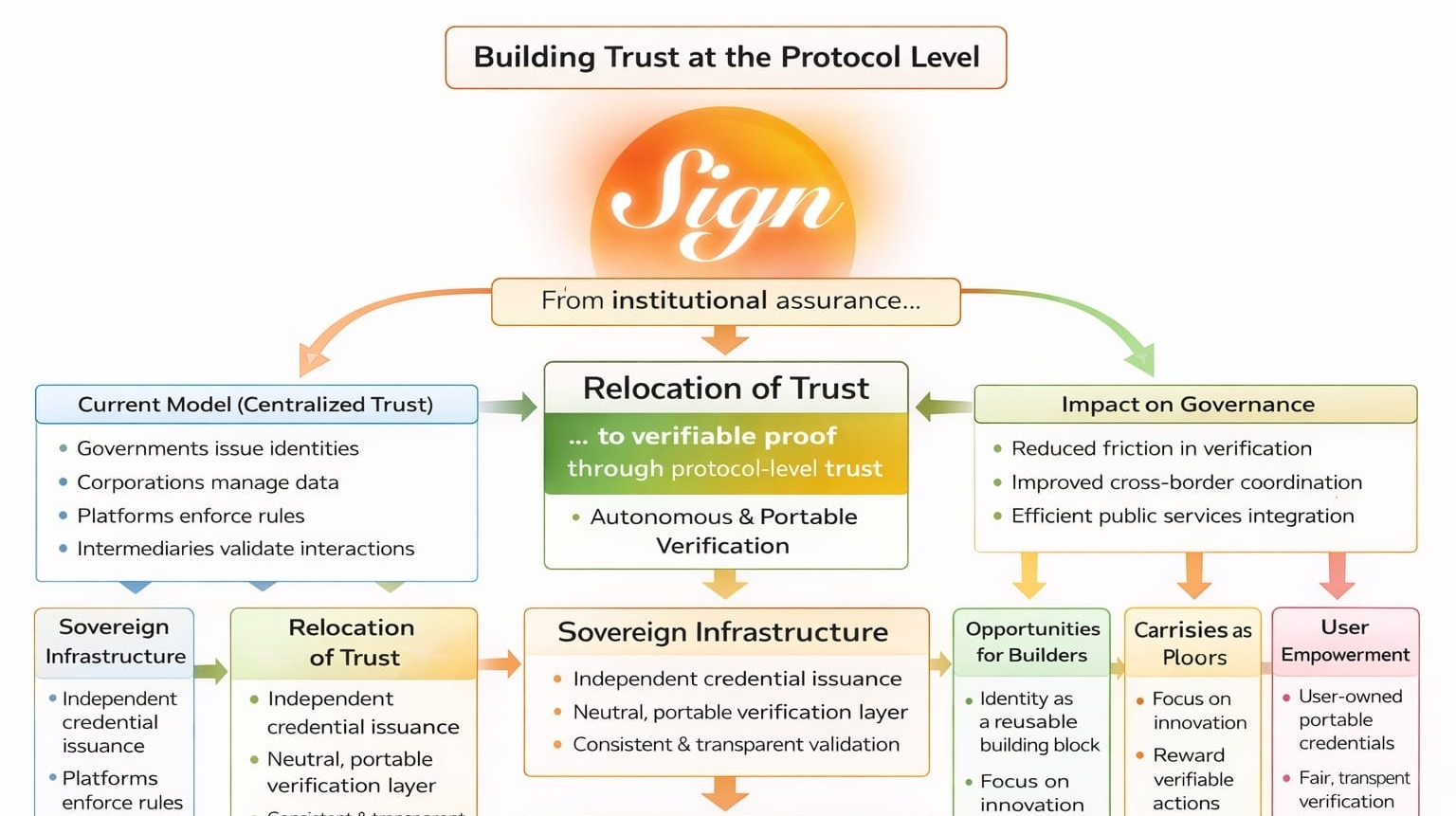
I’ve been thinking a lot about how trust actually works in digital systems, and the more I look at it, the more it feels like the real shift isn’t just decentralization it’s the relocation of trust itself. For a long time, we’ve leaned on institutions to play that role. Governments issue identities, corporations manage data, platforms enforce rules, and intermediaries validate interactions. It’s a model we’ve grown used to. But as everything becomes more digital and more global, cracks start to show. Information moves faster than traditional systems can verify it, and once interactions cross borders, the assumptions behind trust don’t always line up.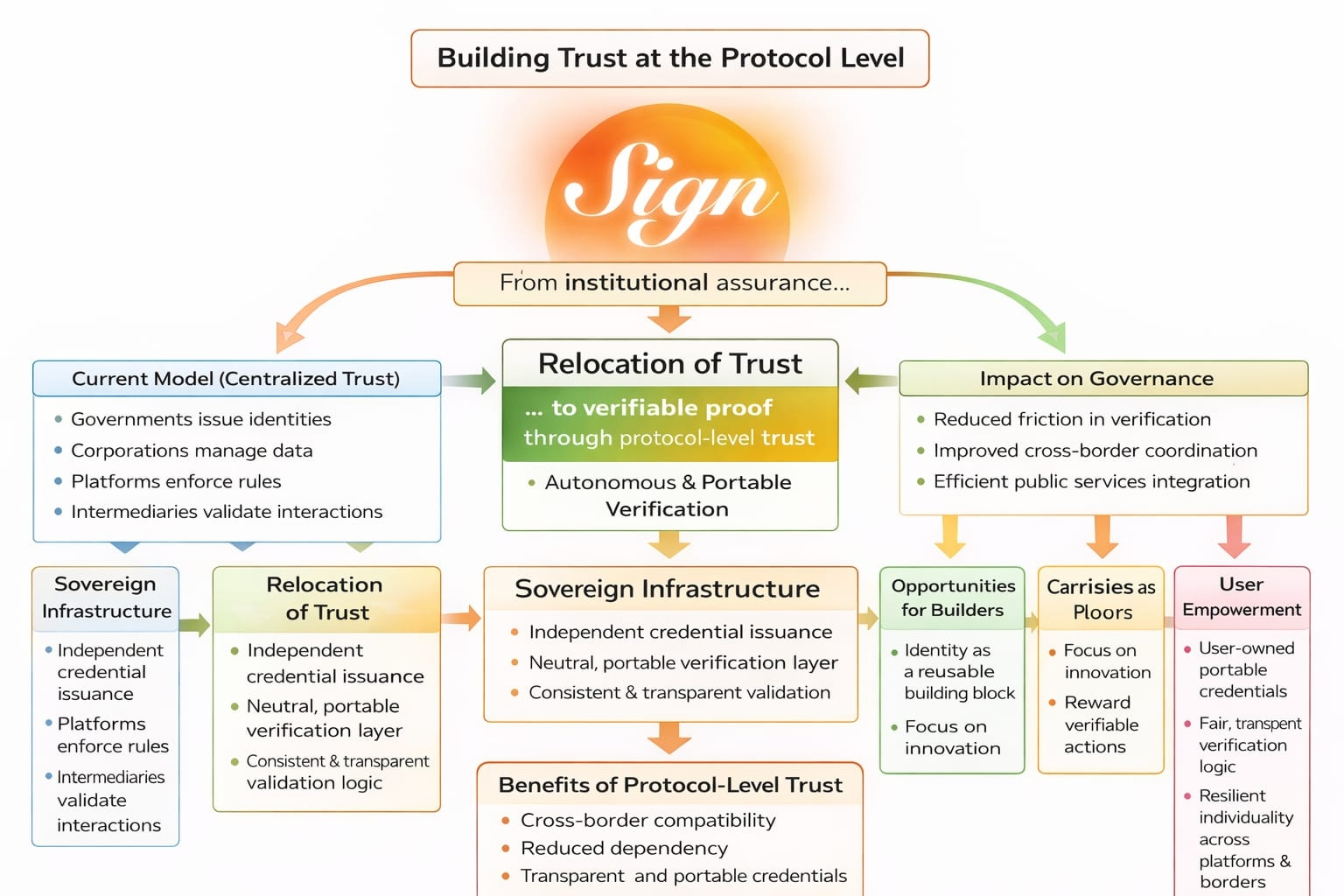
That’s where the idea of sovereign infrastructure starts to make sense to me. I don’t see sovereignty purely as national control, but more as autonomy the ability for individuals, organizations, and countries to define and verify things without depending on a single centralized authority. When trust is built into shared infrastructure, it becomes less about who you rely on and more about what can be independently proven. In that world, verification becomes portable, and credibility isn’t confined to one ecosystem.
This is why I find Sign interesting within this broader shift. What stands out is the way it reframes trust as something verifiable by design, rather than something granted by reputation alone. Instead of focusing on the issuer, the emphasis moves toward the proof itself. That small change has big implications. Credentials, attestations, and claims stop being tied to a single platform. They become portable signals that can be checked anywhere, regardless of where they originated. It’s a more flexible model, and it feels better suited to a connected world.
From a sovereignty standpoint, this matters more than it might seem at first glance. Many nations exploring digital identity or verification systems face a difficult choice. They can rely on centralized infrastructure built elsewhere, which introduces dependency, or they can create isolated systems that don’t easily interoperate. Neither option is ideal. Protocol-level trust offers a middle path. With a neutral verification layer, different entities can issue credentials independently while still sharing a common logic for validation. Everyone maintains control over what they issue, but the way those claims are verified remains consistent and transparent.
I also think this shifts how governance can function. When trust is embedded directly into the infrastructure, coordination becomes smoother. Instead of manual checks and fragmented processes, policies can reference verifiable claims. Cross-border initiatives could rely on shared attestations, and public services might operate more efficiently when eligibility can be proven without exposing unnecessary personal data. It doesn’t remove institutions from the picture, but it changes their role. They become participants in a shared trust framework rather than the sole gatekeepers.
For builders, this opens up a different design space. Identity and credibility stop being problems that need to be solved repeatedly. They become building blocks. Applications can rely on existing attestations, integrate verification more easily, and focus on what they’re actually trying to create. That lowers friction and encourages experimentation. It also nudges systems toward rewarding verifiable actions rather than closed-platform reputation, which feels like a healthier direction.
On the user side, the impact is quieter but meaningful. Credentials start to feel like something you own rather than something temporarily granted by a service. Trust becomes more portable, and that portability adds resilience. It also introduces a sense of fairness, since the rules for verification are transparent and not hidden inside proprietary systems. You’re not starting from zero every time you move between platforms or jurisdictions.
When I step back, building trust at the protocol level feels less like a technical improvement and more like a philosophical shift. It changes the foundation from institutional assurance to verifiable proof. It reduces dependency and strengthens autonomy. And as nations, organizations, and individuals continue digitizing identity and coordination, infrastructure like Sign points toward a future where credibility isn’t simply assigned it’s something that can be proven, carried, and trusted across borders without needing permission.
@SignOfficial #Sign #SignDigitalSovereinInfra $SIGN
