

Most token distributions do not fail because the smart contract breaks. They fail earlier, in quieter places, where no one is looking closely enough. A spreadsheet gets passed between teams and edited one too many times. A CSV file is exported from one dashboard, cleaned up by hand, then imported into another. An approval request sits in an inbox while a launch date inches closer. By the time the tokens actually move, the process behind them is already fragile.
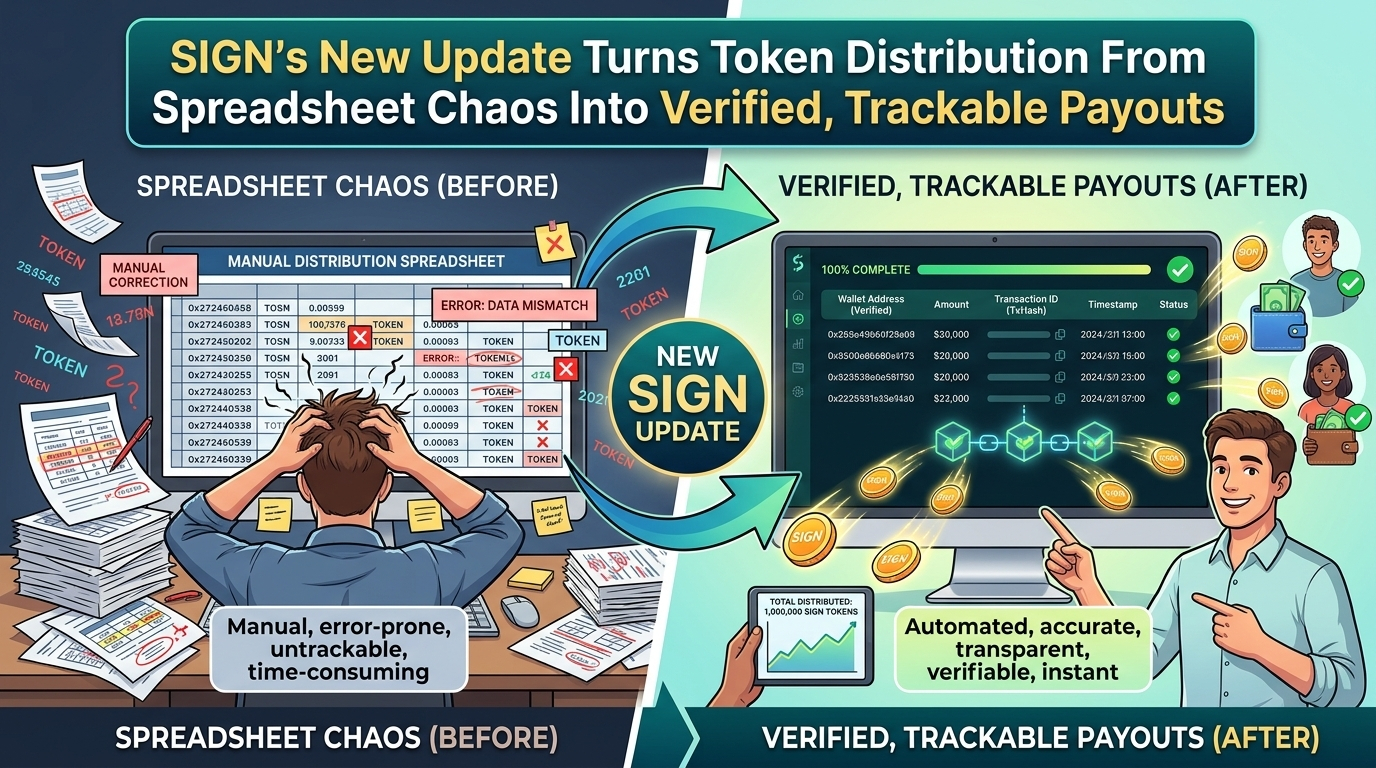
That is the part people tend to gloss over when they talk about distribution infrastructure. The public story is usually about the drop itself: who got paid, how much, whether the market liked it. The private story is more procedural and usually more important. Someone has to decide who qualifies. Someone has to verify that decision. Someone has to translate policy into a payout list. And someone has to explain, later, what happened when the numbers do not line up. In practice, those jobs often live in different systems, managed by different people, under different assumptions.
This is the gap SIGN’s upcoming release appears to be addressing. The idea, at least as it is being framed, is simple enough to understand without technical theater. First, a user proves the thing that matters for a given program. That proof could be about identity, membership, task completion, supply chain status, or some other condition. Then the payout logic follows from that proof inside the same flow, creating a record that can be checked afterward. Not a loose chain of screenshots and chat messages. A single path from eligibility to action.
That sounds modest on paper. In operational terms, it is not. Anyone who has been close to a token distribution knows how quickly small errors become expensive ones. A wrong wallet address is not a typo in the ordinary sense; it can mean funds sent somewhere irretrievable. A duplicate claim is not just an accounting issue; it becomes a trust issue, especially if others were excluded or delayed. A rule that seemed obvious during setup can become impossible to reconstruct a week later, once revisions, exceptions, and “temporary” fixes have piled up.
What makes these failures so common is not incompetence. It is fragmentation. Verification is treated as one job. Payment is treated as another. Tracking comes later, often as a scramble. Teams assemble a process from whatever is available: a form tool here, a wallet list there, maybe a script maintained by one engineer who also happens to be on call for something else. It works until the moment someone asks a plain question with real stakes behind it. Why did this wallet receive funds twice? Why was this user excluded? Which version of the rules was in force on the day the claim window opened?
Those are not edge cases. They are Tuesday afternoon questions. A finance lead asks because the books need to close. A compliance person asks because an exception was raised. A community manager asks because users are posting receipts in public. And too often the answers come from a patchwork of browser tabs, Discord threads, exported logs, and human memory. That is where confidence starts to fray—not because no one tried, but because the process was never built to be legible after the fact.
A more unified system has obvious appeal in that context. If verification and payout are linked from the start, the team is not reconstructing intent from artifacts later. They can inspect what was checked, when it was checked, and what that check triggered. That does not eliminate judgment. Someone still has to define eligibility. Someone still has to decide what counts as proof. But it reduces the number of handoffs, and handoffs are where ambiguity likes to hide.
The tracking side may be even more important than the payout side. Sending tokens is the visible act, but visibility is not the same as clarity. What teams often need after a distribution is not a blockchain explorer link. They need an internal answer they can stand behind. Who has claimed and who has not. Which wallets were approved but never completed the process. Whether a rule was applied consistently across the whole list or patched midway through. These are ordinary administrative questions, but in crypto they tend to get wrapped in unnecessary mystique, as if transparency on-chain solves everything by itself. It does not. Raw records exist. Interpretable records are another matter.
Still, tighter infrastructure creates its own pressures. A system that links proof to payout can reduce human error, but it also means errors propagate more cleanly. If the verification layer is wrong, the payout layer may be wrong at scale. A poorly designed eligibility rule does not stay contained; it becomes executable. That is not an argument against integration. It is an argument for being honest about where the real risk moves. Automation is often described as a safeguard. Projects want evidence they can revisit. Users may want minimum exposure beyond what is necessary to receive what they are owed. Those interests do not naturally align. Any system built around verification has to decide whether it is recording facts, proofs, metadata, or some combination of all three, and that decision matters. The difference between “we can confirm eligibility” and “we can map a person’s activity over time” is not academic. It is a design choice with consequences.
Even with those tradeoffs, the direction makes sense. The longer crypto operates in the real world—touching payroll, grants, rewards, supply chains, identity checks, contributor programs—the less room there is for improvisation disguised as infrastructure. At a certain scale, messy operations stop looking flexible and start looking careless. People do not mind a system being complex if it is coherent. What wears them down is complexity without accountability.
That is why a release like this lands less as a flashy product story and more as a practical one. It speaks to the part of the industry that has matured just enough to be embarrassed by its own back office. Not the market-facing drama, not the headline numbers, but the actual mechanics of getting decisions from one end of a process to the other without losing the plot. If SIGN can make that chain easier to verify, easier to audit, and harder to fudge with a late-night spreadsheet edit, it will be solving a problem many teams know intimately, even if they do not talk about it much in public.
And maybe that is the clearest measure of whether this kind of update matters. Not whether it sounds ambitious. Whether, a week after a distribution, someone can answer a simple question with a straight answer and a clean record to match.