
@SignOfficial #SignDigitalSovereignInfra $SIGN 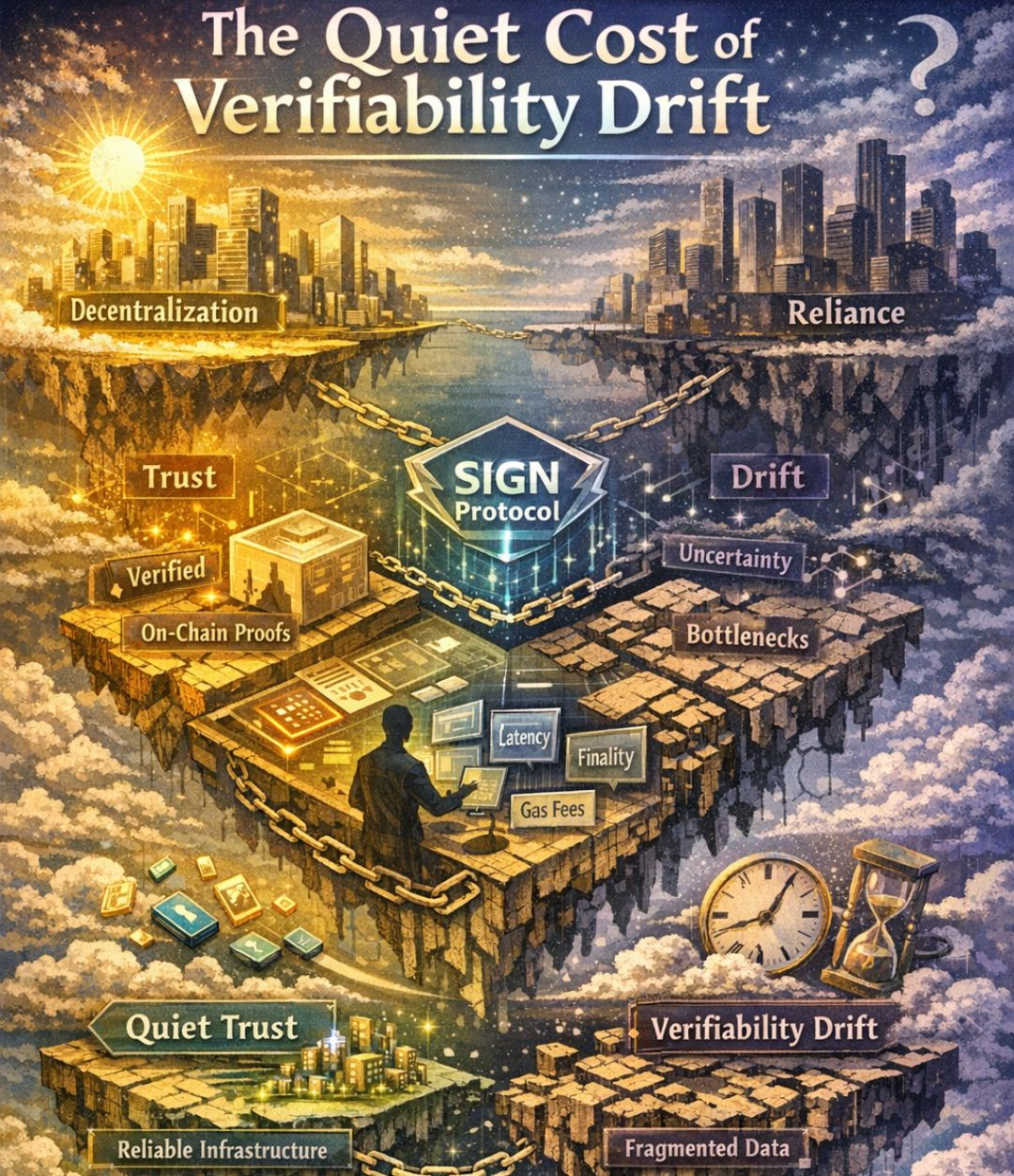 I’ve started to think of a subtle force in crypto markets that rarely gets named directly: verifiability drift. It’s the quiet gap between what a system claims to prove and what participants can actually trust in real time. Not a failure. Not even a flaw on the surface. Just a gradual misalignment between data, ownership, and execution that most users adapt to without noticing.
When I look at SIGN Protocol, what stands out to me is not just its ambition to standardize credential verification and token distribution, but the way it tries to compress that drift into something measurable and, ideally, reducible. Because in practice, decentralization begins to lose its meaning the moment the underlying data layer becomes abstracted away from the user’s control. You can sign transactions, hold keys, and interact permissionlessly, but if the credentials that gate access, identity, or rewards are anchored in semi-trusted layers, the system quietly reintroduces reliance.
You see this most clearly at the execution level. A trader doesn’t think in terms of ideology when placing an order or interacting with a distribution contract. They think in latency, confirmation, and finality. If an airdrop requires multiple signatures, delayed attestations, or unpredictable gas conditions, behavior adapts. Some rush. Some avoid. Others script around it. The friction becomes part of the market structure. SIGN’s attempt to formalize credentials into portable, verifiable units changes that dynamic slightly. It turns what is usually an off-chain assumption into something closer to an execution primitive.
But then the question becomes where that data actually lives.
If credentials are issued, stored, and verified through a system that leans on external availability layers or partially centralized indexers, the architecture inherits a trade-off. Availability improves, latency may decrease, but the trust surface expands. This is not inherently negative. It’s just a reality of scaling systems that need to operate under real-world constraints. What matters is how explicitly those assumptions are surfaced.
Underneath, SIGN’s infrastructure reflects a broader trend across modern chains: breaking data into smaller, more distributable components. Whether through blob storage, modular availability layers, or erasure-coded distribution, the goal is the same—reduce bottlenecks while preserving access. But distribution is not the same as ownership. If a validator set, or even a subset of operators, can influence the ordering, availability, or validation of credential data, then the system’s guarantees become probabilistic rather than absolute.
And yet, perfect decentralization is rarely the objective in practice. Predictability is.
From a market perspective, consistent block times and reliable confirmations matter more than theoretical throughput. I’ve seen trades fail not because the chain couldn’t handle load, but because oracle updates lagged by just enough to trigger cascading liquidations. A few seconds. That’s all it takes. In a system like SIGN, where credentials might gate access to distributions or rights, similar delays can compound. An outdated attestation, a delayed verification, and suddenly the user experience fractures. Not dramatically. Quietly.
This is where UX decisions start to shape psychology. Signing flows, gas abstraction, and execution batching aren’t just interface choices. They define how users perceive reliability. If interacting with credentials feels deterministic, users treat them as infrastructure. If it feels conditional, they treat them as opportunities—something to game, front-run, or avoid entirely.
SIGN’s token, in this context, isn’t just a coordination mechanism. It acts as a signal layer. Staking aligns validators or attestors with the integrity of the system, governance introduces adaptability, and distribution mechanisms feed back into usage. But incentives only work when the underlying assumptions are stable. If participants begin to question whether attestations can be delayed, reordered, or selectively unavailable, the token shifts from coordinating trust to compensating for its absence.
Liquidity adds another layer to this. Credentials tied to token distributions inevitably intersect with market flows. Bridges, oracles, and cross-chain liquidity paths introduce latency and fragmentation. A user claiming tokens based on a verified credential doesn’t just care about receiving them. They care about when, where, and how those tokens can be moved or sold. If bridging delays or oracle discrepancies interfere, the economic outcome changes, even if the credential itself is valid.
I keep coming back to stress scenarios because they reveal more than steady-state performance ever does. Imagine a period of network congestion where credential verification requests spike alongside trading activity. Gas fees rise, block inclusion becomes selective, and oracle updates lag. Now layer in a large-scale distribution event. Some users receive and act immediately. Others are delayed by seconds or minutes. That asymmetry creates micro-inefficiencies, and those inefficiencies aggregate into market behavior.
This is not a failure of the system. It’s a reflection of its design boundaries.
Compared to other high-performance environments, SIGN appears less focused on raw execution metrics and more on structuring trust around data itself. That’s a meaningful distinction. Some systems optimize for speed and parallelism, pushing execution as far as hardware allows. Others, like this, lean into the idea that what matters is not just how fast something executes, but whether what is being executed can be verified, reused, and trusted across contexts.
Still, the trade-offs remain. Partial centralization in data availability layers. Reliance on validator honesty. The complexity of maintaining consistent performance under variable load. These are not unique issues, but they are persistent ones.
What makes SIGN interesting is not that it solves them completely, but that it frames them differently. It treats credentials as first-class infrastructure, not peripheral metadata. That shift has implications. It means identity, access, and distribution are no longer loosely coupled—they become part of the same execution surface.
And that changes how participants behave.
Over time, the real structural test for SIGN won’t be how many credentials it issues or how many distributions it facilitates. It will be whether users begin to rely on those credentials without second-guessing their availability, timing, or integrity. Quiet trust. The kind that doesn’t need to be advertised.
Because in the end, infrastructure proves itself not when everything works, but when something breaks and the system absorbs it without distorting user outcomes.That’s where verifiability drift either widens or disappears.And that’s the test that matters.
@SignOfficial #SignDigitalSovereignInfra $SIGN
