
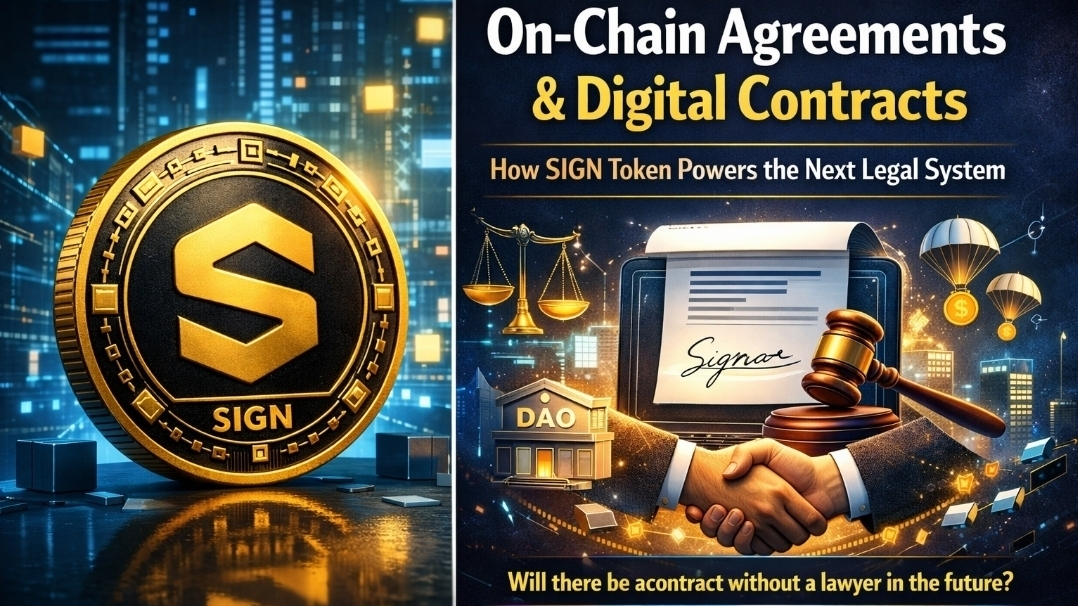

What if contracts… just stop needing lawyers?
Not disappear completely, but… what if most of the stuff we sign today — freelance gigs, token deals, even basic business agreements — just move on-chain and run themselves?
Sounds a bit extreme at first. I thought so too.
But after spending some time watching what Sign is building, I’m not as dismissive anymore.
At first, I wasn’t even looking at SIGN as anything special.
Just another token tied to some “infrastructure” project. We’ve seen hundreds of those. Most of them promise to fix something vague like “trust” or “data verification” and then fade into the background.
But Sign kept popping up in places I didn’t expect.
TokenTable here… some attestation use case there… projects quietly using it without making noise.
That got my attention.
What I noticed is that Sign isn’t trying to be flashy.
It’s doing two very specific things:
1. Verifying information on-chain (Sign Protocol)
2. Handling token distribution cleanly (TokenTable)
And weirdly… those two things connect more than I first realized.
Because when you strip contracts down to their core, they’re really just:
Agreements
Conditions
Proof that something happened
That’s it.
And Sign is basically turning those three pieces into something programmable.
The part that started to click for me was the “attestation” idea.
At first, I wasn’t sure why that mattered. It sounded like a fancy word for “proof.”
But then I started thinking about how messy verification is in crypto.
Who actually completed a task?
Who is eligible for rewards?
Who signed what, and when?
Right now, a lot of this still relies on centralized platforms or manual processes.
Sign changes that by letting these “truths” live on-chain.
Not just transactions… but statements.
That’s a subtle shift, but it’s big.
Now add TokenTable into the mix.
If you’ve been around long enough, you know how chaotic token distributions can be.
Airdrops delayed.
Vesting schedules unclear.
Unlocks handled in messy spreadsheets or opaque contracts.
TokenTable feels like someone finally said:
“Why is this still so manual?”
It automates distribution logic in a way that’s actually transparent.
And here’s where SIGN token quietly fits in.
It’s not trying to be flashy utility. It’s more like fuel for the system:
Signing contracts
Claiming rewards
Interacting with these on-chain agreements
Not exciting on the surface… but necessary if this ecosystem grows.
The bigger idea though… is what kept me thinking.
On-chain agreements.
Not just smart contracts that developers write, but actual human agreements that live on-chain.
Imagine:
A freelancer agreement where payment unlocks automatically when work is verified.
A DAO contributor deal where rewards are tied to provable actions.
A cross-border business contract that doesn’t need intermediaries.
No chasing payments.
No “he said, she said.”
No middle layer holding things together.
Just conditions + proof + execution.
After watching this for a while, I started to see why this narrative is getting attention.
It’s not about replacing lawyers overnight.
It’s about removing friction where trust is already fragile.
Crypto already operates globally.
But agreements? Still stuck in Web2 thinking.
That mismatch is real.
That said… I’m not fully convinced yet.
One thing that kept bothering me is adoption outside of crypto-native users.
It’s easy for us to say, “just sign on-chain.”
But for most people, even managing a wallet properly is still confusing.
Now imagine explaining:
“Your contract is an attestation stored across chains, and execution depends on predefined logic…”
Yeah… not exactly user-friendly.
Also, legal systems don’t move fast.
Even if the tech works perfectly, there’s still the question of recognition.
Will courts accept these agreements?
Will businesses trust them at scale?
That part doesn’t get solved by code alone.
Still… I can’t ignore the direction.
We’ve already seen money go on-chain.
Then identity.
Now agreements are starting to follow.
Sign isn’t the only one exploring this space, but it feels early in a way that reminds me of infrastructure plays before they became obvious.
Quiet. Slightly misunderstood. Not hyped enough.
And those are usually the ones worth watching a bit longer.
I don’t think contracts are disappearing anytime soon.
But I do think they’re changing shape.
Less paper. Less intermediaries. More logic.
And maybe, at some point, we stop asking:
“Do you trust this person?”
And start asking:
“Is this agreement verifiable?”
That shift… feels closer than people think.