
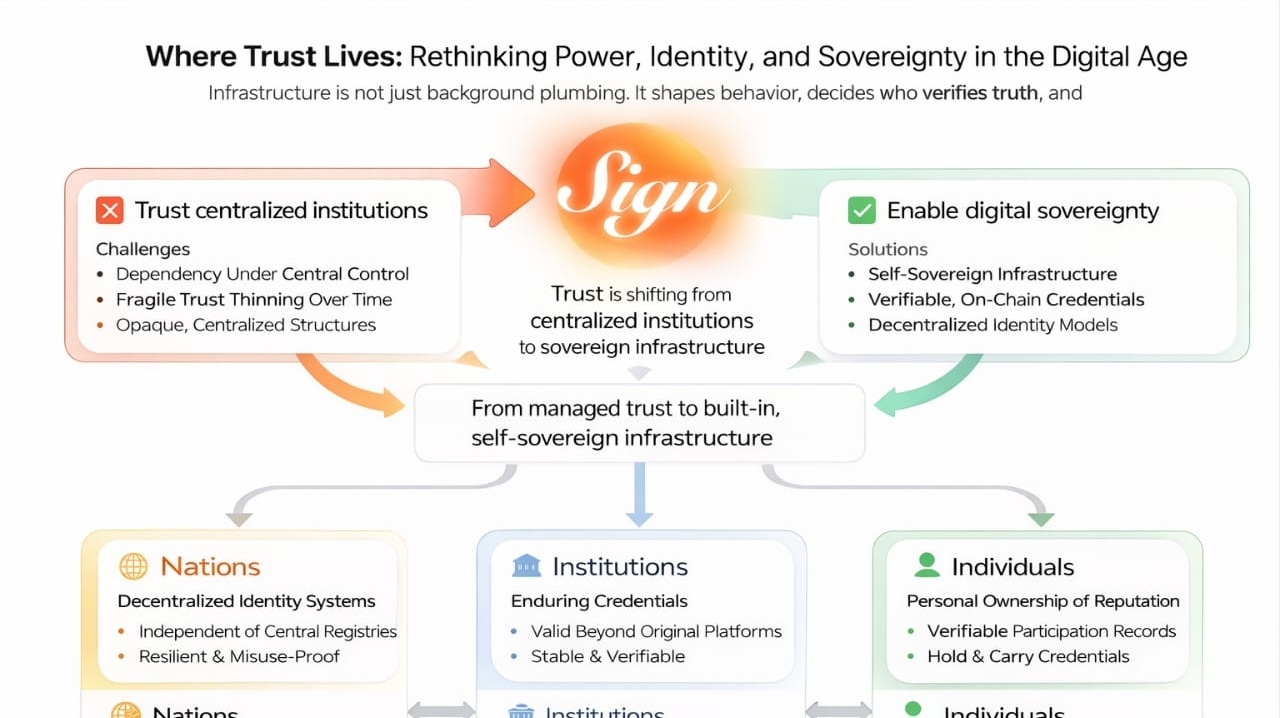
I didn’t come to the idea of digital sovereignty through theory or a single breakthrough moment. It built up slowly, almost in the background, from noticing something that didn’t quite sit right. So much of what we rely on every day our identity, our money, even our sense of credibility lives inside systems we don’t really control. For a long time, I didn’t question it. That was just the way things worked. Institutions held the records, platforms mediated trust, and we operated within those boundaries without thinking twice.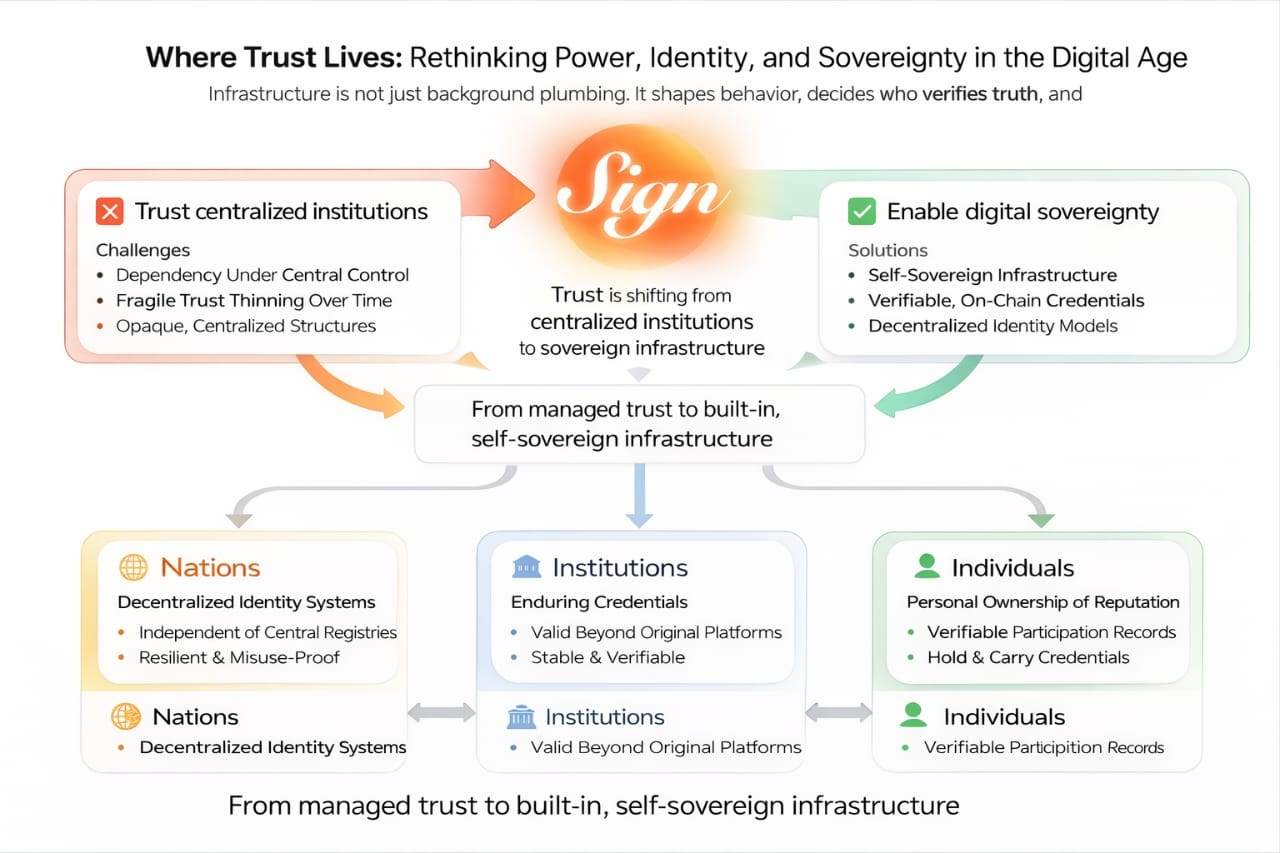
But over time, that sense of normality started to feel a little fragile.
As everything became more digital and more global, the cracks became harder to ignore. Work moved online, people began collaborating across borders without ever meeting, and entire systems of coordination started happening in real time. At the same time, trust in centralized institutions didn’t disappear, but it did start to feel less automatic. Not broken just thinner. That’s when the idea of sovereign infrastructure stopped feeling abstract and started to feel necessary.
The moment it really clicked for me was realizing that infrastructure isn’t neutral. It’s not just background plumbing. It shapes behavior. It decides who gets to verify what’s true, who gets included, and who has to rely on someone else’s word. Once you see that, it’s hard to ignore how closely infrastructure and power are tied together.
That’s where Sign stood out to me.
Instead of treating identity and verification as something issued and controlled by a central authority, it approaches them as something you can carry and prove yourself. Not in an abstract way, but in a way that’s actually verifiable. At first, terms like “cryptographic proofs” or “on-chain credentials” can sound distant, but the idea behind them is simple: trust doesn’t have to be granted anymore it can be demonstrated.
When I think about what that looks like in practice, it becomes much more real. A degree that isn’t locked inside a university database. A work history that doesn’t disappear when a platform shuts down. Participation in a community or governance process that can be verified without relying on a single organization to confirm it. These aren’t just improvements they change how credibility moves and who gets to own it.
And that shift carries real weight.
For nations, it opens the door to identity systems that aren’t dependent on a single centralized registry that can fail or be misused. For institutions, it means the credentials they issue can remain valid and verifiable beyond their own systems. For individuals, it creates a different relationship with reputation. Instead of being scattered across platforms, it becomes something you actually hold and carry with you.
We’re already starting to see early versions of this. Educational credentials issued on-chain, decentralized identity models being tested, governance systems experimenting with verifiable participation instead of opaque processes. None of this is fully mature yet, but the direction feels clear.
What keeps pulling me back to this space what genuinely holds my attention is that this isn’t just a technical shift. It’s a structural one.
We’re moving from a world where trust is managed for us to one where it’s built directly into the systems we use.
And if that continues, the real question won’t just be who we trust but whether the systems themselves are designed to deserve that trust.
@SignOfficial #Sign #SignDigitalSovereinInfra $SIGN
