
Some projects feel like noise, always trying to grab attention. SIGN doesn’t feel like that. It feels quieter, more focused, like something meaningful is being built in the background. Not just another trend, but something that actually tries to fix a real problem.
At first glance, the SIGN Leaderboard Campaign looks simple. You complete tasks, earn points, climb the ranks, and receive rewards. But when you slow down and really look at it, you realize it’s more than just a campaign. It’s a small glimpse into a bigger system where actions are verified, effort is measured, and rewards are distributed fairly.
SIGN, at its core, is trying to solve a very simple but powerful question: how do we know something is real on the internet? Every day, people claim things that they completed a task, that they own a wallet, that they deserve a reward. Most systems today rely on trust or weak verification. SIGN changes that by turning actions into proof. It creates something like a digital receipt for truth, where every action is recorded, verified, and can be checked at any time.
This matters more than people realize. The internet, especially in crypto, is full of systems that are not fully reliable. Airdrops get abused, bots take over reward campaigns, and genuine users often get left behind. Data is scattered, and different platforms don’t connect well with each other. SIGN is trying to clean this up by making everything provable instead of assumed. When something can be proven, fairness improves naturally, and manipulation becomes much harder.
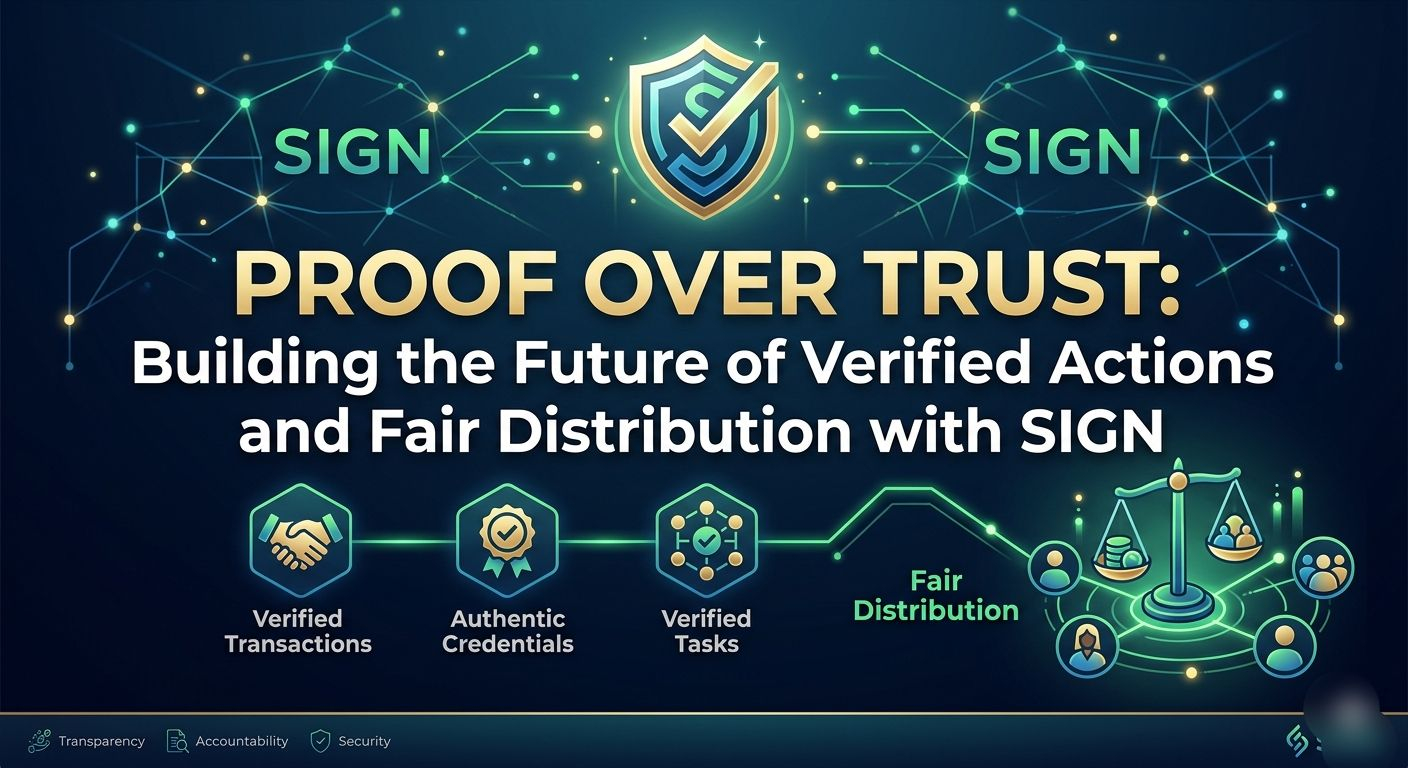
The way SIGN works is actually simple when you break it down. First, it defines clear rules for what is being tracked. Then, when a user performs an action, that action gets recorded. After that, it is turned into a verified proof. This proof is not just stored it becomes something useful. It can be checked, reused, and even used to trigger rewards. That’s where SIGN becomes powerful, because it doesn’t just store truth, it allows systems to act on it.
This is exactly what we see in the leaderboard campaign. Users complete tasks, their actions are verified, and then rewards are distributed based on real data. There is structure behind everything. Nothing is random. Tools like TokenTable make sure that rewards go to the right people, following clear rules. This creates a system where users can actually trust the outcome, which is rare in many digital campaigns.

The SIGN token itself plays a supporting role in all of this. It is not designed to represent ownership or control. Instead, it acts like fuel for the system. It helps power the creation of proofs, supports verification, and keeps the network running. This makes it feel more grounded, because its value comes from usage rather than just speculation.
If you zoom out and look at the bigger picture, SIGN is not just about campaigns or tokens. It is trying to build a complete system where identity, actions, and rewards are all connected. A place where people don’t have to rely on blind trust anymore, but can simply verify everything. Imagine a system where no one can fake participation, where rewards are always fair, and where every action has a clear and verifiable record. That is the direction SIGN is moving toward.
Of course, building something like this is not easy. There are real challenges. Adoption is a big one, because people are used to existing systems, even if they are flawed. The technology itself can be complex, and simplifying it for everyday users is not a small task. There are also regulatory pressures, especially when dealing with identity and financial systems. And like any growing project, scaling to handle millions of users smoothly is a constant challenge.
Still, what makes SIGN interesting is not just what it has built so far, but what it is trying to become. It is not chasing attention. It is building structure. The Leaderboard Campaign is just one example, a live demonstration of how a fair and verifiable system can work.
In the end, SIGN is about something deeper than technology. It is about making the internet feel more honest. A place where actions are proven, not assumed. Where rewards are earned, not manipulated. And where trust is no longer a guess, but something you can actually verify.