There’s a persistent belief in crypto that putting something on-chain automatically creates trust. Transparency, in this view, is treated as a cure-all. But after watching multiple cycles, it’s hard not to question that assumption. Visibility alone doesn’t guarantee accountability, and in many cases, it introduces new problems.
Earlier experiments made this tension clear. NFTs promised ownership clarity but often lacked real-world enforceability. DAOs aimed for open coordination, yet struggled with decision-making at scale. Privacy coins leaned toward secrecy, limiting institutional adoption. Across these models, systems became either too transparent to be practical or too opaque to be trusted.
This is where the deeper issue begins to surface. Real-world systems rarely operate at extremes. Businesses, regulators, and users often need to prove something is true without revealing everything behind it. A company may need to verify compliance without exposing internal data. An individual may need to prove identity without sharing full personal details. The challenge is not transparency or privacy alone, but how to balance both.
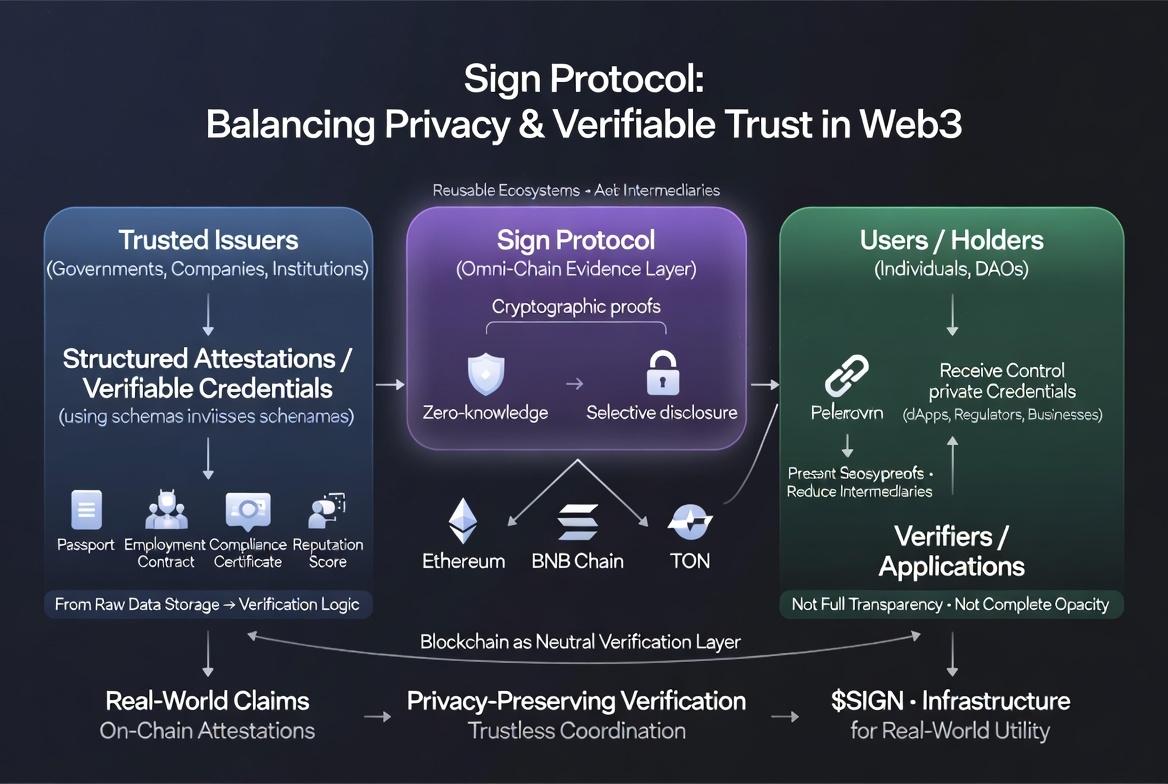
Infrastructure projects like @SignOfficial and $SIGN start to address this structural gap. Rather than forcing all data into public view or hiding it entirely, they explore controlled disclosure , systems where specific truths can be verified without exposing sensitive information. This shifts the focus from data storage to verification logic.
The idea is relatively simple, even if the technology is not. Instead of publishing raw data, systems rely on proofs. These proofs confirm that certain conditions are met, while keeping the underlying details private. It’s a model that allows applications to decide what should be public and what should remain hidden, creating a more flexible coordination layer.
In this context, blockchain begins to make more practical sense. It acts less as a public database and more as a neutral verification layer. It can provide shared records, auditability, and coordination without forcing every interaction into complete transparency. This opens the door for institutions to participate without compromising operational or regulatory requirements.
The implications are significant but not guaranteed. Verification costs could decrease. Cross-border coordination could improve. Trust between parties might rely less on intermediaries and more on cryptographic proof. But these outcomes depend on adoption, and adoption is rarely straightforward.
There are real challenges. Developer tooling remains complex. Regulatory frameworks are still evolving. Integrating new infrastructure into existing systems takes time and incentive alignment. Even well-designed systems can fail if they don’t reach practical usability.
Still, this is where long-term capital tends to concentrate. Not in short-lived applications, but in infrastructure that attempts to solve underlying coordination problems. If systems like Sign can effectively balance verification with privacy, they may push blockchain beyond experimentation and closer to real-world utility. But whether that shift fully materializes remains an open question.#SignDigitalSovereignInfra