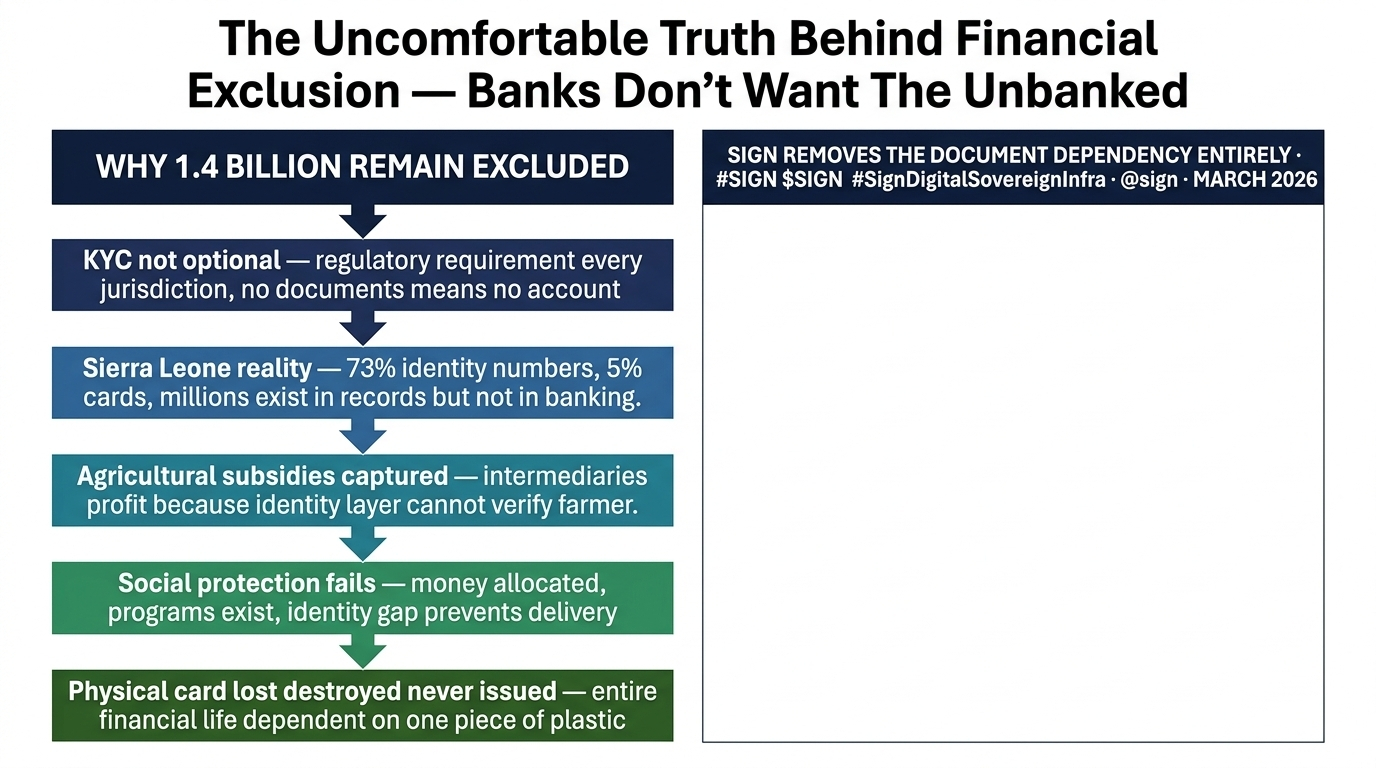
1.4 billion people still don’t have a bank account.
Most people assume the reason is simple — banks haven’t reached them yet.
Rural areas, weak infrastructure, limited branches, high fees.
That’s true.
But it’s not the full story.
The real reason is deeper.
And honestly, a bit uncomfortable.
Banks don’t exclude people because they are poor.
They exclude people who cannot prove who they are. #Sign @SignOfficial $SIGN

This Isn’t an Access Problem — It’s an Identity Problem
When we talk about financial inclusion, the focus is almost always on access.
Build more branches.
Expand mobile banking.
Lower the cost of services.
The assumption is that once financial systems reach people, the problem will solve itself.
But reality doesn’t work that way.
The system already exists.
Banks already exist.
Financial infrastructure is already in place.
The reason people remain outside the system isn’t because it hasn’t reached them —
it’s because they cannot enter it.
And there is only one gate:
Identity.
KYC — The Gatekeeper of the Financial System
In the formal financial world, one rule is non-negotiable:
KYC — Know Your Customer.
Every regulated institution, in every country, must verify identity before offering financial services.
That usually means:
A government-issued ID
Proof of address
A tax identification number
Sometimes even income verification
And this is where the problem begins.
Hundreds of millions of people simply don’t have these documents.
No registered address.
No formal paperwork.
No physical ID.
So the system responds in the only way it knows how:
No documents = No access.
It doesn’t matter how honest or hardworking someone is.
If they cannot prove their identity, they are locked out.
The Data Tells a Clear Story
According to the World Bank’s Findex database,
the biggest barrier for unbanked adults is not distance from a bank.
It’s the lack of documentation.
That’s the silent filter —
the invisible wall that keeps people out of the formal economy.
Sierra Leone — A Real-World Example
Take Sierra Leone as an example:
73% of people have an identity number
Only 5% have a physical ID card
Think about that gap.
Millions of people exist in government records.
They are counted. They are recognized.
But when they walk into a bank,
they cannot prove it.
Because they lack physical proof.
That gap isn’t just statistical.
It represents real exclusion.
When Identity Fails, Everything Else Breaks
This problem goes far beyond banking.
Government subsidies fail to reach the right people
Welfare programs leak or get misallocated
Intermediaries exploit the system
Funds never reach those who actually need them
The issue is rarely a lack of money.
The issue is verification.
If a system cannot confirm who someone is,
it cannot serve them effectively.
So What’s the Solution?
If identity is the problem,
then identity has to be the solution.
But not the traditional kind —
the one tied to plastic cards and paper documents.
Because that’s exactly where the system breaks.
The answer is:
Digital, verifiable, portable identity.
Where the Shift Begins
Imagine identity not tied to a physical document.
Imagine this instead:
A simple biometric scan.
Converted into a cryptographic proof.
No paper.
No physical dependency.
No repeated verification.
Just a secure, verifiable identity that works anywhere.
This isn’t theoretical anymore.
It’s already possible.
A Different Approach to Identity
This is where frameworks like Sign come in.
The idea is simple, but powerful:
Remove identity’s dependence on physical documents.
A person registers using whatever they have available:
A biometric scan
An existing identity number
Government validation
Or even a trusted witness
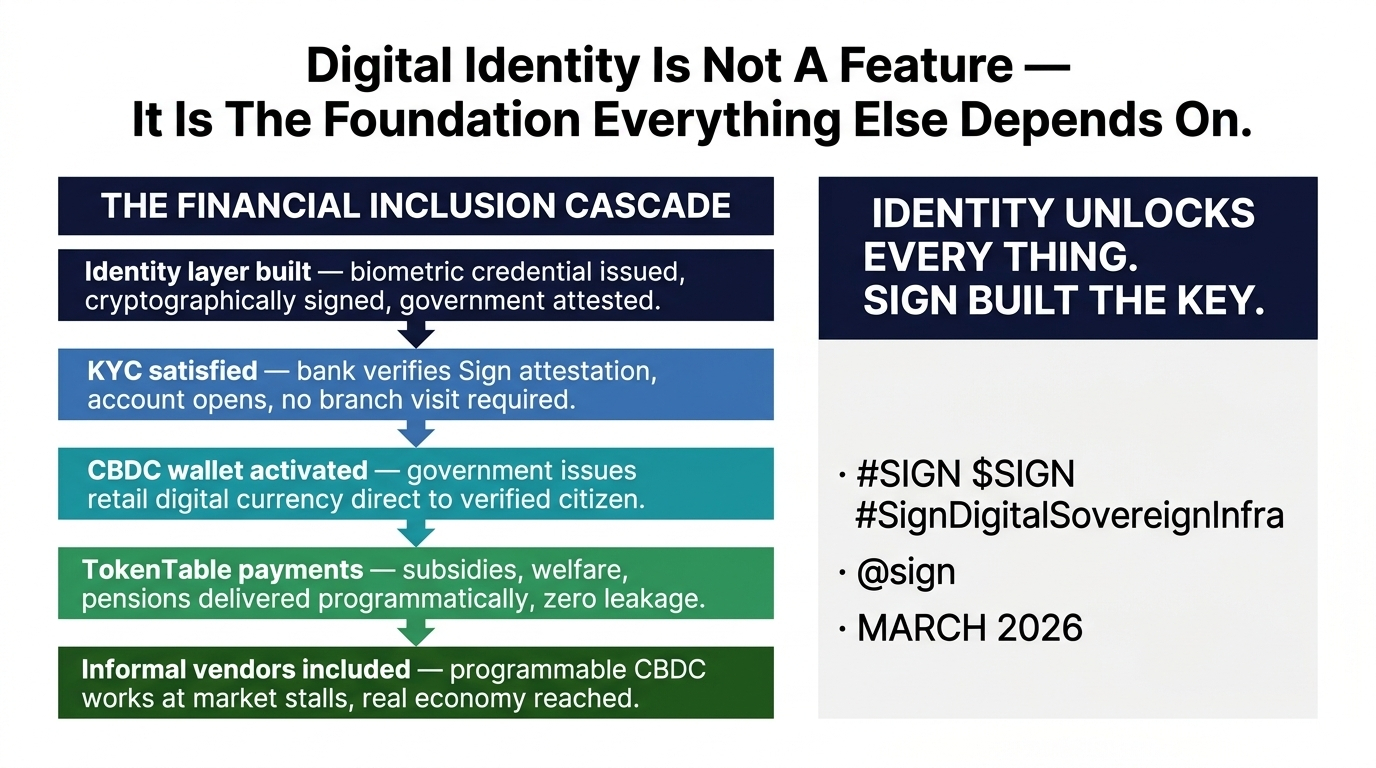
From that, the system issues a cryptographically signed digital credential.
This credential is:
Tamper-proof
Instantly verifiable
Globally usable
And most importantly:
It doesn’t rely on a physical card.
KYC — Reinvented
In the traditional system:
Documents → Verification → Approval
In the new model:
Digital identity → Cryptographic proof → Instant verification
A user presents their identity.
A bank verifies the proof.
The account opens.
No paperwork.
No branch visit.
No repeated checks.
Financial Access Finally Unlocks
Once identity is solved, everything else follows.
Bank accounts
Credit access
Insurance
Savings tools
People who were previously invisible to the system
suddenly become part of it.
The Role of CBDCs
Now add another layer:
Central Bank Digital Currencies (CBDCs).
Traditional banking comes with heavy infrastructure:
Physical branches
Regulatory overhead
High operating costs
This is why low-income and rural populations are often ignored —
serving them isn’t profitable.
CBDCs change that completely.
Governments can issue digital currency directly to individuals.
No bank account needed.
No branch required.
No minimum balance.
Just a verified identity and a digital wallet.
Programmability — The Real Advantage
This isn’t just digital money.
It’s programmable money.
That means:
Government payments can be targeted
Funds can be restricted to specific uses
Transactions can be tracked transparently
Leakage drops.
Efficiency increases.
Including the Informal Economy
Here’s something most systems ignore:
Low-income populations don’t rely on formal retail systems.
They rely on local vendors and informal markets.
Traditional banking struggles to include these participants.
But with digital identity and programmable payments:
Both parties can verify themselves
Transactions can happen directly
No POS machine needed.
No bank account required.
Just identity.
The Real Challenge — Devices
Of course, no system is perfect.
There’s still one real barrier:
Access to devices.
Digital identity requires a smartphone or similar device.
And in many underserved regions,
financial exclusion overlaps with limited access to technology.
Progress, Not Perfection
Solutions are already emerging:
QR-based identity sharing
NFC-enabled verification
Offline credential systems
These reduce dependency on constant connectivity
but don’t eliminate it entirely.
Still, it’s a step forward.
The Bigger Picture
When you zoom out, one thing becomes clear:
The infrastructure to include 1.4 billion people already exists.
Banks exist.
Money exists.
Systems exist.
The missing layer was always identity.
And That Layer Is Finally Being Built
Once identity works:
Financial inclusion becomes real
Government systems become efficient
Economic participation expands
This isn’t just about opening bank accounts.
It’s about bringing people into the global economy.
The Bottom Line
This was never just a banking problem.
It was never just an access problem.
It was always an identity problem.
And now…
That barrier is finally starting to break. 🔥