
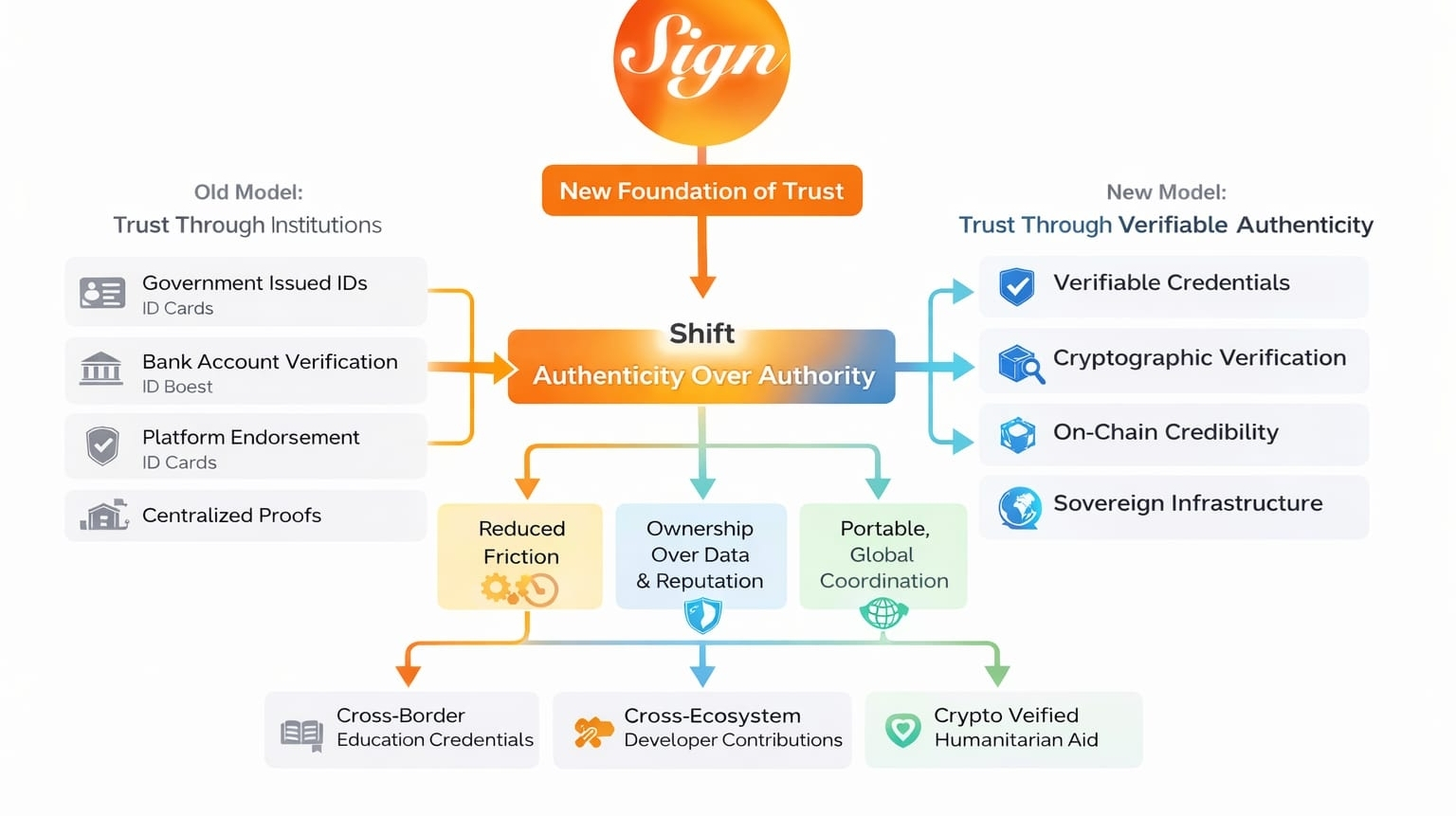
I used to think trust in digital systems was mostly about authority. Governments issued IDs, banks verified accounts, and platforms decided who was credible. If an institution said something was valid, we accepted it. That model worked for decades, but the more I looked at how global coordination actually happens today, the more I realized it’s starting to crack. Data moves instantly across borders, yet trust still depends on slow, siloed institutions. That mismatch is where the idea of sovereign infrastructure started to click for me.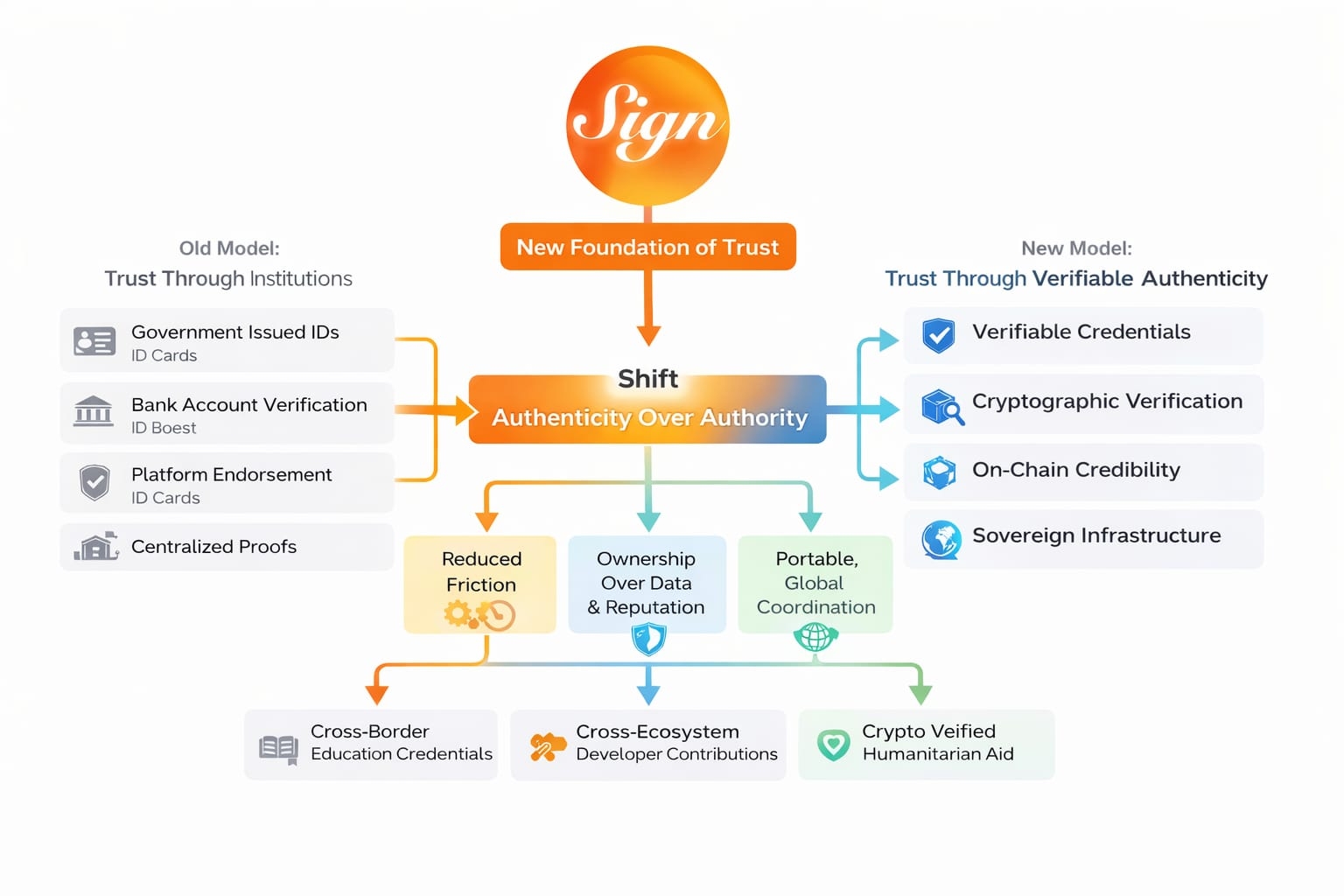
The shift became especially visible over the last few years. Remote work, global digital communities, cross-border payments, and online governance all accelerated. Suddenly, people needed to prove who they were, what they’d done, and what they were allowed to do without relying on a single authority. That’s when I began to see trust moving from institutional endorsement to verifiable authenticity.
This is where Sign started to make sense to me. Instead of asking, “Who approves you?” the question becomes, “Can this claim be cryptographically verified?” That’s a subtle but profound change. Sign focuses on verifiable credentials proofs that can confirm identity, participation, eligibility, or reputation without exposing unnecessary data. It’s not about replacing institutions entirely, but about reducing the friction and fragility of centralized trust.
Sovereignty in the digital age isn’t just a national concept anymore. It applies to individuals, communities, and even protocols. Nations want control over digital identity systems. Organizations want portable credentials that work across platforms. Individuals want ownership over their data and reputation. When infrastructure supports verifiable authenticity, power shifts from gatekeepers to participants.
What makes this tangible are real-world use cases. Imagine cross-border education credentials that can be verified instantly. Or a developer proving contributions across multiple ecosystems without relying on platform-specific profiles. Or governments coordinating humanitarian aid where eligibility can be confirmed cryptographically rather than through paperwork. These aren’t abstract ideas they’re emerging patterns.
The more I explored this space, the more I became almost obsessed with the idea that infrastructure quietly shapes power. Whoever controls verification controls participation. Traditional systems centralize that power. Sovereign infrastructure redistributes it. Sign fits into this shift by enabling on-chain credibility making claims portable, verifiable, and resistant to manipulation.
What changed my perspective was realizing that authenticity scales better than authority. Authority requires trust in institutions; authenticity requires trust in math and transparent systems. That doesn’t eliminate governance it changes how governance is built. Decisions become based on verifiable signals rather than opaque approvals.
We’re moving toward a world where identity, reputation, and eligibility aren’t locked inside databases but exist as verifiable layers of infrastructure. Nations, builders, and users all gain more flexibility when trust is composable rather than siloed. And once trust becomes infrastructure, coordination becomes easier, faster, and more inclusive.
I keep coming back to one thought: the future of sovereignty may not be decided by who holds authority, but by who builds systems where authenticity can be proven by anyone, anywhere.
@SignOfficial #sign #SignDigitalSovereinInfra $SIGN
