
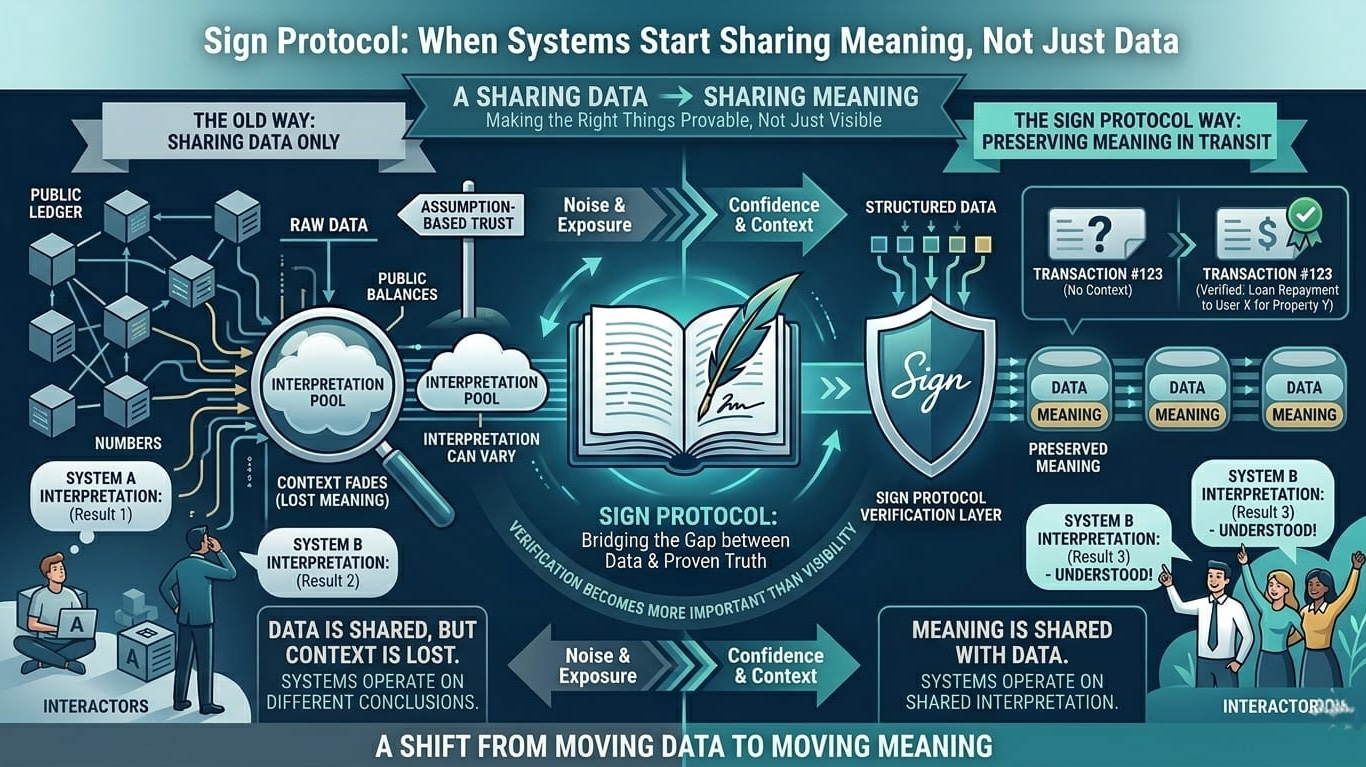
One thing I’ve been thinking about is how most systems today are actually good at sharing data, but not so good at sharing meaning. You can move information anywhere across chains, across platforms but once it leaves its original environment, something gets lost. The numbers are still there, the records are still there, but the context behind them fades. And without context, data doesn’t carry much value. That’s where Sign Protocol started to click for me not as a tool for identity or compliance, but as a way to preserve meaning when information moves between systems.
Right now, when one system looks at another, it mostly sees raw output transactions, balances, interactions. But it doesn’t really understand what those things represent. It has to interpret them, and that interpretation can vary. That’s where inconsistencies come from. Two systems can look at the same data and still reach different conclusions. What Sign does differently is structure certain pieces of information in a way that keeps their meaning intact. Instead of just moving data around, it carries a verified statement along with it something that explains what that data represents and why it matters.I think this changes how systems connect over time. Instead of guessing or rebuilding context every time, they can just refer to something that already explains it clearly. It makes things less about interpretation and more about actually understanding what’s going on. And the good part is, it doesn’t force everything into one system.
Each environment can still operate on its own terms, but when they need to interact, they have a shared way of interpreting specific pieces of information.
At a broader level, this feels like a shift from moving data to moving meaning. And that difference might end up being more important than it seems.
#signdigitalsovereigninfra @SignOfficial $SIGN
