2026 Strategic Market Outlook: Navigating the Infrastructure Discount and Regulatory Inflection
1. The 2026 Market Regime: From Euphoria to Extreme Fear
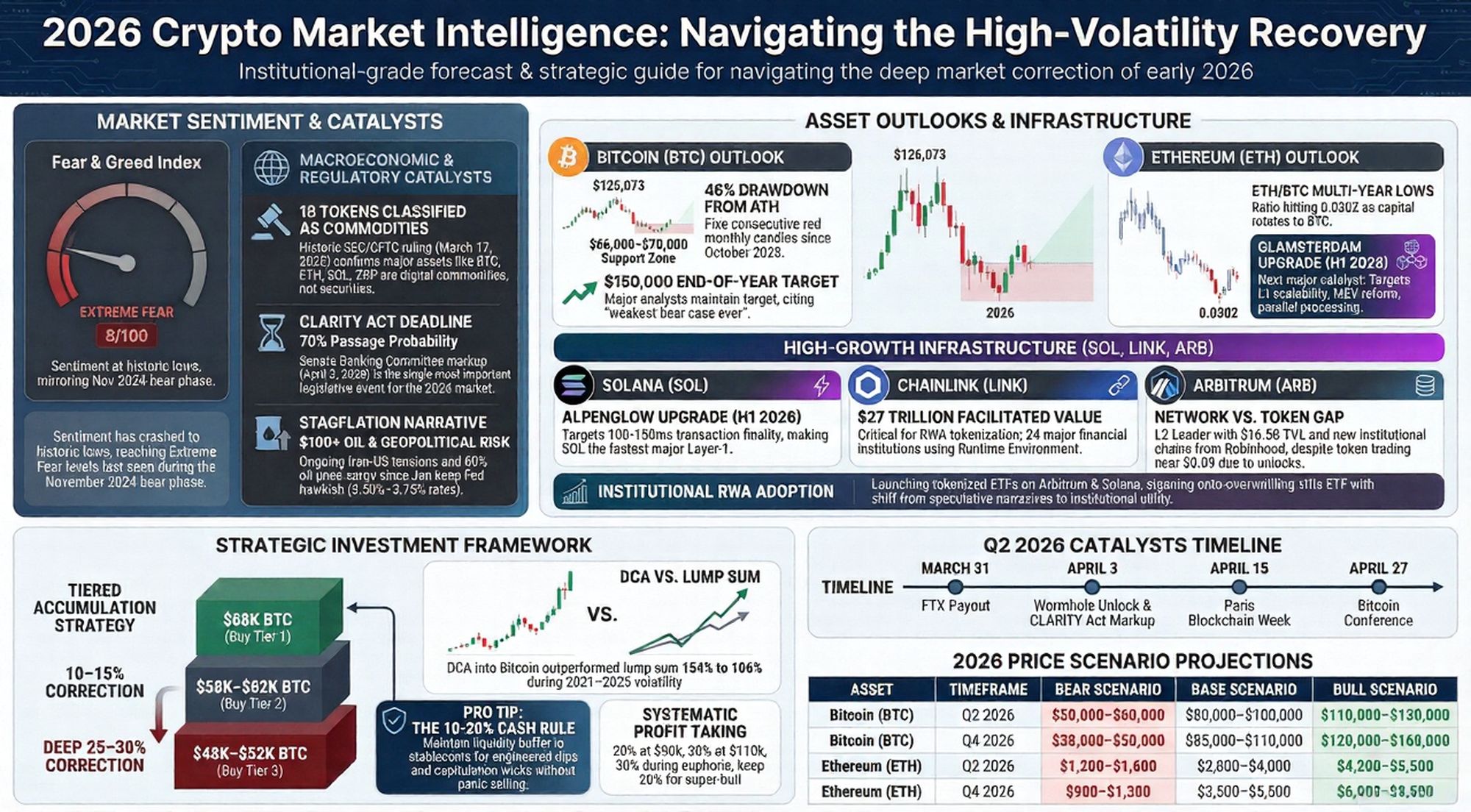
The Q1 2026 regime is a binary environment defined by the violent transition from October’s $126,080 peak to a state of systemic exhaustion. For the institutional allocator, the current "Extreme Fear" reading of 8–9 is not a signal of terminal decline, but a structural re-accumulation floor. Since the October high, Bitcoin has undergone a 46% drawdown, printing five consecutive red monthly candles, while Ethereum has retraced 60%. This "washout" phase has effectively purged speculative leverage, leaving 43% of the BTC supply at an unrealized loss—a level that historically precedes major regime shifts. Understanding this volatility is the prerequisite for capturing the "infrastructure discount" currently available in the market.
Asset Performance Matrix (March 20, 2026)
Asset
Price (USD)
24h Change
Dominance
Market Positioning
Bitcoin (BTC)
$70,245.03
▼ 0.33%
58.8%
Institutional Floor Support
Ethereum (ETH)
$2,124.16
▼ 0.86%
18.2%
Testing Multi-year ETH/BTC Low
Solana (SOL)
$88.13
▼ 0.41%
3.4%
Leading Relative Strength
XRP (XRP)
$1.4463
▼ 0.24%
2.1%
Regulatory Inflection Pivot
The psychological state of the market is currently paralyzed by geopolitical uncertainty, yet Bitcoin’s resilience serves as a lead indicator. While the Nikkei recently plunged 6% in response to Middle East tensions, BTC held steady near its $67,000 baseline, reinforcing its emerging role as a geopolitical hedge for institutional portfolios.
2. Macroeconomic Catalysts and the Hormuz Geopolitical Risk
The 2026 macro landscape is dominated by a toxic combination of energy-driven inflation and shifting central bank leadership. Traditional risk-on variables have been superseded by the Strait of Hormuz crisis, where the surge in WTI Crude Oil to the 95–110/bbl range (with a 72% probability of hitting $120) has introduced a genuine stagflation risk. For digital assets, this creates a high-sensitivity environment where energy costs dictate the risk premium.
Simultaneously, the Federal Reserve is preparing for the May 15, 2026, transition from Jerome Powell to Kevin Warsh. The market is already pricing in Warsh’s "sound money" stance and his explicit intent toward "balance sheet normalization." This shift has pushed the DXY to a 10-month high of 100.4+, tightening global dollar liquidity just as the industry seeks structural stability.
CPI Sensitivity: The March 11 Catalyst
Strategists must monitor the March 11 CPI release as the primary volatility trigger for Q1.
Bullish (Below 2.3%): Likely triggers a violent short-covering rally, reclaiming the $74k resistance.
Base Case (2.4%–2.5%): Continued range-bound consolidation within the 65k–70k corridor.
Bearish (Above 2.6%): Confirms stagflation; likely breaks the "Bitcoin Air Pocket" at $65,600, testing the macro floor at $60,000.
These macro pressures have accelerated the demand for a definitive regulatory framework to decouple digital asset valuations from broader risk-off sentiment.
3. The Regulatory Watershed: Commodity Classification and the CLARITY Act
March 2026 represents the most significant structural tailwind in the history of the asset class. The March 17 joint ruling by the SEC and CFTC provided a binding 68-page interpretive release classifying BTC, ETH, XRP, and SOL as digital commodities. Critically, this ruling explicitly protects staking, mining, and airdrops from security-based enforcement, providing the legal "safe harbor" required for sovereign wealth and pension fund entry.
The CLARITY Act and ETF Horizon
Legislative Urgency: The Digital Asset Market Clarity Act faces a mid-April Senate Banking Committee markup. Polymarket currently assigns 72% odds to its passage, but Senator Bernie Moreno has warned that the midterm cycle will stall all legislation if it fails to clear committee by May.
ETF Decisions (March 27): The SEC faces a hard deadline on 91 ETF applications. While commodity status clears the path for XRP and SOL, a "deferral" risk remains as the Commission manages the market impact of such a massive expansion.
This regulatory clarity is currently at odds with the "Infrastructure Discount" seen in the Layer 2 sector, where network growth has decoupled from token price.
4. Arbitrum (ARB): Solving the Fundamental-Tokenomics Gap
Arbitrum presents a strategic paradox: it remains the "DeFi King" with 16.5 billion in TVL and record bridge flows, yet its token trades near multi-year lows (0.09–$0.22). This is "hard mode" investing, where fundamental network utility is masked by aggressive supply-side mechanics.
Tokenomics Fatigue: Monthly unlocks of 90–100 million ARB will continue through March 2027. Without a native staking or fee-sharing mechanism, the token currently lacks a value-capture hook to offset this 1.5–2% monthly dilution.
Technical Exhaustion: Technical indicators show a momentum shift. The RSI sits at 35.87 (oversold), the %B position is at 0.0748 (hugging the lower Bollinger Band), and MACD convergence suggests bearish momentum is finally exhausting.
ARB 2026 Price Targets
Bull Case: Reclaiming the $0.105 resistance; contingent on DAO fee-share signaling.
Bear Case: A break below the $0.092 support pivot, testing the $0.085 psychological floor.
5. Chainlink (LINK): Evaluating the Infrastructure Token Discount
Chainlink has successfully transitioned into the "enterprise deployment layer" for global finance. The protocol now secures $27 trillion in facilitated value and has integrated 24 major financial institutions—including JPMorgan and SWIFT—into the Chainlink Runtime Environment (CRE). A pivotal "alpha" milestone was reached in March 2026, with the U.S. Department of Commerce delivering government data directly on-chain via Chainlink.
The Undervaluation Metrics
Despite trading 82% below its ATH, LINK’s on-chain health is at record highs.
CCIP Velocity: Weekly transfer volume has reached $90 million.
NVT Ratio: Currently sits at 78, indicating that network utility is growing significantly faster than market cap (undervaluation zone).
Supply Dynamics: The staking pool is aggressively expanding toward a 200 million LINK target, which will structurally lock a massive portion of the liquid float.
The gap between LINK’s role in the $4 trillion tokenized real-world asset (RWA) market and its current price represents the purest "infrastructure discount" in the 2026 market.
6. Asset-Specific Forecasts: Bear, Base, and Bull Scenarios
Professional execution in this regime requires planning for three distinct bands of probability.
Bitcoin (BTC) 2026 Pathways
Bear (30%): A break of the 65,600 neckline into the "Air Pocket," targeting a cycle bottom of 38k–$50k.
Base (50%): Re-accumulation and stabilization of ETF flows, recovering to 85k–110k by Q4.
Bull (20%): A Warsh-led Fed pivot and sovereign allocations pushing BTC to 120k–160k.
Ethereum (ETH) 2026 Pathways
Ethereum’s recovery hinges on the "Glamsterdam" upgrade (H1 2026), which introduces parallel processing, EIP-1559 refinements, and Enshrined Proposer-Builder Separation (ePBS).
Bear: Extended underperformance on the ETH/BTC ratio, testing 900–1,300.
Base: Post-upgrade re-rating to 3,000–4,500.
Bull: Liquidity explosion targeting 5,000–7,500.
7. Strategic Execution: Allocation Frameworks for Professional Portfolios
In the 2026 regime, "process over timing" is the mandate. Institutional conviction remains high despite "Extreme Fear"—evidenced by MicroStrategy's continued accumulation to a total of 761,068 BTC.
Portfolio Sizing Models
Allocation
Conservative
Moderate
Aggressive
BTC/ETH
70%
55%
45%
Major Alts (LINK/SOL)
10%
30%
45%
Cash/Stablecoins
20%
15%
10%
Execution & Risk Protocol
While lump-sum investing historically outperforms 68% of the time, the current geopolitical risk warrants a "Tiered Accumulation" approach—deploying 40% at current levels and laddering the remainder down to $55k BTC.
The Five Pillars of 2026 Risk Management:
Self-Custody & Cold Storage: Essential to mitigate exchange-level counterparty risk.
Zero Leverage: Maintaining spot-only positions in "Extreme Fear" zones to avoid liquidation cascades.
Tiered Profit-Taking: Pre-set sell orders starting at $100k BTC to remove emotional bias.
Tax-Loss Harvesting: Strategically selling underperforming assets to offset gains for tax optimization.
Quality Concentration: Focusing on assets with verified institutional demand (LINK, SOL, BTC) over speculative narratives.
Final Summary: The Q1 2026 market is defined by a profound "Infrastructure Token Discount." While macro noise and energy shocks suppress prices, the convergence of regulatory clarity and massive network utility is inevitable. Strategic patience during this re-accumulation phase is the only path to outsized performance in 2027.