Institutional Risk Management Framework: 2026 Volatility & Systematic Accumulation
1. Executive Context: The 2026 Macro-Volatility Pulse
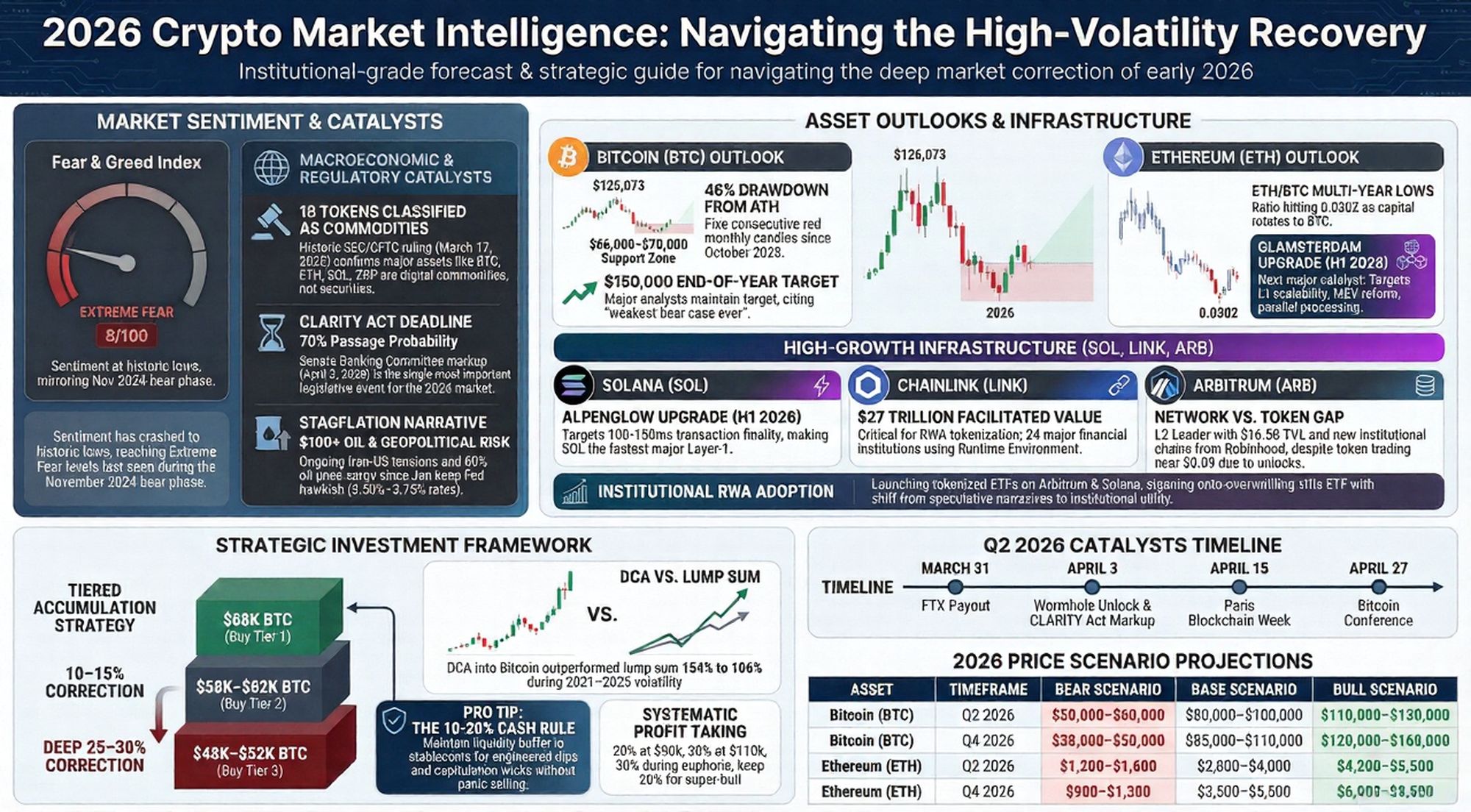
As of March 2026, the digital asset market has entered a regime of "Extreme Fear," with the sentiment index cratering to a range of 8–9. This environment is the byproduct of a 47% drawdown in Bitcoin (BTC) from its October 2025 all-time high of approximately $126,000, and a 60% correction in Ethereum (ETH). This represents a fundamental regime shift; while retail participants are absorbed by localized volatility, institutional capital is mandated to navigate a confluence of geopolitical shocks and a pivot in Federal Reserve leadership.
Primary 2026 Macro Drivers and Portfolio Impact
Macro Driver
Event Description (Source Context)
Portfolio Impact
Strait of Hormuz Crisis
Saudi Aramco’s Ras Tanura refinery shut following Iranian drone strikes; G7 evaluating a 300–400M barrel reserve release as Oil hits $110.
Bearish: Significant "risk-off" pressure; intensifies global stagflationary concerns.
Fed Leadership Transition
May 15 expiration of Powell’s term; Kevin Warsh confirmed as successor, signaling "sound money" and balance sheet normalization.
Uncertainty: Markets pricing in high-duration hawkishness; requires defensive posture until policy clarity.
US CPI "Stagflation" Trigger
Critical threshold monitored at 2.4%–2.6% YoY; energy shocks threaten to push prints above the 2.6% ceiling.
High Alert: A print exceeding 2.6% validates the stagflation thesis, likely forcing BTC toward $59,500.
The Regulatory Inflection
The strategic landscape shifted on March 17, 2026, with the SEC/CFTC joint 68-page interpretive release classifying BTC, ETH, XRP, and SOL as digital commodities. The strategic implication is the removal of the primary regulatory overhang that previously deterred Tier-1 custody and pension fund allocations. By explicitly clearing staking and mining from "security" designations, the Commission has provided the jurisdictional certainty required for large-scale product expansion and institutional-grade infrastructure. This necessitates a transition from passive holding to the systematic, tiered protocols detailed in this framework.
--------------------------------------------------------------------------------
2. Strategic Scenario Analysis: 2026 Projections for BTC and ETH
Scenario planning is mandated to eliminate emotional bias during the 47-60% drawdowns observed in Q1 2026. By establishing strict validation triggers, the Trading Desk is mandated to maintain an objective posture despite extreme sentiment lows.
Bitcoin (BTC) Scenario Matrix: Q4 2026 Targets
Bear Case (30–35% Probability):
Price Target: 38,000–50,000.
Validation Trigger: Sustained weekly close below the $55,000 Macro Floor, accompanied by structural ETF outflows and global recessionary confirmation.
Base Case (40–45% Probability):
Price Target: 85,000–110,000.
Validation Trigger: Reclaim of the $80,000 level supported by stabilized US Spot ETF inflows and the Fear & Greed Index recovering above 40.
Bull Case (20–25% Probability):
Price Target: 120,000–160,000.
Validation Trigger: Weekly close above $100,000 fueled by confirmed Sovereign Wealth Fund (SWF) allocations and a weakening US Dollar Index (DXY).
Ethereum (ETH) Relative Beta Analysis
Ethereum continues to exhibit a significant "utility-valuation gap," with the ETH/BTC ratio at 3-year lows (~0.0302). Trend reversal requires four critical catalysts:
Glamsterdam Upgrade: Implementation of parallel processing and gas limit expansion (200M) to resolve L1 scalability constraints.
Staking ETF Adoption: Sustained institutional inflow into staking products, which captured 38.7M in one week following the sub-2,000 dip.
Layer 2 Volume Migration: Massive-scale adoption of L2s (Arbitrum, Base) reinforcing Ethereum’s role as the global settlement layer.
Clearance of Overhead Supply: Final absorption of the $157M Vitalik-related supply that has contributed to current price suppression.
--------------------------------------------------------------------------------
3. Tiered Accumulation Protocols: Capital Deployment in "Extreme Fear"
In the current environment of a 46% drawdown from 2025 peaks, tiered accumulation offers a decisive advantage over lump-sum entry. This systematic protocol ensures capital is deployed within optimal value zones while maintaining liquidity for tail-risk events.
BTC Deployment Schema
Based on February 2026 volatility wicks, "dry powder" must be allocated according to these tiers:
Tier 1 ($68,000): Deploy 30–40% of allocation. Captures the structural floor provided by Spot ETFs (6% of circulating supply).
Tier 2 (58,000–62,000): Deploy 30% of allocation. Aligns with the February 5 capitulation wick and long-term holder realized price.
Tier 3 (48,000–55,000): Deploy 20% of allocation. Reserved for structural bear case confirmation.
Contingency Reserve: Retain 10–20% in stablecoins for extreme "black swan" scenarios (38,000–45,000).
Evaluation of Historical Precedent: The MicroStrategy Proxy for Systematic Persistence
The consistent accumulation strategy employed by Michael Saylor’s Strategy remains the primary case study for persistent capital deployment. Institutional planners must adopt a similar discipline, governed by the following directive:
Strategic Directive: All automated Dollar-Cost Averaging (DCA) protocols are to be paused immediately if the Fear & Greed Index crosses above 50 (Neutral). The Desk will then pivot to capital preservation and "Profit Taking" protocols to de-risk ahead of late-cycle distribution.
--------------------------------------------------------------------------------
4. Risk Mitigation & Structural Guardrails: Stop-Loss and Preservation
Institutional portfolios must establish "lines in the sand" to prevent catastrophic capital impairment in a 30-35% probability Bear Case.
Hard Stop Protocols
Bitcoin (BTC): A weekly close below $55,000 serves as the "Cycle Invalidation" trigger. This level is critical, as it aligns with the Head & Shoulders neckline and the November "Death Cross" (50-day crossing below the 200-day). A breakdown here exposes $38,000.
Ethereum (ETH): The structural floor is set at $1,500. A sustained close below this level signals a regime change from a "correction" to a "long-term impairment" of ETH's relative beta.
The Liquidation Cascade Warning
Current Bitcoin Open Interest (OI) sits at $21.3B, a 6-month low.
Analysis: Low OI indicates a lack of leveraged propellant in the market.
Warning Directive: The Trading Desk should anticipate high-duration consolidation or a "slow-burn" price action rather than V-shaped recoveries. Position sizing must account for "time-risk" as heavily as "price-risk," as the lack of leverage suggests a lack of immediate directional momentum.
--------------------------------------------------------------------------------
5. Infrastructure Positioning: Evaluating the "Utility-Valuation Gap"
The 2026 "Infrastructure Token Discount" presents a unique institutional entry window for assets where network growth metrics have diverged from token pricing.
Asset-Specific Evaluation: Arbitrum (ARB)
The Desk must evaluate ARB’s "Hard Mode" tokenomics through a binary lens of network dominance versus supply-side pressure.
Fundamental Strength
Supply Headwinds
TVL resilient at $16.5B; dominant Layer 2 stack for DeFi and stablecoin liquidity.
"Hard Mode" tokenomics: Monthly unlocks of 90M–100M ARB (1.5–2% of supply).
Stylus upgrade allows WASM (Web2) developers to ship high-performance code.
Continuous sell-side drag projected through March 2027.
Chainlink (LINK) and Solana (SOL)
Chainlink (LINK): The Chainlink Runtime Environment (CRE) is now a production standard for 24 global financial institutions (including SWIFT and JPMorgan). With $27 trillion in facilitated value and a target of 200M LINK staked, the structural reduction in sell-side float is the primary on-chain driver for appreciation.
Solana (SOL): Q1 2026 technical leader. The strategic implication of sub-200ms finality is the enabling of high-frequency institutional trading and real-world asset (RWA) programs requiring instantaneous confirmation. SOL remains the primary high-beta diversification asset.
--------------------------------------------------------------------------------
6. The Behavioral Layer: Psychological Fortification and Institutional Discipline
Institutional success in 2026 is a function of "Process over Emotion." Five consecutive red monthly candles have exhausted retail sentiment; the Desk is mandated to maintain posture through the following protocols.
Senior Partner's Discipline Checklist
Mandatory Revalidation of the Halving Cycle Thesis: Confirm structural growth windows remain intact despite the 47% drawdown.
Isolation of Price Action from Network Growth Metrics: Audit TVL, active wallets, and ETF inflows. If network metrics rise while price falls, the "Infrastructure Discount" is confirmed.
Audit of Sovereign Wealth Allocation Signals: Verify if the "Bull Case" triggers are supported by sovereign-level capital movement.
Execution of Tax-Loss Harvesting: Utilize the end of Q1 to optimize capital efficiency by harvesting realized losses.
Prohibitive Directives for the Trading Desk
No FOMO: Prohibition on buying vertical pumps (>20% gains in 24 hours).
No Panic Selling: Prohibition on exiting positions based on short-term geopolitical headlines or sentiment troughs.
No Overconfidence: Profitable dip-buys do not justify increasing leverage beyond 2–3x.
No "Hope" Strategies: If an asset’s fundamental thesis (e.g., protocol failure) changes, the position must be exited regardless of potential bounces.
Final Summary
The 2026 outlook is defined by a transition from speculative mania to institutional infrastructure. While macro headwinds remain clouded by the Hormuz crisis and Fed leadership shifts, the structural support provided by $88B in Spot ETFs—6% of the Bitcoin supply—differentiates this cycle from all prior bear markets. By adhering to tiered accumulation and strict structural guardrails, institutional portfolios are positioned to navigate the current "Extreme Fear" and capture the eventual re-pricing of the digital commodity asset class.