
what caught my attention:
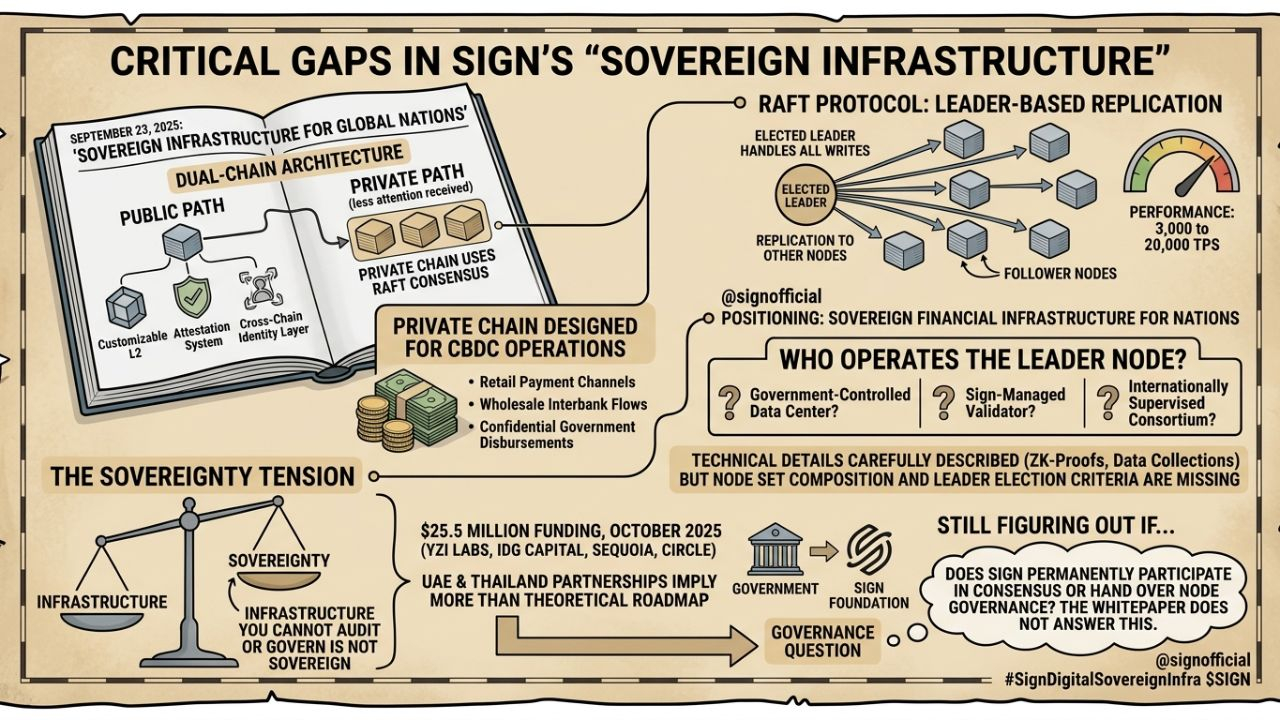
caught something in the sign whitepaper — published september 23, 2025, titled "sovereign infrastructure for global nations" — that i keep returning to. the document describes a dual-chain architecture: a public path and a private path. most of the coverage in the weeks after publication focused on the public path — the customizable L2, the attestation system, the cross-chain identity layer. the private path received far less attention, which is probably why the consensus mechanism buried in that section hasn't been discussed publicly.
the private chain uses raft consensus. not proof of stake, not BFT-based, not a delegated validator scheme. raft. for those unfamiliar: raft is a leader-based replication protocol designed for distributed systems in controlled infrastructure environments. a single elected leader node handles all write operations; other nodes replicate from that leader. the whitepaper claims 3,000 to 20,000 TPS for the private chain — a number that is plausible precisely because raft doesn't require coordination across a decentralized validator set. that tradeoff is real, and naming it directly matters more than the coverage suggests.
the part that's interesting:
the private chain is specifically designed for CBDC operations. retail payment channels, wholesale interbank flows, confidential government disbursements. @SignOfficial is positioning this as sovereign financial infrastructure for nations. technically, raft can carry that workload — the TPS range fits the stated use cases, zero-knowledge proofs handle transaction privacy, and private data collections manage confidentiality. the architecture is coherent on its face.
but a raft leader is not a governance-neutral concept. the leader is a specific node. that node processes every write. in any government deployment, a critical question follows immediately: who operates the leader node? a government-controlled data center? a sign-managed validator? an internationally supervised consortium? the whitepaper describes private data collections and ZK proof verification in careful technical detail. it does not describe the node set composition or leadership election criteria for any specific national deployment. that's not a minor omission — it's the governance question that determines whether the sovereignty claim holds.
what im not sure about:
sign raised $25.5 million in october 2025 from YZi Labs and IDG Capital, backed additionally by sequoia capital and circle from the $16 million series A in january 2025. that funding level implies a deployment roadmap that is more than theoretical. the UAE and thailand partnerships described in public materials, if they involve the private chain, require real answers to the governance question above — answers that don't yet appear in any public documentation.
the whitepaper presents the dual-chain model as the sovereignty solution: governments get their own infrastructure, their own rules. but infrastructure you cannot independently audit or govern is not sovereignty in any meaningful sense. if the raft leader node is controlled by the sign team or a sign-appointed entity, then the government is running sign-defined infrastructure with sign-controlled consensus — not their own. that's not an unusual model in enterprise blockchain; it's how many national blockchain deployments actually work. but presenting it as sovereign infrastructure while leaving the governance structure unspecified is a tension worth naming, not smoothing over.
still figuring out if…
i cant figure out whether sign intends the private chain to eventually be fully government-operated — where the team hands over node governance and signs off — or whether the sign foundation remains a permanent participant in the consensus layer for government deployments. the whitepaper does not answer this. the funding structure and the speed of the partnership pipeline suggest the answer matters sooner than the documentation implies 🤔