
by MMK | 30.3.26
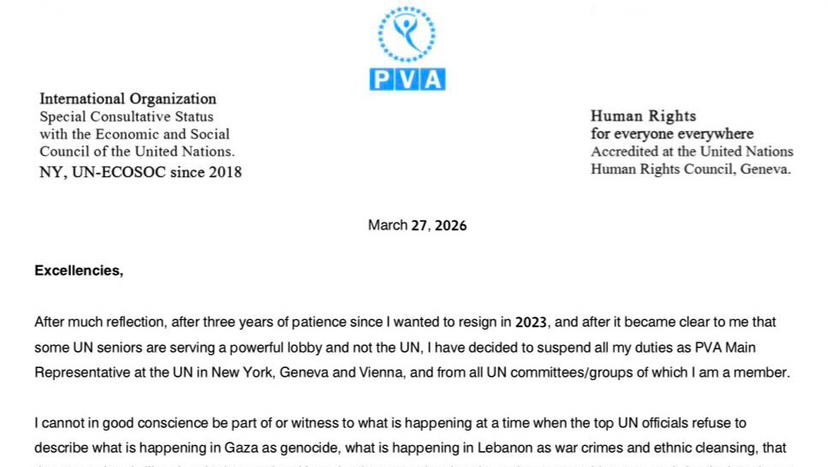
A public letter is not proof. It is not a court ruling, not a verified dossier, not a finished truth. But there are moments when a letter becomes something else: a test of whether the world still knows how to take danger seriously before it is too late.
That is how Muhammad Safa’s statement should be read. Its most serious claims have not been independently verified in the public record, and they should not be treated as settled fact. But that is not the only question that matters. Another question matters just as much: what does it mean when someone inside an international system is willing to risk his own standing in order to say that the system is failing just as the stakes become unbearable? Reuters and AP reporting already show a crisis that is wider, harder and more unstable than ordinary war language suggests: emergency regional diplomacy, worsening energy shock, and openly escalatory rhetoric are all now part of the same picture.
What makes this moment so dangerous is not only the possibility of a larger war. It is the possibility that the boundaries which once seemed morally fixed are starting to soften. AP has reported discussion of highly escalatory options such as seizing Kharg Island, alongside Iranian threats involving Gulf mining and talk of leaving the nuclear non-proliferation framework. None of this proves that a nuclear strike is coming. But it does suggest a crisis moving into a darker kind of politics, where miscalculation may matter more than declared intent. The real danger begins when the unacceptable starts to sound discussable.
Too much commentary still treats war as if it stays where the bombs fall. It does not. Reuters has already described a worst-case energy scenario around Hormuz, with severe supply disruption and a sharp rise in oil prices. That kind of shock never stays in the Gulf. It moves through shipping, food, transport, debt, electricity and public fear. It reaches poorer countries fast and punishes them hardest. A crisis like this does not spread only through fire; it spreads through prices, shortages and fraying nerves.
This is why international institutions matter most when they seem weakest. No one expects them to perform miracles. But they are still expected to do one essential thing: tell the truth about danger in language that is equal to the moment. When institutions stop naming what is happening and start merely managing how it is heard, something deeper begins to fail. Reuters has reported intense diplomatic efforts to stop the war spreading further, while AP has reported confusion created by mixed political messaging. Those are not signs of a crisis under calm control. They are signs of a system under strain.
There is also the question of information, which modern politics still prefers to underestimate. Wars are no longer prepared only by troops and weapons. They are prepared by language, framing, repetition and selective silence. A threat is amplified, then normalised. Public shock fades. Institutional language softens. Then escalation becomes easier to carry politically. The most dangerous lie is not always the obvious one. Often it is the half-true story that arrives at exactly the moment power needs it.
That is why the right response to Safa’s letter is neither blind belief nor lazy dismissal. It is disciplined seriousness. Reuters has reported that Trump now faces “only hard choices” after a month of war, while Pope Leo has condemned the conflict in stark moral terms. Markets, mediators and moral voices are all signalling that this is not a contained event with predictable edges. It is a widening stress test for the region and for the international order itself.
So the real question is not whether every line of one letter can be proved today. The real question is whether the world still has enough judgment left to respond to a serious warning while there is still time to choose caution. If the danger is overstated, restraint will have cost relatively little. If it is understated, the cost may be counted in broken systems, broken countries and broken human lives. That is the measure of this moment.
And perhaps that is the hardest truth of all: the world may not fail because it was never warned. It may fail because it was warned, and preferred the comfort of doubt.