
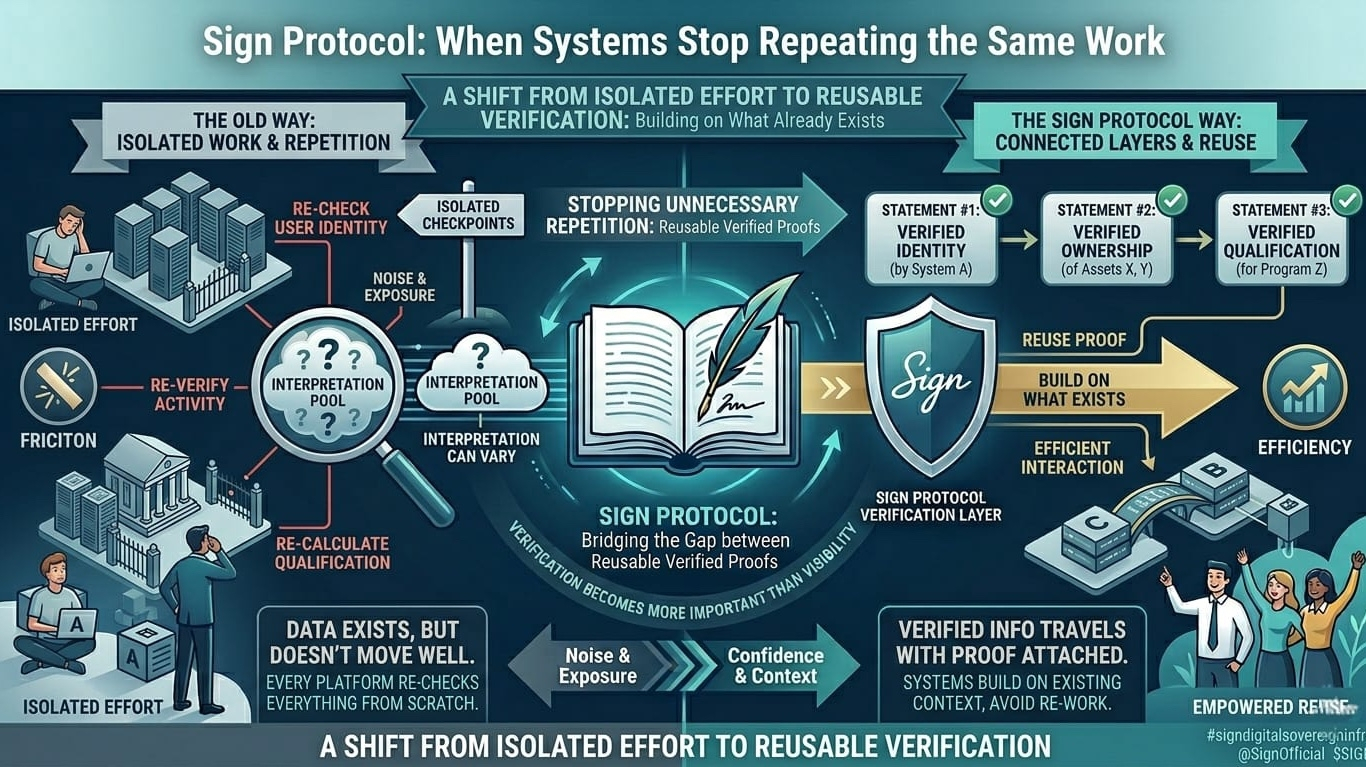
One thing that keeps coming back to me is how much repetition exists across different systems. Every platform tries to figure out the same things again who the user is, what they’ve done, whether they qualify for something. It’s like every system just starts from scratch, even when the info already exists somewhere else. That’s not really a tech limitation, it’s more about how information is structured and shared. That’s where Sign Protocol started to make sense to menot as identity or compliance, but as a way to stop systems from constantly redoing the same work.
Right now, even if useful data exists, it doesn’t move well between systems. One platform might recognize something, but another one either doesn’t trust it or can’t interpret it properly. So the same checks happen again and again in slightly different forms. That’s inefficient, but it’s also why processes feel heavier than they need to be. If something has already been verified once, ideally it shouldn’t need to be fully re-verified everywhere else from scratch.
What Sign seems to be doing is giving that verified information a form that can actually travel without losing meaning. Not everything needs to move—just the part that matters. And more importantly, it moves with its proof attached. That way, another system doesn’t have to rely on assumptions or rebuild context. It can just check what’s already there and decide based on that.
I think this changes how systems evolve over time. Instead of operating like isolated checkpoints, they start to behave more like connected layers. Each one can still do its own thing, but it doesn’t need to ignore what happened before. That way things connect over time without forcing everything into one setup.And it doesn’t mean everything has to be open either. Systems can still keep things private and run their own rules.The difference is that when something needs to be recognized externally, it doesn’t have to start from zero again. It can carry forward in a way that still makes sense outside its origin.
What stands out to me is that this approach doesn’t try to change how systems operate internally. It focuses on how they interact at the edges where most of the friction usually happens. And fixing that part alone can remove a lot of unnecessary repetition.
At a broader level, this feels like a shift from isolated effort to reusable verification. Instead of doing the same work again and again, systems can start building on what already exists.#signdigitalsovereigninfra @SignOfficial $SIGN
