
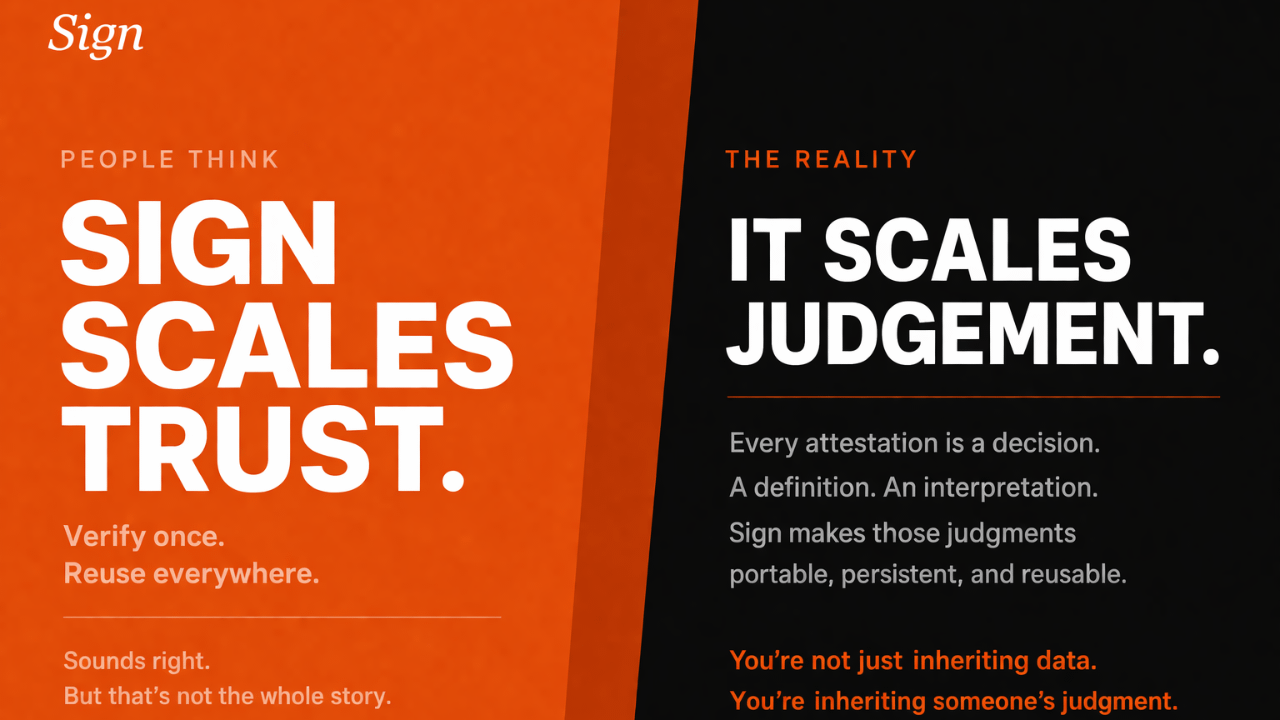
People usually describe systems like @SignOfficial as a way to scale trust. You verify something once, turn it into an attestation, and other systems can reuse it without starting from zero. It sounds clean, almost obvious.
But the more I think about it, the less it feels like $SIGN is scaling trust.
It feels like it’s scaling judgement.
Because an attestation isn’t just raw data. It’s a decision someone made about that data. What counts as “active,” what qualifies as “real,” what passes as “valid.” Those definitions don’t come from the protocol, they come from whoever issued the attestation in the first place.
$SIGN takes those decisions and makes them portable. Once they’re structured, signed, and readable across systems, they don’t stay local anymore. They move. They get reused. They start influencing other systems that never made that judgement themselves.
And that’s where the shift happens.
You’re not just inheriting data. You’re inheriting someone else’s way of interpreting that data.
At first, that feels like efficiency. Systems don’t need to evaluate everything from scratch. They can rely on what’s already been decided. But over time, it starts to look more like dependency.
Because once enough systems build on top of the same attestations, they stop being independent. They start aligning around the same underlying definitions, even if those definitions were never meant to be universal.
$SIGN isn’t doing anything wrong here. It’s doing exactly what it’s designed to do: make claims reusable and consistent across contexts.
But consistency doesn’t mean neutrality.
If anything, it amplifies whatever judgement was encoded at the start. A weak definition doesn’t stay small, it scales. A biased interpretation doesn’t stay local, it travels. And the more it gets reused, the harder it becomes to question it, because it starts to look like infrastructure instead of opinion.
So the question shifts.
It’s not just “can this be verified?”
It’s “whose judgement am I relying on right now?”
And once Sign becomes the layer that carries those judgements across systems, that question doesn’t go away.
It just gets easier to ignore.