

Looked like another “infrastructure” project. You know the type — big words, vague promises, and somehow always tied to “multi-chain future” narratives. I didn’t pay much attention.
But then it kept showing up. Not in hype threads… more in weird places. Conversations about identity. Government pilots. Credential verification. Stuff that usually doesn’t live in the same room as crypto Twitter.
That’s when I started actually looking.
At first, I thought Sign Protocol was just about attestations — like, proving something happened on-chain. Wallet owns this NFT, user passed KYC, address belongs to X… basic stuff we’ve seen before.
But after watching it for a while, I realized it’s trying to go way beyond that.
It’s basically positioning itself as a layer for trust.
Not “trust me bro” — actual verifiable, on-chain trust.
And yeah, I know… that sounds abstract. It did to me too.
What made it clearer was how they split things:
Sign Protocol handles the data layer (who you are, what’s verified about you)
TokenTable handles distribution (who gets what, when, and why)
That combination started to make sense in a more real-world way.
Because identity without distribution is incomplete.
And distribution without identity is chaos.
What really caught my attention though… wasn’t the tech.
It was the countries.
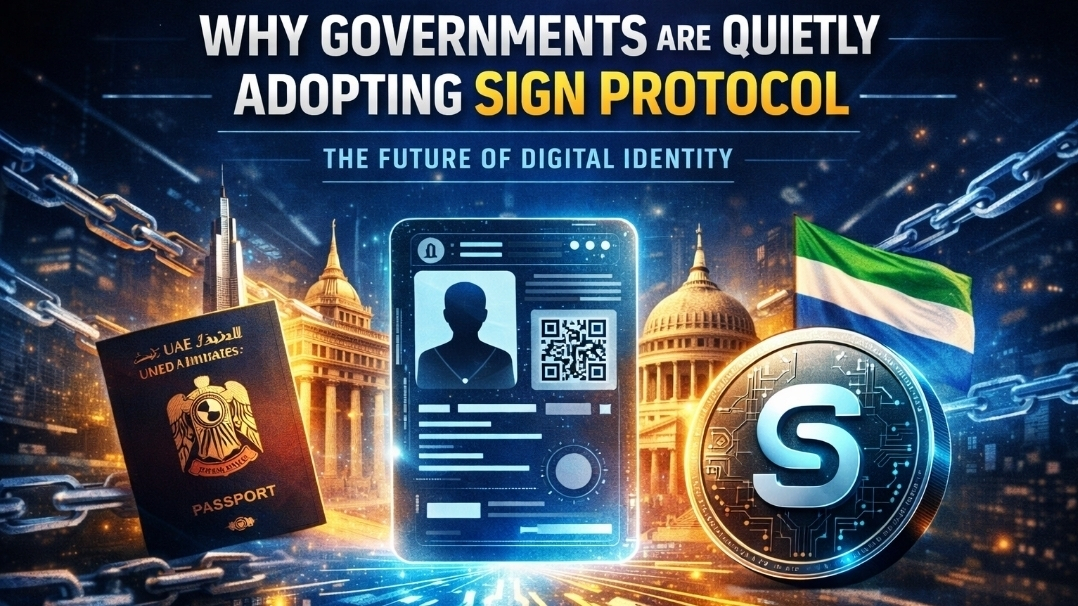
UAE. Thailand. Sierra Leone.
Not exactly the usual suspects for “experimental Web3 pilots”… but also not random.
That’s when the narrative shifted in my head.
This isn’t trying to compete with DeFi protocols.
It’s not another yield farm or trading playground.
It’s trying to sit underneath systems.
Like… actual systems.
Digital IDs. Credentials. Government-backed verification.
At first, I was skeptical. Governments and crypto don’t exactly have a smooth history.
But then I thought about it differently.
Governments don’t adopt “crypto”.
They adopt infrastructure.
And Sign doesn’t really feel like crypto in the usual sense. It feels more like plumbing.
Invisible, but necessary.
What I noticed is that the idea of “on-chain identity” has been floating around for years… but it never really stuck.
Mostly because it either became too invasive (full KYC everywhere) or too useless (random badges no one cares about).
Sign seems to be trying a middle ground.
Not forcing identity — but allowing verifiable credentials when needed.
So instead of saying “this wallet is KYC’d”, you can say:
“This wallet has a government-issued credential proving X”
And that credential can be reused across apps, chains, and systems.
That’s where the “digital passport” idea starts to feel less like a buzzword and more like something practical.
TokenTable is another piece I didn’t expect to care about… but it actually matters more than I thought.
Airdrops, vesting, unlocks — all of that has been messy forever.
Projects either over-distribute, under-control, or just completely lose track of who should get what.
TokenTable feels like an attempt to formalize that.
Not just “send tokens to wallets”… but:
Verified recipients
Structured release schedules
Transparent distribution logic
It’s boring on the surface… but honestly, that’s where real systems win.
Not flashy. Just reliable.
The bigger picture here is what’s interesting.
Crypto used to be mostly about financial experimentation.
DEXs, lending, leverage, yield… all internal loops.
But this feels like a different phase.
Where crypto starts touching things outside its own bubble.
Identity. Government systems. Public infrastructure.
That shift is subtle… but it changes everything.
Because now the question isn’t “can this token go up?”
It’s “does this system actually get used?”
That said… I’m not fully convinced yet.
There are a few things that still sit weird with me.
One is dependency on governments.
It’s a double-edged sword.
On one hand, adoption at that level is massive.
On the other, it introduces centralization pressures.
If a government controls the issuance of credentials… how “decentralized” is the system really?
And more importantly — do users actually have control over their data?
That part still feels unresolved.
Another thing is user experience.
Let’s be honest — most people don’t care about “attestations” or “on-chain identity layers”.
They care about convenience.
If using Sign ends up feeling like extra steps, extra wallets, extra friction… it won’t matter how powerful it is underneath.
It needs to disappear into the background.
Like email verification. Or logging in with Google.
Invisible, but essential.
Still… I can’t ignore what I’m seeing.
This isn’t loud hype.
It’s quiet positioning.
And those are usually the ones that either fade away… or suddenly become everywhere.
After watching this for a while, I don’t see Sign as a “crypto project” anymore.
It feels more like something trying to sit between crypto and the real world.
Not replacing systems.
Not fighting governments.
Just… integrating.
And whether that’s a good thing or not probably depends on how much you trust the people building it.
I’m still figuring that part out.