
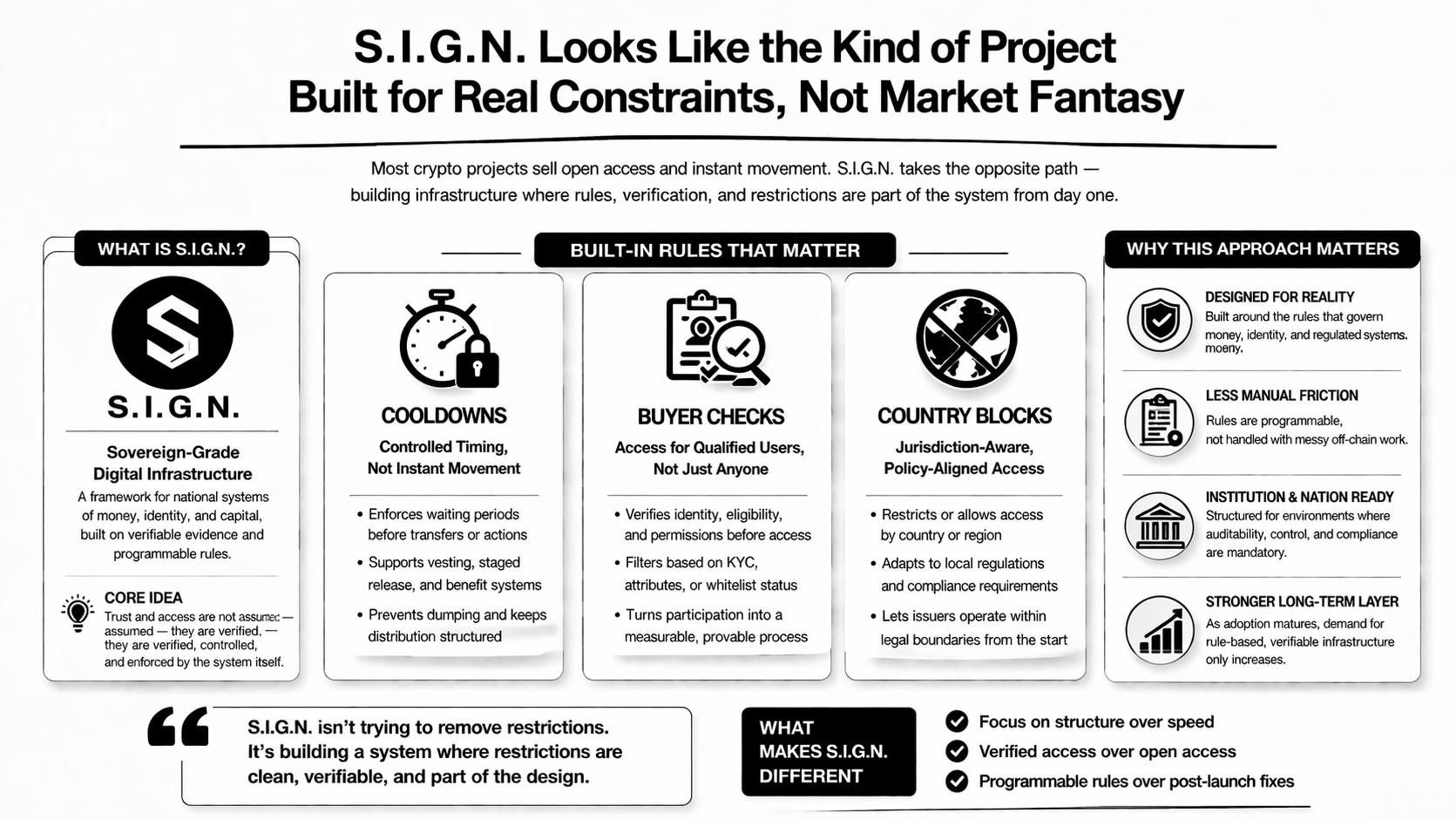


S.I.G.N. is the kind of project I don’t dismiss quickly, and that already says something because most of this market feels like recycling at this point. Same promises. Same noise. Different logo. I’ve watched too many teams dress up weak infrastructure with big language and borrowed conviction, so now I mostly look for one thing: does the thing actually make sense when the hype burns off?
That’s where S.I.G.N. keeps pulling me back.
What I see here is a project built around friction. Not ignoring it. Not pretending everything onchain should be instant, open, and available to everyone everywhere. That fantasy still sells, sure. But in the real world, money moves with rules attached. Access comes with conditions. Distribution has limits. Geography matters. Identity matters. Timing matters. Most projects still write like those problems will magically disappear. I don’t think S.I.G.N. is making that mistake.
That’s why the whole cooldowns, buyer checks, and country blocks angle feels important to me. Not because it sounds impressive. Honestly, it doesn’t. It sounds restrictive. Heavy. A little annoying, even. But that’s exactly why it feels real.
Cooldowns tell me this project understands that not everything should move the second it lands. Sometimes there needs to be a pause. A hold. A waiting period. Not because it’s exciting, but because controlled flows are part of serious systems. That kind of logic usually gets ignored in crypto until it becomes a problem. Then everyone scrambles. S.I.G.N. looks like it’s starting from the other side, building with that grind already in mind.
Buyer checks matter for the same reason. I’m long past the point of being impressed by “access for all” as a slogan. Access is easy to promise when nothing serious is happening. The moment real assets, real compliance, or real capital enters the room, the whole conversation changes. Then it becomes: who qualifies, who gets blocked, who gets verified, who gets through cleanly. I think S.I.G.N. understands that shift. It feels like a project built for systems where eligibility is part of the architecture, not some patchwork filter taped on later when regulators start knocking.
Country blocks. Same story. People hate hearing that stuff because it cuts against the old open-border internet dream. I get it. But I’m not here to be sentimental about where the market used to think it was going. I’m looking at where the pressure is actually building. Different jurisdictions have different rules. Different products have different restrictions. And if a project wants to play anywhere near serious finance, identity, or national infrastructure, then pretending geography doesn’t matter is just lazy thinking.
That’s what makes S.I.G.N. more interesting than most. It doesn’t feel like it’s trying to escape the hard parts. It feels like it’s building directly into them.
And I respect that more than I get excited by it.
Because the truth is, I’ve seen a thousand projects talk a big game about the future. Most of them never even survive contact with reality. They look clean in pitch decks, smooth in threads, polished on stage. Then the first real constraint hits and the whole thing starts showing cracks. Weak assumptions. Thin demand. Too much dependence on narrative, not enough on structure. That’s always the break. I’m always looking for the break.
With S.I.G.N., I don’t get that same immediate feeling of emptiness. I get weight. Maybe that’s the right word. It feels like a project designed for systems that are messy, political, slow-moving, and full of rules people don’t want to talk about until they have to. That doesn’t make it exciting in the usual crypto sense. It makes it harder to ignore.
I also think a lot of people are still reading it too narrowly. They see a token. They see a market cycle. Maybe they see a quick catalyst and stop there. I think that misses the point. What matters more is the framework underneath. The bigger idea is not just moving value around. It’s deciding how value moves, who can touch it, when they can touch it, and under what conditions. That’s a much more serious design space.
And it’s probably where this market ends up whether people like it or not.
The part I keep circling back to is simple. Crypto spent years trying to remove friction from everything. S.I.G.N. looks like it’s asking a different question — what if the real opportunity is in structuring that friction properly instead of pretending it shouldn’t exist?
I don’t know. Maybe that’s why it stays on my radar. Not because it feels easy.Mostly because it doesn’t.