


What stands out to me about Binance’s Capital Connect upgrade is that it is not simply another “connect investors with traders” product.
The more interesting part is the structure behind it.Binance has rebuilt Capital Connect as a portfolio marketplace on top of its Portfolio Accounts infrastructure, where institutional investors can allocate capital to professional trading teams while assets remain in Binance custody and investors keep ownership of those assets. Trading teams control execution, but they do not self-custody client capital inside this setup.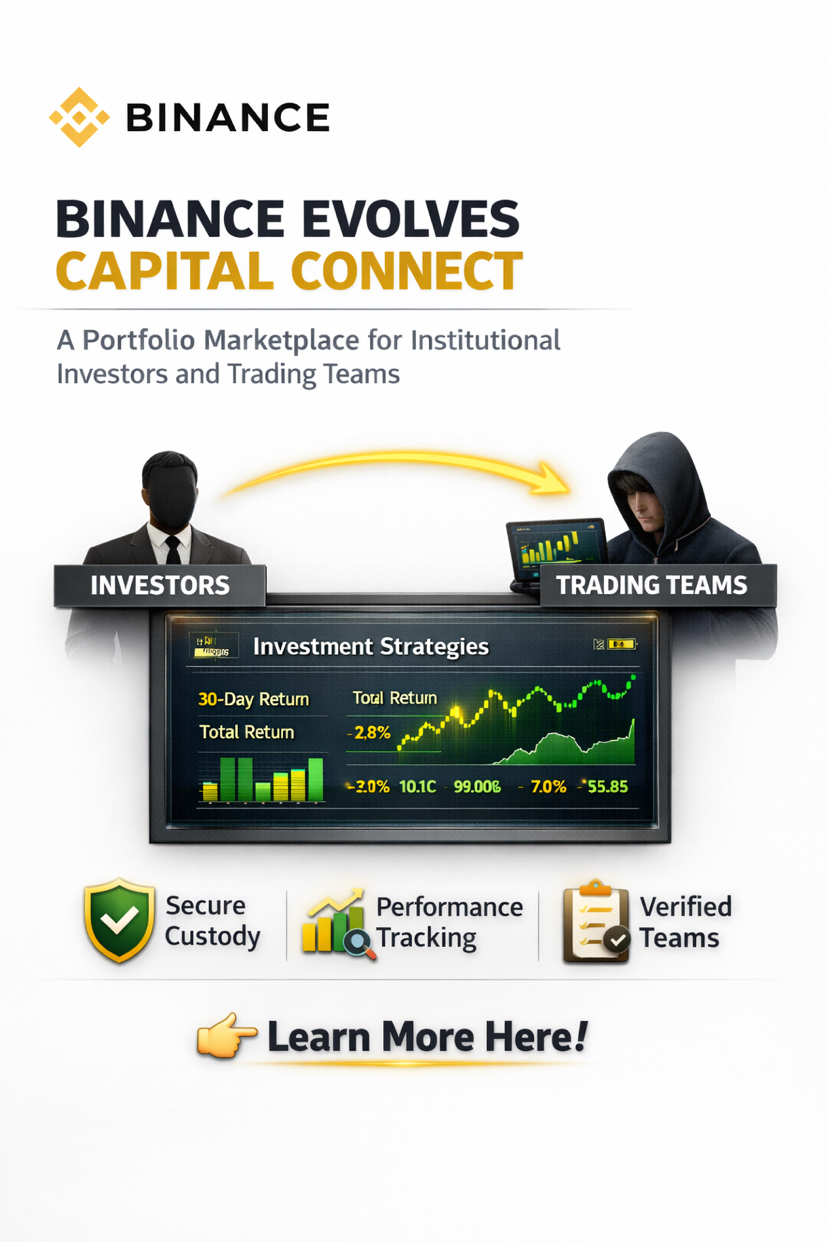
That matters because crypto has never really lacked strategies.What it has often lacked is institutional-grade coordination.Most capital allocation models in crypto break down around the same pressure points: who holds the assets, who verifies the participants, who reports the performance, and how much trust the allocator is forced to place in the manager. Binance is clearly trying to reduce that friction by keeping the arrangement inside its own exchange, custody, and compliance framework. Both investors and trading teams must complete KYB, and performance data is disclosed directly by Binance rather than self-reported by the teams.
That changes the pitch.This is less about “here are some good traders” and more about “here is a controlled marketplace where capital formation, execution, and reporting are packaged inside one operational environment.”
For investors, the marketplace is structured in a way that looks much closer to an allocation dashboard than a typical crypto discovery flow. They can compare strategies by category, 30-day return, since-inception return, NAV per allocation, Sharpe ratio, maximum drawdown, and terms such as fees, minimum investment, lock-up period, and settlement window. Binance also says each strategy includes a cumulative return curve and NAV trendline.
For trading teams, the bar is also higher than just showing a PnL screenshot and asking for outside capital. To join, teams need KYB verification, a valid asset management or portfolio management licence or recognized exemption in their jurisdiction, and at least 30 days of active Portfolio Account trading history. During the initial launch period, Binance says it is charging 0% commission to trading teams.
The practical implication is bigger than the feature itself.
Crypto markets are maturing into an environment where serious allocators want access to strategy exposure, but they also want guardrails around reporting, verification, custody, and operational accountability. Capital Connect looks like Binance’s attempt to build that bridge in a more native way instead of pushing institutions into a fragmented patchwork of external managers, off-platform reporting, and trust-heavy workflows. That is a meaningful shift.
But there is also an important tradeoff here.A marketplace like this may improve discovery and standardization, yet it does not remove investment risk. Binance explicitly says Capital Connect is a facilitation service, not investment advice, and that investors remain responsible for due diligence and suitability assessment. In other words, better structure does not eliminate bad strategy selection. It just makes the operating environment more legible.
That is why I think the real story here is not “Binance launched another institutional product.”
The real story is that Binance is trying to turn capital allocation in crypto into something more governed, more comparable, and more operationally credible.
If this works, it could become one of those quiet infrastructure upgrades that matters more than the headline suggests.
Because in institutional crypto, the edge is not only performance.It is whether trust, reporting, and capital control can scale together.
Does Capital Connect make crypto portfolio allocation more investable for institutions, or does it simply concentrate more of the process inside Binance’s own system?#MarketRebound $XRP $ROBO