
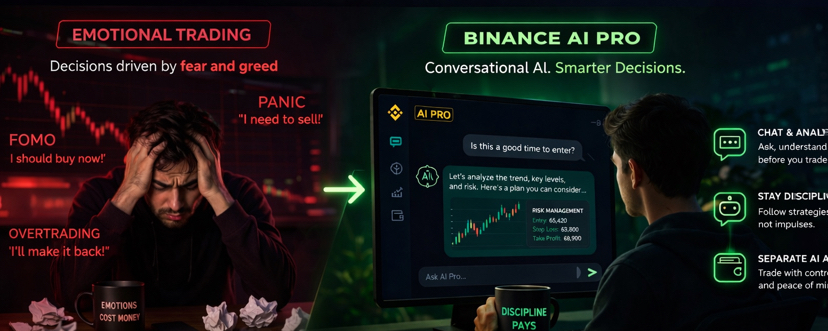
What makes Binance AI Pro appealing to me is not the promise of smarter signals. It is the possibility that it might help traders become a little less emotional at the exact moment emotion usually does the most damage. Binance describes AI Pro as an AI trading assistant that can handle market analysis, monitoring, and trade-related actions through a separate AI Account with restricted permissions. That matters because it suggests the product is not only trying to interpret the market, but also trying to sit closer to the point where hesitation, panic, and impulsive clicks usually take over.
For me, emotional trading has never been just a cliché. It is one of the most persistent structural problems in crypto. People often talk as if losing discipline is a personal weakness, but I think it is partly a product design problem. Most traders still move through a fragmented process: they read information in one place, think through risk somewhere else, and then execute in another interface under time pressure. That is exactly where fear expands and conviction breaks down. A system that lets someone ask questions, test assumptions, monitor exposure, and move toward execution in one flow has a chance to reduce that friction. Binance says AI Pro can support actions such as spot trading, perpetual contracts, leveraged borrowing, asset monitoring, and custom strategy execution, which is why I see it as a behavioral tool as much as a technical one.
The separate AI Account is the part I find most persuasive. Binance says the AI Pro account is a virtual sub-account tied to an AI API key that has no withdrawal or transfer permissions, and that the main account remains segregated from the AI environment. I think this boundary matters more than people realize. Emotional trading is not only about overreacting to price. It is also about how much control a user feels they still have when volatility rises. If an AI system is going to help at the execution layer, it needs to exist inside clear limits. Otherwise, the cure for emotional trading becomes another source of anxiety.
I can imagine a few situations where this actually helps. A part-time trader who cannot watch charts all day might use the AI conversationally to check whether market conditions still match the original plan, instead of improvising later out of stress. Someone managing a futures position could use it to monitor risk more consistently, rather than waiting too long and then reacting in panic. Even the chat interface itself matters here. Binance says users can interact with AI Pro conversationally, and that actual execution depends on enabling permissions on the AI Account. That kind of step-by-step structure feels healthier to me than going straight from market noise to a manual trade.
Still, I would not romanticize it. A tool like this only reduces emotional trading if it performs reliably when markets are messy, not just when the interface feels smooth. If the AI is vague, overconfident, or context-blind, it could create a false sense of calm rather than real discipline. Binance AI Pro only entered public testing in late March 2026, so it is still early to know whether the product can build trust under live market stress.
So yes, the reason Binance AI Pro appeals to me is simple: it seems to be aiming at a real problem. Traders do not always fail because they lack information. Often, they fail because they cannot hold their own process together when price starts moving fast. If AI can help reduce that gap, even slightly, then it is doing something more interesting than just sounding intelligent. The real test, though, is whether that discipline survives contact with the market.