
I keep looking at this market the same way people watch the tide—coming in, going out, always moving, but rarely leaving anything permanent behind. Every few months there’s a new narrative, a new promise, a new “this changes everything” moment. And after a while, you start to recognize the pattern. The excitement shows up first, then the noise, and then… silence. Most of it fades before it ever really touches the real world.
I’ve been watching long enough to know that crypto loves ideas more than outcomes. Projects don’t fail because they sound bad—they fail because turning an idea into something people actually use is much harder than it looks on paper. That gap is still there, no matter how many new tokens launch.
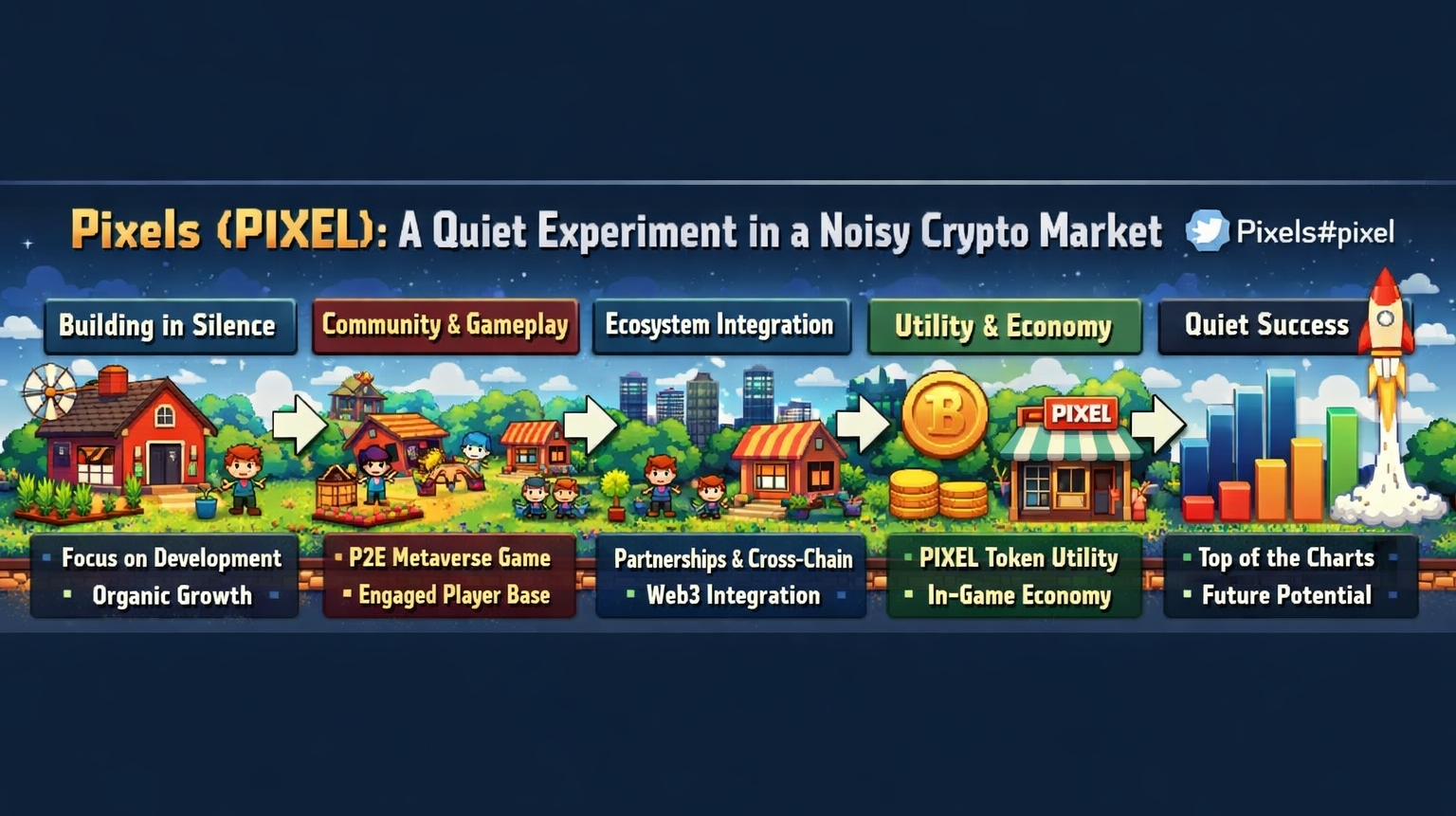
So when Pixels (PIXEL) showed up, I didn’t think much of it at first. Just another Web3 game, another attempt to merge gaming with blockchain. Farming, exploration, crafting—it all sounded familiar, almost too familiar. The space has seen plenty of these before, and most of them didn’t stick.
But something about it made me pause a little longer than usual.
Maybe it’s the simplicity of it. Pixels doesn’t feel like it’s trying to impress you with complexity. It feels more like it’s trying to recreate something people already understand—slow progress, building something over time, logging in not because you’re chasing rewards, but because you enjoy the loop. That’s a very different mindset from a lot of crypto games, which often feel more like financial systems disguised as gameplay.
And that’s where it gets interesting. The idea here isn’t really about “earning” or “optimizing yield.” It’s more about creating a space where ownership exists quietly in the background. You farm, you explore, you collect—but the blockchain part isn’t constantly screaming for attention. If anything, it’s trying to stay out of the way.
Of course, that raises its own questions.
Do players actually care about ownership when they’re playing a game, or do they just want something that feels good to play? Because traditional games have already mastered that feeling. They’re smooth, polished, and built by teams with years—sometimes decades—of experience. Competing with that isn’t easy, no matter how good the idea sounds.
And then there’s the usual challenge: staying power. Getting attention in crypto is easy. Keeping it is where things tend to fall apart. A lot of projects feel alive in the beginning, when everything is new and people are curious. But once that initial wave passes, what’s left?
I also think about how fast crypto expects things to happen. Growth, adoption, success—it all needs to come quickly, or people move on. But games, like any real product, take time to grow into something meaningful. Communities don’t form overnight, and habits definitely don’t.
That tension is always there. Crypto moves fast. Real engagement moves slow.
So I find myself somewhere in the middle with Pixels. I don’t see it as a breakthrough, but I also don’t dismiss it. It feels more grounded than most, more aware of what actually makes people stick around. And that alone makes it stand out a little, even if the idea itself isn’t entirely new.
Maybe it works. Maybe it doesn’t.
But at least it’s trying to build something people might genuinely spend time with, instead of something they’re just supposed to believe in. And right now, in a space full of loud promises and short-lived narratives, that feels like a more honest place to start.