
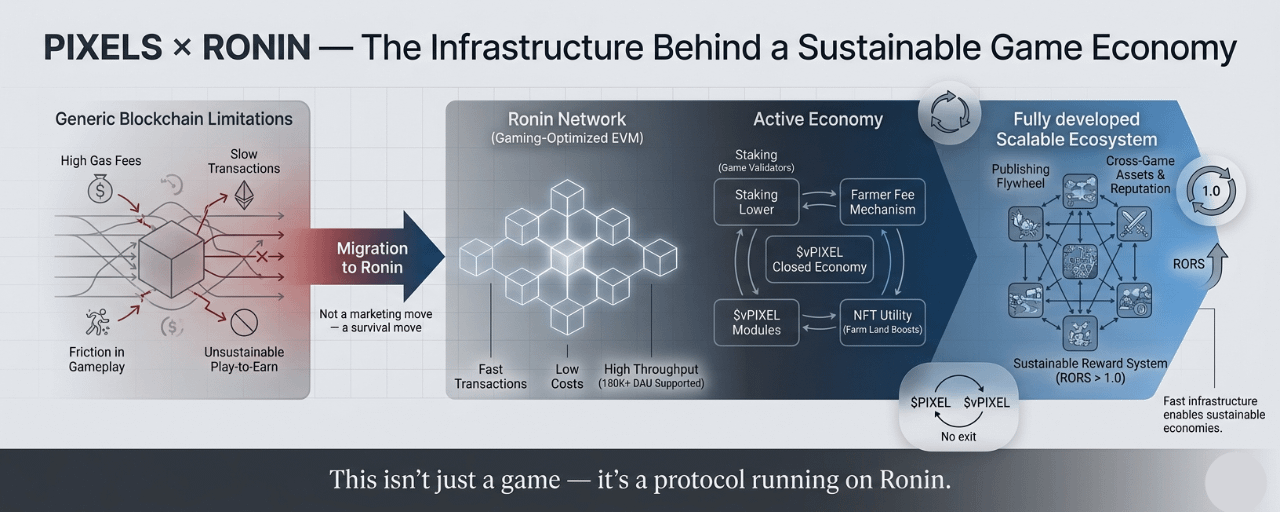
Most people pick a game and never think about what blockchain it runs on. That is a mistake. The chain underneath determines your transaction costs, your speed, your asset ownership, and ultimately whether the economy inside that game can actually survive long term.
When the Pixels team made the decision to migrate to the Ronin Network, it was not a marketing move. It was a survival move. And once you understand why, the entire Pixels ecosystem starts to make a lot more sense.
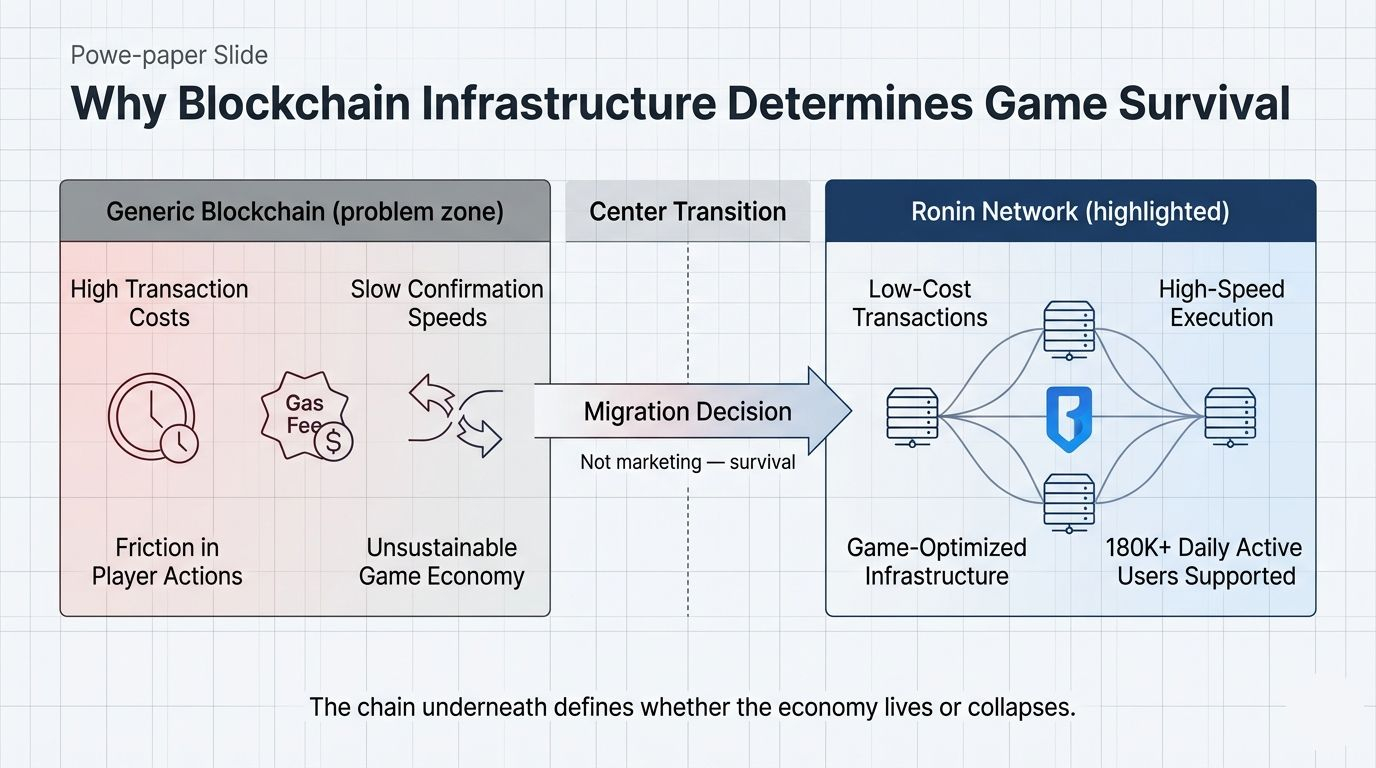
Ronin is a purpose-built EVM-compatible blockchain designed specifically for gaming. It was originally built by Sky Mavis for Axie Infinity — a game that at its peak had millions of daily active users. The infrastructure had to handle that. It was stress-tested at a scale most blockchain networks never see.
Pixels inherited that infrastructure. And when they brought their player base over, something remarkable happened. Their daily active users surpassed 180,000. They became one of the highest DAU games in all of Web3. That does not happen on a slow, expensive chain.
What Ronin Unlocks for the $PIXEL Economy
Here is the part that directly connects to your PIXEL token and why the Binance campaign makes sense in this context.
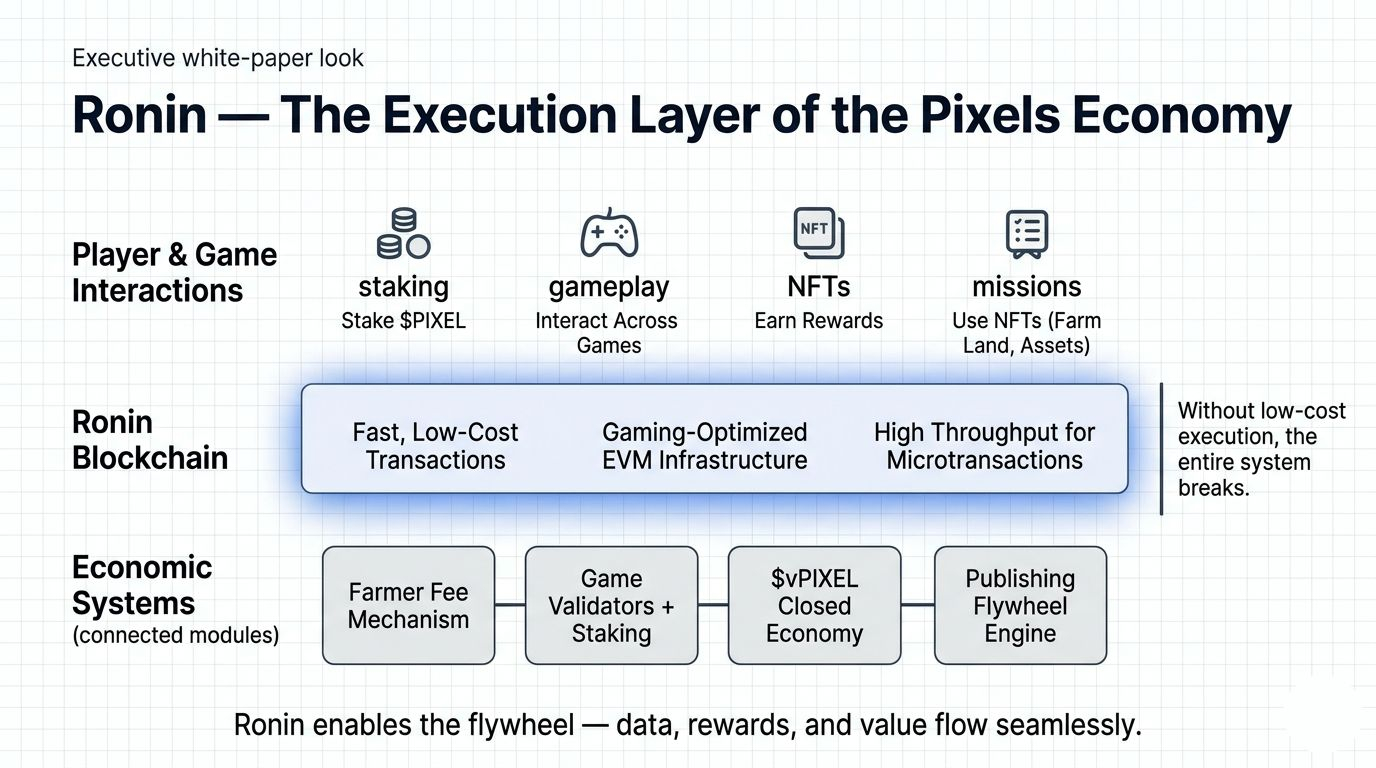
The entire PIXEL economic model — the Farmer Fee, the staking system, the Game Validators, the $vPIXEL token — all of it requires fast, cheap, reliable on-chain transactions. If every interaction cost $5 in gas fees, nobody would stake. Nobody would mint Farm Land NFTs. Nobody would pay the Farmer Fee just to withdraw tokens. The economy would collapse before it started.
Ronin makes microtransactions viable. Players can stake PIXEL into specific Game Validators, earn staking rewards, and interact with partner games like Pixel Dungeons and Forgotten Runiverse — all without worrying about gas eating their earnings. That frictionless environment is what lets the Publishing Flywheel actually spin.
The Publishing Flywheel is Pixels' core growth engine. Better games join the ecosystem, generating richer player data. That data trains machine learning models for Smart Reward Targeting, which cuts user acquisition costs. Lower costs attract even more quality games. Ronin is the ground this flywheel runs on. Without a fast chain, the loop breaks at step one.
Asset Interoperability is another major unlock that Ronin enables. Through the Pixels Events API, your reputation, progress, and NFT assets travel with you across partner games inside the ecosystem. Your Farm Land NFT gives you a 10% staking power boost in the core game. Your Reputation Score determines your Farmer Fee tier when withdrawing PIXEL. These cross-game mechanics only work cleanly when the underlying chain is built for gaming-scale activity.
Ronin + Pixels Is a Long Game, Not a Quick Flip
The PIXEL token has a hard cap of 5 billion. Emissions are controlled daily and approved on-chain. The team moved all investor, team, and advisor allocations into transparent vesting contracts — you can verify it yourself on-chain. That level of accountability is rare and it matters.
The Community Treasury, funded by 80% of all in-game PIXEL spend, sits on Ronin. The 20% that cycles back into the Ecosystem Rewards pool runs on Ronin. The $vPIXEL token — built on Limit Break's ERC20c technology — operates on Ronin. Everything is connected on one chain, which means the data is clean, the flows are auditable, and the RORS metric — Return on Reward Spend, their north star for long-term sustainability — can actually be measured accurately.
RORS is critical to understand. It tracks how much revenue the ecosystem generates for every PIXEL rewarded. The target is above 1.0. Pixel Dungeons is already there. The core game is getting closer. When the whole platform crosses that line, Phase 4 of staking unlocks — where even USDC can be used for user acquisition, while PIXEL remains the only way to earn staking rewards.
That is not a game. That is a protocol. And it is running on Ronin for a very good reason.
