
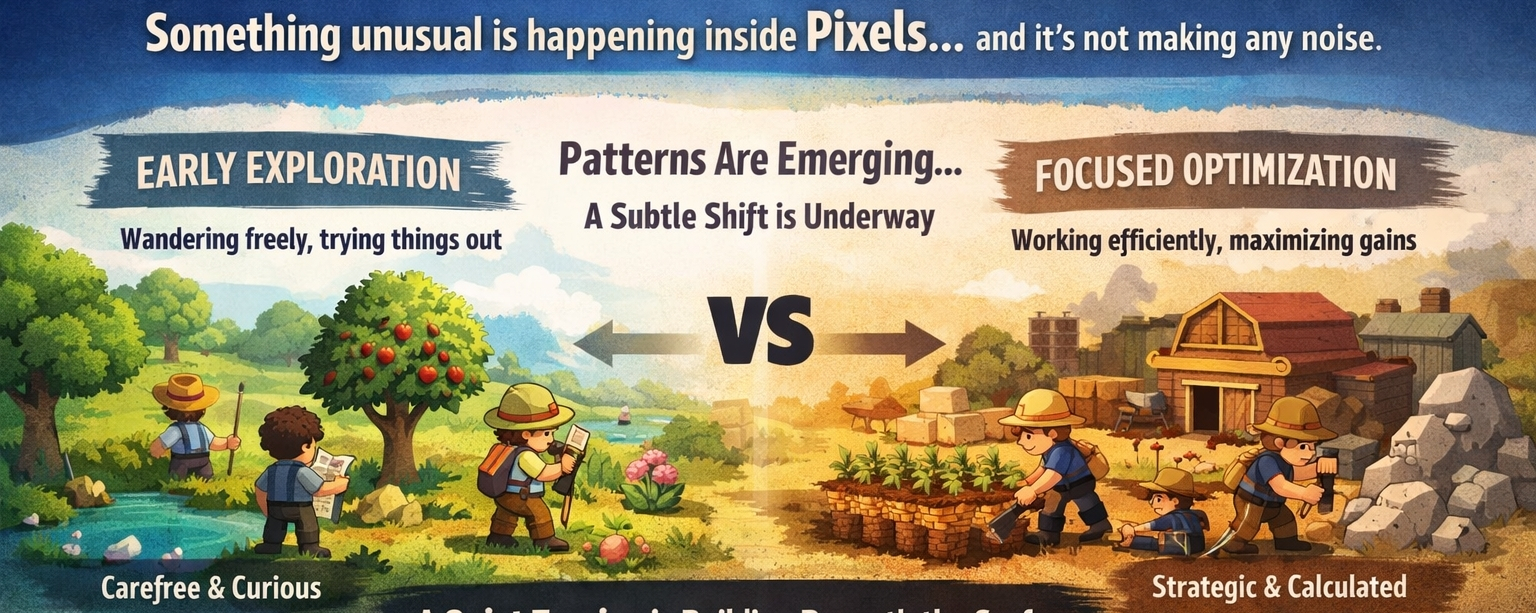
I’ve been spending time observing how a world like Pixels unfolds, and the more I sit with it, the less it feels like a game you simply play and the more it feels like a space you slowly grow into. At first, everything appears straightforward. You move around, plant, collect, explore a little, and it all feels light, almost casual. There’s no pressure in those early moments, just a quiet curiosity guiding where you go and what you choose to do next.
But that feeling doesn’t stay exactly the same. It doesn’t disappear either—it just changes shape. After a while, I started noticing how people, including myself, begin to settle into certain habits without consciously deciding to. The same paths get walked a little more often. The same tasks get repeated, not because they have to be, but because they start to feel familiar. It’s a subtle shift, almost unnoticeable at first, but over time it creates a rhythm that wasn’t there in the beginning.

What’s interesting is how natural that transition feels. There’s no clear moment where exploration turns into routine. It just blends. One day you’re wandering without direction, and the next you realize you’ve been returning to the same place again and again. It’s not forced by the system in an obvious way—it feels more like the environment quietly encourages certain behaviors, letting them grow on their own.
I’ve also noticed how even the smallest sense of ownership changes things. The moment something starts to feel like yours—whether it’s a piece of land, a set of resources, or simply progress you’ve built over time—your perspective shifts slightly. You become more aware of your actions. You think a bit more about what you’re doing and why. It’s not a dramatic change, but it’s enough to make the space feel less temporary and more meaningful.
Over time, the world itself begins to feel different, even though nothing major has changed. Areas that once seemed interchangeable start to develop their own quiet identity. Not because they were designed that way, but because people treat them differently. Repetition leaves a kind of imprint. Where players gather, where they spend time, what they choose to focus on—these small decisions slowly shape the atmosphere of the world.
The social side grows in a similar way, almost in the background. It’s not always about direct interaction or communication. Instead, it’s about presence. You begin to notice the same players moving through familiar spaces, working on similar things, existing alongside you in a shared rhythm. There’s a quiet connection in that, even if no words are exchanged. It’s less about forming defined communities and more about a gradual sense of not being alone in what you’re doing.
What I find myself thinking about most is how incentives slowly start to influence everything. In the early stages, people act freely, driven mostly by curiosity. But as value becomes clearer—whether it’s time, effort, or rewards—behavior begins to shift. Not suddenly, but gradually. Some players start focusing more on efficiency, finding the best ways to use their time. Others continue exploring, holding onto that initial sense of openness. For a while, both approaches exist side by side, creating a quiet contrast in how the same world is experienced.
That in-between phase feels the most revealing. Nothing is fully defined yet. You can still see the traces of early exploration, but you can also sense the pull toward structure and optimization. It’s like watching something take shape without knowing exactly what it will become. The smallest patterns begin to matter more—where attention goes, what gets repeated, what slowly fades away.
And even as these patterns form, there’s no sense that anything is permanent. The world continues to shift, not in big, obvious ways, but through accumulation. Small changes build on top of each other, and over time, they create something new without ever announcing that a change has happened. People adapt, the environment responds, and the cycle continues.
I keep coming back to the idea that nothing here feels finished. It’s not a system moving toward a clear end, but something that keeps adjusting as people interact with it. What feels stable today might quietly evolve tomorrow. And maybe that’s what makes it interesting—not the features or the mechanics on their own, but the way everything slowly reshapes itself through behavior, time, and subtle shifts that are easy to miss unless you’re really paying attention.