
I was reading through Pixels' network documentation when the word "validator" stopped me. Not because it was unexpected, exactly, but because I noticed I had already formed an assumption about what it meant before I finished the sentence. In proof-of-stake systems, a validator is a node that stakes collateral, participates in consensus, and faces real penalties if it behaves badly. It travels with an assumption built in that the participant bearing the title has something to lose.
In Pixels, the term points to something considerably simpler. A studio applies, gets accepted, and its game enters the distribution network. Players come through, activity is recorded, and the studio collects a share of platform emissions for having hosted them. That is the full scope of the arrangement. I sat with that for a while, because the word and the mechanism are not describing the same thing, and the gap between them is not small.
I want to stay with that gap rather than move past it, because the choice to use particular vocabulary in a system that players and studios are being asked to commit resources to is not a neutral one. Language shapes how participants model what they are participating in, and when the model is inaccurate, the consequences are practical rather than merely semantic.
To understand what is actually happening in the Pixels validator system, it helps to trace the workflow as it operates rather than as it is named. A game studio applies to join the network. Pixels or Stacked evaluates the application through some governance or curatorial process. If accepted, the studio integrates the SDK, and its game becomes a node in the reward distribution network. Players who play that game generate behavioral signals that the platform records and rewards with PIXEL. The studio receives a portion of the platform's reward emissions for hosting those players. At no point in this workflow does the studio's game validate a block, participate in consensus, stake collateral that can be seized, or produce any cryptographically verifiable output that the chain depends on for its integrity. The game is a distribution venue. The word validator describes something else entirely in every context where it was coined.
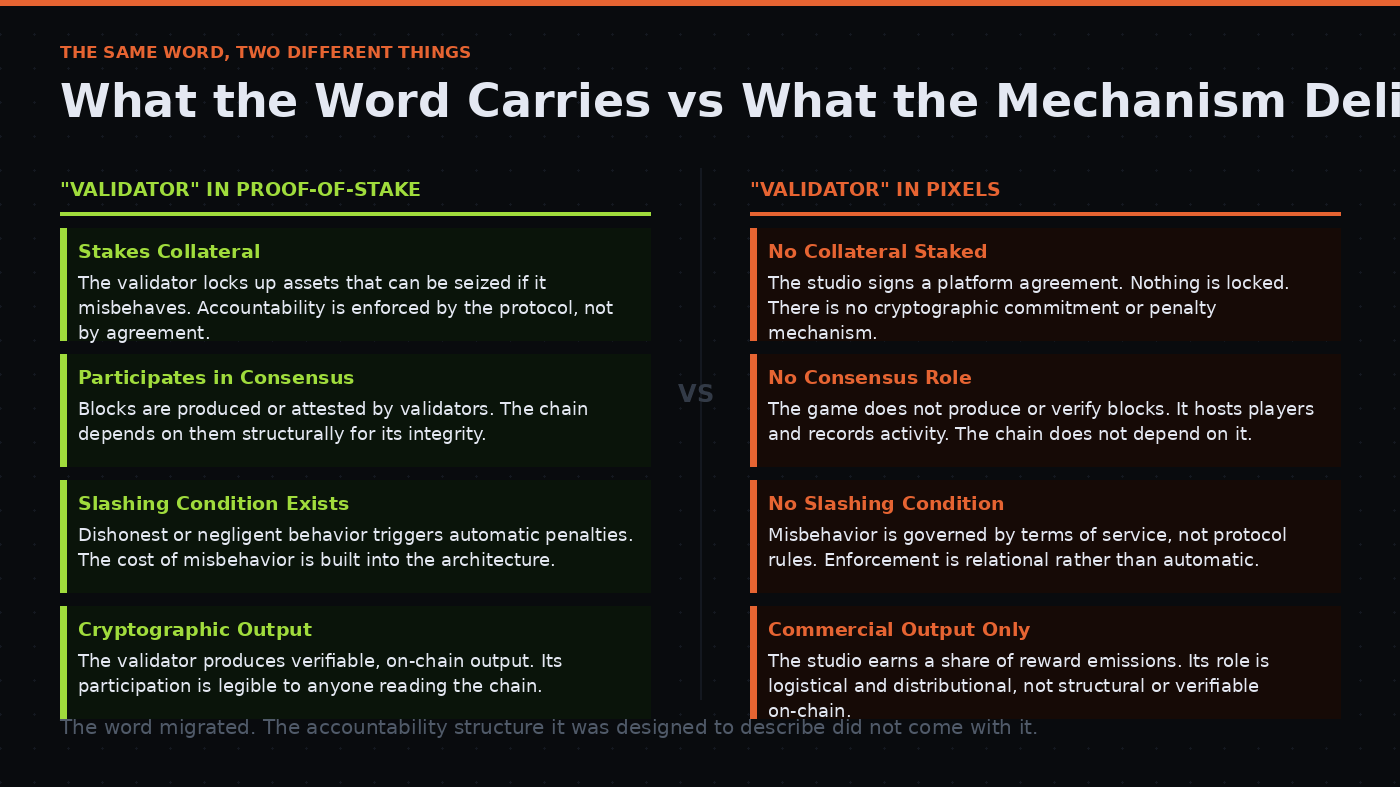
This matters because the vocabulary of proof-of-stake carries implicit promises that the Pixels implementation does not deliver. When someone familiar with blockchain systems hears that a game is a validator, they arrive with a set of expectations: that the validator has skin in the game in a technical sense, that its continued participation is enforced by economic penalties for misbehavior, and that the network's security or validity is genuinely distributed across its validator set. None of those properties apply here. The studio's participation is governed by a platform agreement, not by cryptographic commitment. There is no slashing condition. There is no consensus function being served. The game's role in the network is commercial and logistical rather than structural.
For participants who do not bring that prior knowledge, the problem runs in a different direction. The word validator implies that something is being verified, that the participant holding that role is performing a function that produces trust. A studio that signs up to be a Pixels validator might reasonably understand itself as contributing to the network's integrity rather than simply distributing rewards in exchange for a fee share. The framing subtly elevates what the relationship is. A distribution partner is a commercial arrangement. A validator is a structural participant. The distinction matters when studios are deciding how much to invest in the relationship, and when players are deciding how much weight to give the network's architecture claims.
None of this is unique to Pixels. The broader Web3 space has been borrowing and remixing technical vocabulary for years in ways that drift from the original definitions. Governance tokens frequently govern very little. Decentralized systems often have highly centralized decision points. Trustless protocols sometimes require trusting a specific team to upgrade the contracts correctly. The pattern is consistent enough that it is worth treating as a structural feature of how these systems communicate rather than an isolated instance of imprecision.
What makes the validator case worth examining specifically is that it involves vocabulary that was designed to describe accountability. Proof-of-stake validators are trustworthy because they have something to lose. The architecture enforces behavior through penalty, not through reputation or agreement. When that word migrates into a context where none of those enforcement mechanisms exist, the implied accountability migrates with it in the minds of participants even as the actual accountability structure is entirely different. The word does work that the mechanism cannot.
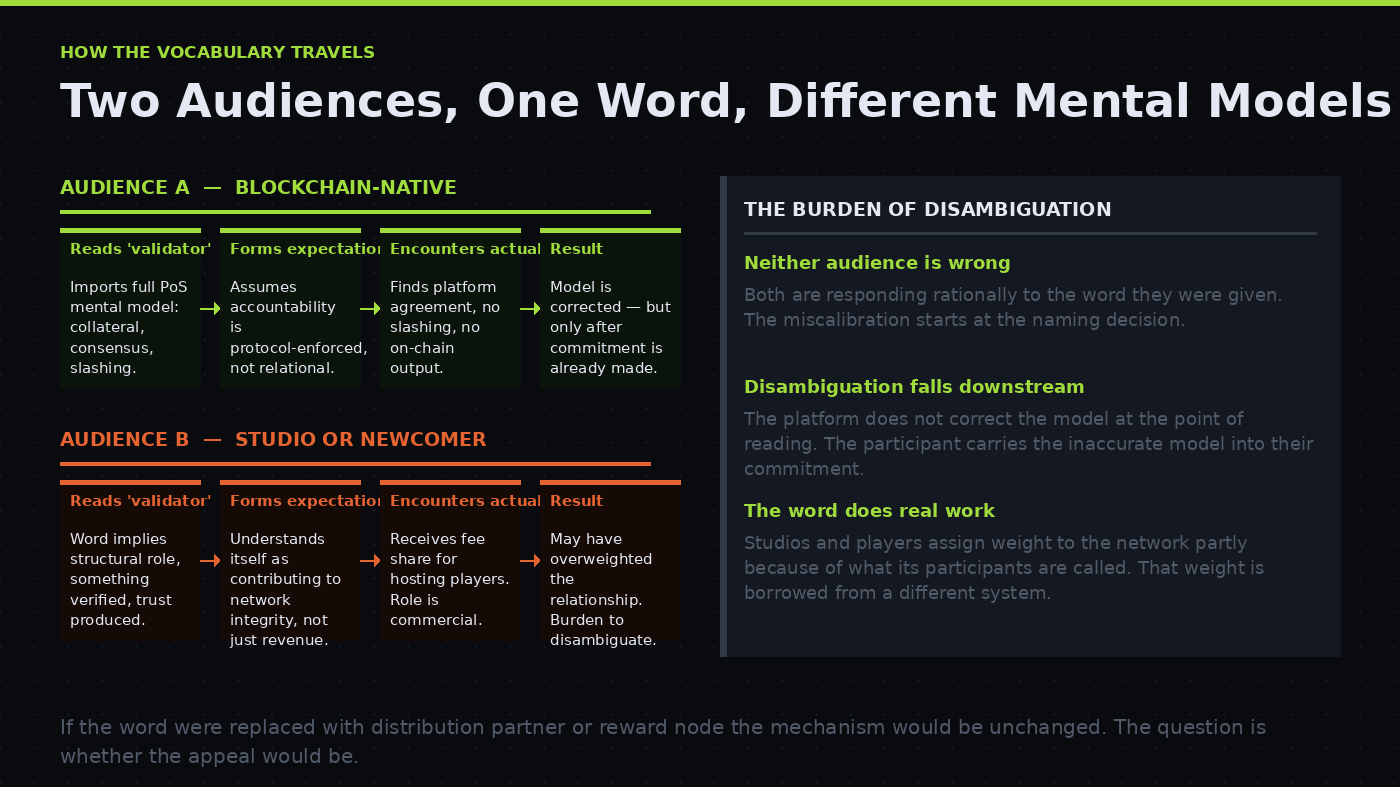
There is a version of this that is defensible. Language evolves, and technical terms acquire looser meanings as they enter mainstream use. Someone could argue that validator in the Pixels context simply means a participating node in a reward network, and that readers should understand the context rather than import definitions from proof-of-stake systems. That is not an unreasonable position. But it places the burden of disambiguation on the participant rather than on the platform, and the participant is being asked to make resource commitments while carrying a potentially miscalibrated model of what they are participating in.
The deeper question is whether the vocabulary was chosen because it accurately described the mechanism or because it carried associations that made the mechanism sound more structurally significant than it is. I cannot answer that from the outside, and I am not suggesting the choice was made cynically. It is possible that the term felt natural to a team thinking in blockchain terms and applying those terms to a new context without fully auditing what the word implies to different audiences.
What I keep returning to is a narrower question. If you removed the word validator from Pixels' architecture documents and replaced it with distribution partner or reward node or some other phrase that described the commercial relationship accurately, would the network's appeal to studios change? And if the answer is yes, that tells you something important about how much of the value proposition is carried by the mechanism itself and how much is carried by what the mechanism is called.