
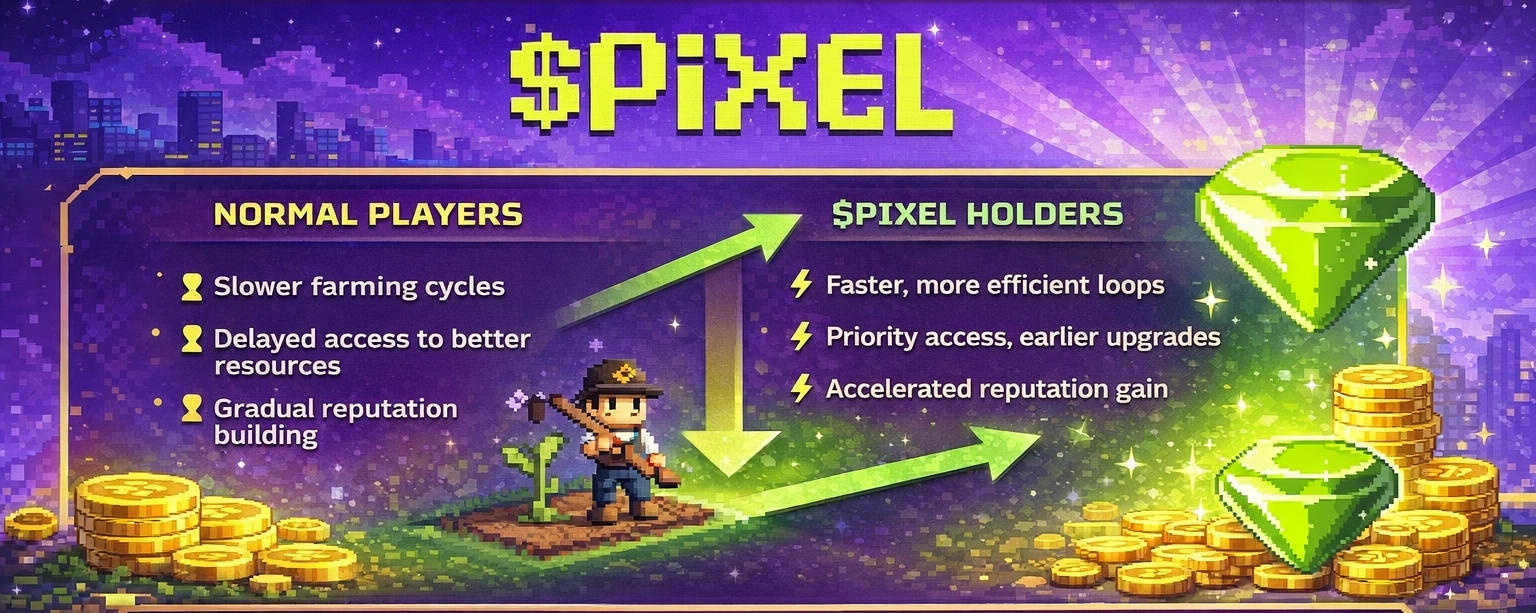

I used to think “free to play” was a solved idea. You either paid to unlock things faster, or you didn’t. Simple tradeoff. But lately, watching systems like Pixels more closely, I’m not sure it’s that clean anymore. The entry is free, yes. That part is obvious. What’s less obvious is how the system decides who actually moves forward with any kind of momentum.
Because when you sit inside the game for a while, really sit with it, the pacing starts to feel uneven in a way that’s hard to point at directly. Nothing blocks you. There’s no moment where the system says “stop, pay here.” You just… move slower. Slightly. Then slightly more. And over time that “slightly” begins to stretch.
That’s where $PIXEL started to make more sense to me, but not in the way people usually describe it.
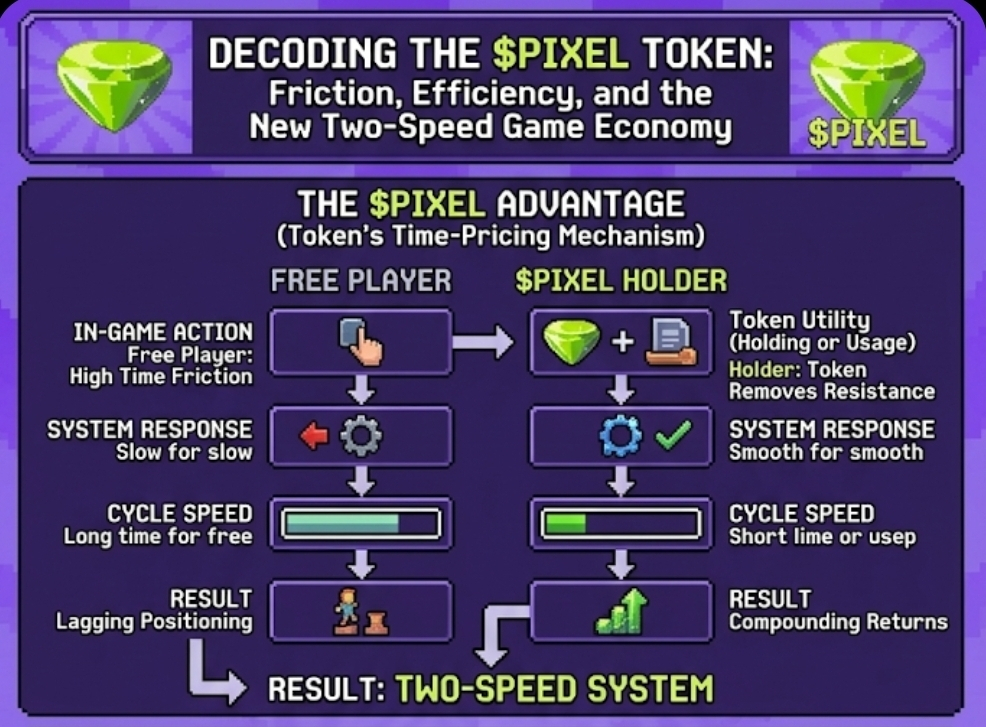
It’s easy to call it a utility token. That’s the default explanation. You use it for upgrades, features, maybe some in-game advantages. But that framing feels too neat. What it actually does is mess with time. Or maybe price it. I’m still not sure which is the better way to say it.
If you hold it, or use it, things don’t just unlock. They smooth out. Actions feel less delayed. Progress feels less sticky. You don’t notice it immediately. That’s the strange part. It’s not like flipping a switch. It’s more like removing small bits of resistance that you didn’t even realize were there until they’re gone.
And once you notice that, it’s hard to unsee.
Two players can technically do the same things in Pixels. Same tasks, same loops, same effort. But they don’t arrive at the same place at the same time. One just gets there… earlier. Not dramatically earlier. Just enough to matter. Early access to better cycles, better positioning, sometimes better assets before others catch up.
It reminds me less of gaming, and more of how certain market systems work. Speed isn’t advertised as the main advantage, but it quietly is. In trading, in logistics, even in information flow. Whoever moves first, even by a small margin, tends to shape what comes next.
Pixels doesn’t say this out loud. It doesn’t need to. The structure does it anyway.
What makes it more interesting is that nothing forces you into $PIXEL. You can ignore it completely. And for a while, that feels fine. You’re still playing, still progressing, still part of the system. That’s why most people don’t question it early.
But optional doesn’t always stay optional.
I’ve seen this pattern before in crypto. Gas priority, staking advantages, access tiers. They all start as tools. Then slowly, almost quietly, they become expectations. Not because the system demands it, but because competing without them starts to feel inefficient.
Pixels might be drifting in that direction, but in a softer way.
Instead of locking content, it stretches time. Instead of saying “you can’t,” it says “you can, just slower.” And psychologically, that’s a very different pressure. It doesn’t trigger resistance. It builds discomfort over time.
The part I keep coming back to is how this shapes outcomes, not just experience.
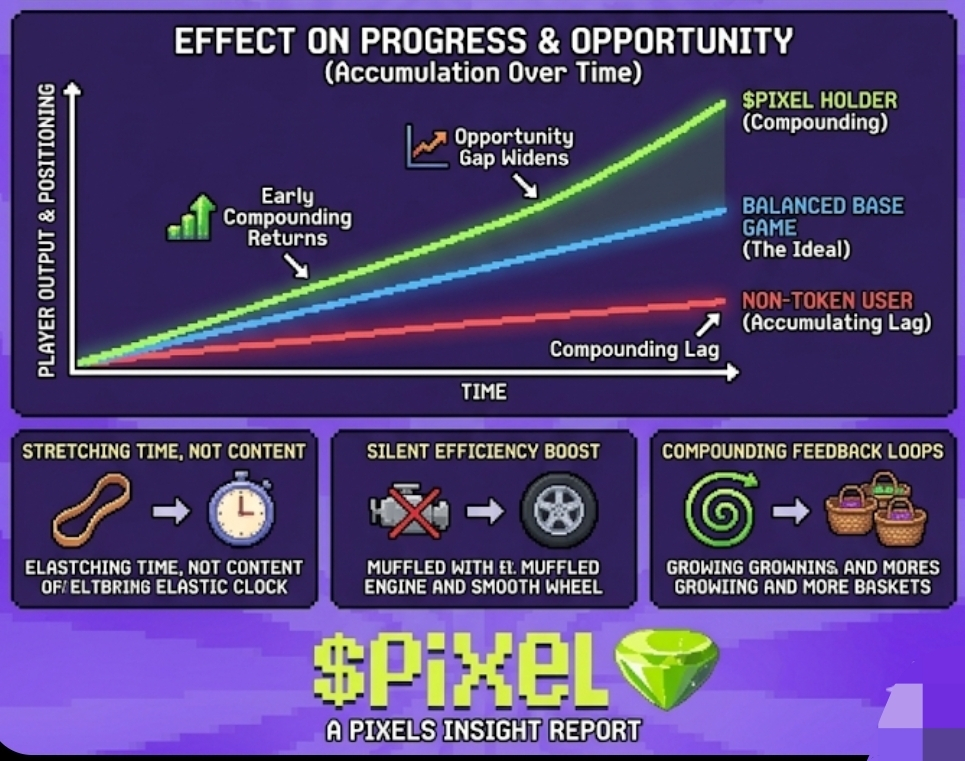
If progression speed is uneven, then opportunity distribution becomes uneven too. Early movers get access to better loops. Better loops generate more output. More output feeds back into stronger positioning. It compounds. Quietly, but consistently.
And $PIXEL sits right in the middle of that loop.
So the token isn’t just about spending. It’s about positioning yourself relative to everyone else. That’s a different kind of demand driver. It’s not “do I need this to play,” it’s “how far behind am I willing to be without it.”
That question doesn’t have a fixed answer. It shifts with the system.
If the base game feels balanced, maybe people don’t care. If friction increases, or competition tightens, suddenly efficiency becomes valuable. Not optional, but not mandatory either. Something in between. That grey zone is where tokens like $Pixel tend to live.
Still, this design isn’t risk-free.
There’s a thin line between monetizing efficiency and quietly creating a two-speed system. If the gap becomes too visible, players start to notice. And once they do, the narrative can flip quickly. From “free and open” to “subtly gated.” That shift doesn’t need a big change. Just enough people feeling like they’re always one step behind.
And then there’s the ecosystem angle. Pixels is expanding, adding more experiences, more layers. In theory, that strengthens $PIXEL. More places to use it, more reasons to hold it. But it also complicates things. Different games, different pacing, different expectations. If one shared token controls acceleration across all of them, the balance becomes harder to manage.
I don’t think the market has fully priced this in yet. Most people still look at $Pixel like a typical game token. Activity goes up, demand goes up. Activity drops, demand drops. Clean model.
But this doesn’t feel clean.
It feels like a system where time itself is being unevenly distributed, and the token is the tool that lets you adjust your share of it. Not in a dramatic way. In small increments. Just enough to shift outcomes over time.
And maybe that’s the real point.
Pixels isn’t deciding who can play. That part is already solved. It’s deciding who gets to move faster once they’re inside.