
I stopped looking at Pixels as a game again today and focused on something more technical, how fast the system can move from observation to decision. Not in theory, but in practice. Because most systems do not fail from lack of data, they fail from how slowly they react to it.
In traditional setups, data flows in fragments. Player activity is tracked, dashboards get updated, teams review metrics, then decisions are made. That process introduces latency at every step. By the time a change is deployed, the behavior it was meant to fix has already evolved or been exploited. The system is always slightly behind its own state.
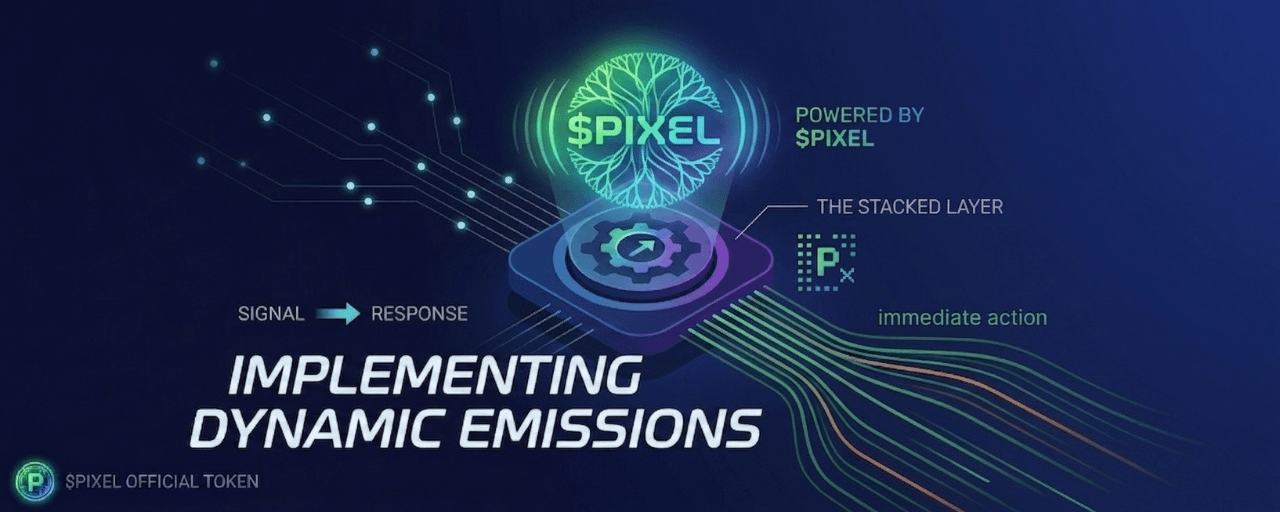
What feels different in $PIXEL is how that loop is being compressed. The Stacked layer is not just aggregating data, it is positioned to interpret it and feed directly into execution. That reduces the distance between signal and response. Instead of data being something you look at, it becomes something the system acts on.
I kept thinking about this in terms of feedback loops. A slow loop creates overshooting, too much reward, then too much correction, then instability. A faster loop allows smaller adjustments, tighter control, and less visible shock to the system. The quality of a game economy is often less about what you design initially and more about how precisely you can adjust it over time.
Another detail that stands out is that this is happening in a live environment with real constraints. Anti bot filtering, behavioral segmentation, and reward routing are not independent modules, they are part of the same decision layer. If one part lags, the whole system becomes inconsistent. That is usually where most projects break, because their components do not share the same timing.
Here, the architecture seems to aim for synchronization. Data collection, interpretation, and execution are not treated as separate phases but as a continuous cycle. That is closer to how high frequency systems operate than how traditional game LiveOps is structured. It is less about planning events and more about maintaining equilibrium.
From that perspective, $PIXEL becomes less of an output and more of a control variable. Its distribution is not fixed, it is shaped dynamically based on how the system evaluates behavior in real time. That introduces a level of adaptability that static emission models cannot achieve, but it also requires the underlying logic to be consistent, otherwise the signal becomes noisy.
I am not assuming this is fully optimized yet. Systems like this only prove themselves under stress, especially when scale increases and edge cases start to appear. But the direction is clear. The focus is not on adding more features, but on reducing the delay between what the system sees and what it does about it.
And that is a much harder problem to solve than it looks, because once you remove latency, you also remove the margin for error. Every decision becomes immediate, and every mistake propagates just as fast. That is the part I am paying attention to right now